Friday, February 29, 2008

What's hot?


frost trees
New literacies aren’t a particularly hot topic according to surveys in the UK and USA. Both the IRA survey and the National Literacy Trust's survey depend on asking experts to read the runes. So experts in both countries think that new literacies and new media should be hot topics but aren’t. Of course both surveys are rather dependent on who’s asked (and, I suppose, who does the asking). Here in the UK we’re still obsessed with phonics….and assessment - no surprises there. Comparing the lists you can’t help but be struck by how they mirror the political agendas in both countries.

Wednesday, February 27, 2008

Names and places


Tracks
I was here today – I know it doesn’t look great, but the staff are fabulous and the students really interesting. The place has recently re-branded itself, which I think is a good move - after all central England could be anywhere, whereas Birmingham, well that’s an entirely different matter. The university’s front page explains that: the move follows extensive consultation with students, staff and key university stakeholders, who were asked to vote on three alternative names for the university. Of the 4,700 people who responded to a survey earlier this year, the greatest number (42.8%) voted in favour of Birmingham City University. That's the power of democracy!

Tuesday, February 26, 2008

Restricted access


lock out
The news on Sunday informed us that the Pakistan government had blocked access to YouTube because of anti-Islamic movies posted on the site. Today we learnt that the service has been restored again. Apparently attempts by the Pakistan Telecommunications Authority to block the site caused a near global blackout of the site on Sunday. This report suggests that Pakistan Telecom hijacked the web server address of the video site…details were then passed on to the country's internet service providers so that anyone in Pakistan attempting to go to YouTube was instead re-directed to a different address. This shows how the internet is not beyond political interference, but is it beyond political control? China made similar attempts last year and is now implementing a general policy on restricting access.

Saturday, February 23, 2008

Nada


frog
Is Nada Kakabadse fanning the flames of moral panic in her investigation of the addictive effects of ICT? BBC news reports that techno addiction can be so bad: that people wake up several times a night to check their e-mails and text messages (the full report is here).Well I can go one better than that. On Thursday night I got a text message whilst I was asleep….but I knew what it said before I read it the following morning. Could this support the theory that I now receive text-messages straight to the brain, thus bypassing any technological devices? Have I gone beyond addiction and entered the realm of psychic messaging? Probably not – it’s more likely that my life is thoroughly predictable…. Anyway, the whole crackberry phenomenon already attracted some good headlines in the Daily Mail last August: it’s similar to drugs – they said (you know you can get arrested for carrying them, you get high and then it's back to normal etc etc). But Kakabadse’s tells us that we would: be surprised how many people had their PDA or Blackberry next to their bed heads. Well maybe they’re using them as alarm clocks, or pillow books....who knows? Well, let’s turn this whole thing around and ask why frogs aren’t getting addicted to technology, that's what I'd like to know?

Thursday, February 21, 2008

Getting together


Ducks on ice
I like the idea that networking sites cluster around nodes or social objects - MySpace around music, Flickr round pictures and YouTube round video. Of course they also seem to add another dimension to pre-existing networks. Facebook, by contrast, is a bit different because the network itself seems to be the social object. Is that why I’m suspicious of Facebook? There’s a whole host of reasons for non-participation here; other bloggers just don’t get it; and then, of course, there’s the questionable data protection issues. But maybe there’s also got to be a limit. Blogging, Allconsuming and Flickr take some time –and then of course there’s the teaching blogs, the wikis…not to mention music sites like Clare Large’s intelligent audio.

Tuesday, February 19, 2008

Reclaiming history


Historic quarter
It’s often said that anything goes in net culture - that it is essentially apolitical etc etc. So it was good to come across Flickr activity that shows that that’s not exactly the case. Some of my images of buildings in Bucharest have attracted attention, and as a result I’ve sent some pictures and then joined the Architectural Monuments of Romania group. The administrator mailed me today saying: Thank you for applying to the group and I’m looking forward to your contribution: as a word of caution - anything to do with Ceausescu's brutalist architecture (especially and in particular the so-called "Palace of the People" and former "Avenue for the Victory of Socialism" are all outside the remit of this group. Well OK, I feel a little guilty, I have some of those – but I’ll keep them hidden from the group!

Saturday, February 16, 2008

A question of time


times past
It used to said, quite glibly, that education was about the transmission of culture. Nowadays it seems to be more an acting out of popular neuroses: responding to moral panics. Whether we worry about obese pupils or internet safety – education is supposed to fix it. Well maybe that’s cultural transmission – a sort of hyper-concern around risk. Not surprisingly then, my initial reaction to five hours of culture in the curriculum was to laugh out loud. Now let’s be clear that that is a guarantee of five hours of quote high quality culture every week (whatever that is). Needless to say the government plan has met with a mixed response. Kids could end up doing some really exciting things; alternatively could be doing really naff stuff. But what really gets to me is a) the time thing, and b) the implication that there’s not enough culture around in the first place. Having got ourselves in a complete mess about time allocation in a standards-driven, outcomes-based education system, innovators are now continually faced with the question of how to fit new ideas into an over-full curriculum. It’s as if pupils, as empty containers, were already brimming over. Actually they’re bored with more and more of the same. So let’s have some arts, some media, some videogaming; but let’s create curriculum space and take some of the pressures off teachers.

Wednesday, February 13, 2008

Pace


old media
Clay Shirky’s new book Here Comes Everybody argues that new social tools are important for society in many different ways. He says here that: one of the great frustrations of writing a book as opposed to blogging is seeing a new story that would have been a perfect illustration (hence the new blog: Here Comes Everybody). I suppose this just illustrates how slow traditional forms of writing and publishing are in comparison with the fluid world of online activity. We always end up writing about what was happening last year. But then again, blogging’s not always at the cutting edge. I’m always apologizing for posting about things I’ve missed (ie things that are old news for some), and that’s curious – the headlong pace of late modernity - it’s a bit like the time-compression phenomenon on email. Just because someone can reply in the next minute we expect them to. And so we often behave as if email isn’t an asynchronous medium when the reponse time is slow. So I’m not going to apologize for pointing to the special issue of JMC on social networking – after all it was only out last October!

Tuesday, February 12, 2008

One in five


garden centre #1
This e-government bulletin draws attention to the suggestion that only one in five primary and secondary schools in the UK make full use of new technology. We know technology is under-used, and that access and connectivity are limited, but it makes one wonder how full use could be defined. Nevertheless, the headline provides an opportunity for Becta to launch a new initiative – next generation learning. The front page of this is interesting in the way that it foregrounds improving teaching (learning platforms), driving up standards (interactive whiteboards), and saving time (recording and analyzing student achievement) – clearly playing along with the old standards agenda which has held sway over this generation’s learning - nothing about harnessing the power of social networking, transforming learning, or critical media literacy. ...

Thursday, February 07, 2008

Learning (again)


Green man

To date, discussion of the opportunities, and indeed the risks (see Dr Joolz, here) presented by Web 2.0 development has been largely confined to the exploration of social and recreational worlds. I'm keen to open up discussion about the relevance of Web 2.0 to educational practice. How might the kinds of communicating and collaboration promoted by Web 2.0 applications combine with new insights into learning in ways that transform how we conceive of education? Do we need new models and new pedagogies?

Tuesday, February 05, 2008

Friending and orality


Snow in Old Whittington #2
This is a really interesting piece by Alex Wright who links the conversational and ‘friending’ aspect of social networking to Walter Ong’s work on orality. I liked the Michael Wesch quote: In tribal cultures, your identity is completely wrapped up in the question of how people know you … when you look at Facebook, you can see the same pattern at work: people projecting their identities by demonstrating their relationships to each other. You define yourself in terms of who your friends are (see more of Michael Wesch’s work here). I think the analysis is interesting, but there are some very significant ways in which online interaction is different to tribal behaviour - but that aside, the parallels between written conversations and orality are useful. I also liked Lance Strate’s comment that social networking sites: fulfill our need to be recognized as human beings, and as members of a community.

Saturday, February 02, 2008

Learning through photosharing


Under the influence
Winter is probably not the best of times to be a tourist in Bucharest. Apart from the cold, there's a general lack of easily available information. Even with a Rough Guide, we found it quite difficult to navigate, ending up instead just wandering around looking at and sometimes photographing interesting looking buildings. This place looked quite attractive, I clicked and moved on. Later on, after uploading my photographs, I returned to my Flickr stream and noticed a comment. The photograph had received a new tag - stavrolpeos - and I'd been invited to send it to a group, which of course, I did without hesitation. The group is a 371 strong archive of images of the exterior and interior of the Stravropoleos Church, showing it over time and through the seasons. From my desktop I wandered around this visual record of the church, looking at the various contributions. There were tourist snaps, some showing those who visited the church, their girlfriends, boyfriends and so on; others were more studied, photoshoped or carefully composed. I learnt about this place, the atmosphere, the decor, the restoration, and also something about how people feel about Stavropoleos Church. Little of this was rendered in writing, apart from the short paragraph written by the administrator of the group who explains his or her interest and connection with the church. Google will offer you this - again simply visual. You have to go to Wikipedia to add to your factual knowledge. I was quite moved by the Flickr experience and felt the real benefit of being connected with others in this world of photosharing. I suppose I was learning from the widom of crowds.

Wednesday, January 30, 2008

Down in the dongles


Romania 08 066
Mobile phones aside, digitally mediated person to person communication has so far, in the UK, tended to be location-specific. Given the relatively low level of free wifi provision, that means you’re either at home or at work (unless you’ve got a Blackberry). Any communication on the move (apart from by phone) is fraught with difficulty. So, largely speaking, Barry Wellman’s idea of networked individualism exists more in vision than reality. But times are changing: the mobile phone company 3’s affordable dongle gives you connectivity and freedom of movement. If competition drives the price down, multiple forms of person to person communication may become far more available when you’re on the move. Perhaps at that point we’ll be networked individuals, if indeed we choose to be. The choice would be nice, and there's some obvious benefits, but do we always want to be in contact? I suppose you can always unplug your dongle!

Tuesday, January 29, 2008

Reprise


Eternal knot
Last week I wrote about a study of the information behaviour of the future and the resulting scare headlines about the google generation. John Naughton’s article in the Observer last Sunday gave a more thorough consideration of the findings which made me realise how my own reading was rather hasty. In this book, Colin Lankshear and Michele Knobel talk about the emergence of new kinds of reading and this is a good example of what that looks like. Here’s John Naughton: The findings describe 'a new form of information-seeking behaviour' characterised as being 'horizontal, bouncing, checking and viewing in nature. Users are promiscuous, diverse and volatile.' 'Horizontal' information-seeking means 'a form of skimming activity, where people view just one or two pages from an academic site then "bounce" out, perhaps never to return.' The average times users spend on e-book and e-journal sites are very short: typically four and eight minutes respectively. Well that’s so interesting, because that’s exactly what I just did….but then I also returned to the topic from an alternative source, wrote about it and passed it on, links and all! All in all that must count as a case study in new literacy - read, think, write, link, read, think, write, link...

Sunday, January 27, 2008

Degrees of participation


Let there be light
Going through my allconsuming archive made me realize something I’ve known for a while but not payed sufficient attention to. Engagement in a social networking site is a variable thing: you can be quite peripheral or right there in the thick of things…. or, of course, you can be at any point along the way. I’m right on the edge with allconsuming – you can see my profile and what I’ve been up to, but there are no comments and I’ve never done any tagging there, let alone any kind of interaction. Flickr’s different. I have a small and changing social network there - I describe, comment, tag, interact, meet new people etc etc. You make your own choices and it’s about degrees of participation, and reasons for participation … I suppose choosing your favourite social networking site is similar to deciding where you like to hang out in meatspace.

Friday, January 25, 2008

Flying in


Bucharest
So tonight I returned to Bucharest from Transylvania without any suspicious marks on my neck! It was an eye watering minus 1C when we landed, with grey mounds of snow still stacked up on the roadside. Getting an internet connection in Cluj was difficult, so I was forced to maintain radio silence. This afternoon I learnt how to build a Joomla website with very simple tools. I also took a look at librarything, which looks good, but I’m afraid I still have brand loyalty to allconsuming. Again there was mention of classroom 2.0 and I made a mental note to spend some time investigating this space. I’ve also been beginning to wonder how social bookmarking and RSS feeds can feature in the Web 2.0 book.

Saturday, January 19, 2008

Placeholder


IMG_0635
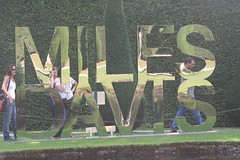
It’s fascinating how we imagine space. I loved this Miles Davis photograph when I first saw it and was convinced it must be in a sculpture park in New York despite the unmistakable English background. Of course, it was only unmistakable when later I found out that it was at Chatsworth House in Derbyshire! (The new Duke's quite trendy.) Still good, but somehow different. Now we’re set to fly out to Cluj in Romania for an IDEC leadership conference. What’s Cluj like? Well, I have some vague stereotypical images in mind. ... the official site, Cluj cyber city is here, but actually this is more informative. Apparently it has a world famous equestrian statue! Anyway, I hope to be able to blog from there, but have no idea about what connectivity is like. But I promise there will be some pictures sooner or later!

Friday, January 18, 2008

Panic?


VIP
Just when we’d started to adjust to the digital assets of a new generation of university students, concerns are being raised about the google generation. The headlines from JISC are that we should be concerned about: impatience in search and navigation [that’s me], and zero tolerance for any delay in satisfying their information need. Young people are dangerously lacking information skills, and that’s in this report. I’m not so sure that there is any evidence of a decline in criticality, but perhaps we need to adjust what we expect, what we provide and what we assess to take into account environmental changes.

Tuesday, January 15, 2008

Networked professionals


old technology
Applying the principle of social networking to professional learning could well be the shape of future CPD. Imagine being able to keep in touch with friends you’ve taught or trained with, and other like minded people, sharing ideas, resources and teaching plans. That’s the idea behind Englishspace, the place where Facebook meets the staffroom. David Hargreaves has spelt out the idea of teachers as hackers involved in ad hoc innovation networks here – Englishspace could help move this forward. Of course like any social networking site, the success of Englishspace will depend on the commitment of its users…and maybe Facebook’s a poor comparison. I say that after reading Tom Hodgkinson searing criticism of Facebook..

Saturday, January 12, 2008

Testing the breaks


Deep cut
I’m learning more about breakbeats, sometimes listening to iBreaks.co.uk, but also through talking to people. It comes out of a digitally-infused subculture, in which the source music is often downloaded and remixed with samples and softsynths. Apples are the preferred platform for doing this. Most of the stuff I’m borrowing comes from live sets, often freebie CDs given away as part of the DJ promotion. I’m not up to partying just yet, but I’m hooking in to Plump DJs, Krafty Kuts, and Def Inc. Am I getting all neurotic about my age, I hear you ask? Probably:What’s your neurosis allowing you to do that you couldn’t do otherwise? asks Richard Ford…