Sunday, March 13, 2022
Travelling with Tolstoy


Sunday, February 27, 2022
Texting characters

Saturday, February 05, 2022
Literacy practices in libraries
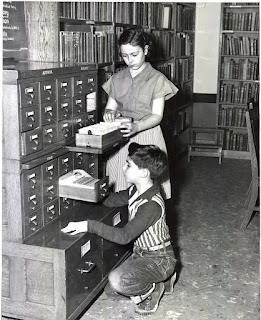
The public library was an important landmark in my childhood. It was in safe cycling distance, it was always warm, and it was the context for a ritualized, and mildly intimidating, interface with the adult world. I can clearly recall the heart-thumping point at which I would offer up my chosen books to be date stamped. I was in awe of the librarians who to my childish mind held the power to refuse me, point out my errors or even fine me. Invariably they were friendly, but they represented a powerful bureaucracy, an arm of local administration, that was strong and ought to be taken seriously. A successful visit to the library was rewarded by a subsequent rush of excitement - checking out was an experience like the end of a school day, clearing passport control or leaving a shop with just the toy you had in mind. But the pinch point at the library desk held all the power. It was the power that charged the anticipation as well as the release. The point where everything seemed to hang in the balance. With repeated visits and growing confidence I gradually became more and more interested in what happened at that point. The way in which a book's identifier - the book card, was deftly removed from a paper pouch glued to the endpapers, date stamped and then slipped with ease into my personal library card, snuggly held in alphabetical order in the custom-built wooden card index. As time went by I learnt more and more about the library system. Ways of classifying books, using card indexes and even requesting books that weren't in my particular branch. Home from my travels, in 1972, I was delighted to find that my mum had put in a request form for Herman Hesse's Magister Ludi - The Glass Bead Game. A postcard arrived at our home address on the 5th August that year with a hand franked two and half pence stamp. I know all this because the form dropped out of a book the other day. Evidently I used it as a bookmark and then forgot all about it. But the card is a fascinating record of a set of social and material literacy practices that were very much alive at the time, in libraries - and elsewhere too. The card - a reservation slip, a standard 6 x 3 inch postcard, serrated on one of its narrower edges at the point where it was detached from the counterfoil. One side with four pre-printed and indented rows of dots (for the address), the other with clearly labelled positions for the book's details - author, title, publisher and so on. The local branch name is ink-stamped on (oh, those ink stamps, so often the seals of officialdom!). All the specific details are captured in the distinctive flourish of my mother's handwriting. And one other feature that deserves a mention: two small holes and an impressed line in one corner, the scars of an earlier stapling, which tell something about a prior process of attachment. Such an efficient system, a marker of a sophisticated analogue literacy practice in its heyday, at a time when public libraries were generously funded. I could go on, but as I nostalgically turn this yellow-edged card in my hands I realise it's also charged with all those memories - returning home, my mother, reading Hesse, the smell of the public library, date stamps, stationery. It is slowly becoming other, its original and specific meaning is tucked into a card pocket in a much larger multidimensional catalogue.
Saturday, December 04, 2021
Powerpoint fiction....anybody?

If you'd told me that the novel I was about to read contained over 60 pages of Powerpoint slides using some of the standard insert graphics you get, I think I'd change my mind and pick something else. Haven't we all had enough of Powerpoint? Surprisingly though, Jennifer Egan makes this device work so well in A Visit from the Goon Squad that I actually found myself really enjoying it. It's one of the many small triumphs in this Pulitzer Prize winner - a work that is packed full of insights and intrigues. I'd missed it when it won in 2011, but came to it late through the first chapter, Found Objects, which appeared as a short story in the New Yorker. It could be argued that the freestanding piece Found Objects has the edge. After all, it's tightly written and only hints at the broader landscape of events. In that sense it's more open for the reader. You can speculate all you like about Sasha, the focal character, about what is lost, found or stolen in her life and the fragmented dialogue with her therapist works very well in prompting this sort of perspective. I like the economy of the short story form for some of these reasons. I think George Saunders writes about making every word count in a short story - and that's why Found Objects works. Egan's stand alone tale raises all sorts of questions most of which are answered in the novel, so I suppose if you're the sort who hopes for some sort of closure in fiction you'd prefer A Visit from the Goon Squad; but both are very good. After several unsuccessful attempts to surf the wave of enthusiasm for Richard Powers, Egan has re-established my flagging confidence in American fiction.
Saturday, October 02, 2021
Going slow

Friday, June 25, 2021
Works in progress

Friday, April 30, 2021
Fake profiles

Thursday, April 22, 2021
Three short pieces

Wednesday, March 17, 2021
A hall of mirrors

Thursday, March 11, 2021
Back to school

Sunday, January 24, 2021
Doing the Romans

Thursday, January 21, 2021
Doing it differently

Thursday, November 05, 2020
Why Talk About Data (in Education)?

An Online Colloquium
12th-19th November 2020
What does data do in education? What does it become? Why does data visualisation matter? What might teachers do with data?
This online colloquium will generate debate about the role and purpose of data in education. It brings together researchers whose work, in different ways, raises issues about data use in schools, coinciding with the launch of a virtual exhibition produced through a British Academy funded project, Doing Data Differently, which showcases teachers’ data drawings about their everyday experiences of literacy teaching.
A series of short video think pieces will be released daily between 12th and 17th November 2020 from Helen Kennedy, Neil Selwyn, Luci Pangrazio, Gemma Moss, Lyndsay Grant, Alice Bradbury, Cathy Burnett and Guy Merchant. These can be accessed via the virtual exhibition – you will find more details on the Exhibition Events page.
Issues and questions arising from the think pieces will be discussed at a live panel on 19th November 4.30-5.30 (GMT) chaired by Marjorie Siegel from Teachers College, New York. Panel members will include Alice Bradbury, Lyndsay Grant, Cathy Burnett, Guy Merchant and Stefanie Posavec, co-author of Dear Data . Please register for the panel on Eventbrite.
Think pieces include:
Data harms and inequalities
Prof Helen Kennedy, Professor of Digital Society, University of Sheffield
Data-driven technologies, automated and algorithmic systems, machine learning and AI are transforming society. They’re having wide-ranging effects, including numerous benefits, but they’re far from straightforward, and their use can result in harms as well as benefits. So we need to question claims that datafication will simply lead to a better society. In fact, it feeds into and is fed into by inequalities. Whether we talk about harms, inequalities, discrimination, bias, injustice or unfairness, the negative effects of data-related change and data-driven systems are not experienced equally by all. This is why we need to talk about data in education.
Deconstructing data traps: Where to draw the line?
Prof Gemma Moss, Professor of Literacy, and Director of the International Literacy Centre, University College London
This think piece sets out some of the issues a team of researchers at UCL have faced in documenting how English primary schools have dealt with the stresses and strains that COVID-19 has produced in our data-driven system. I will consider how and in what ways our research project findings might be able to disrupt the dominant narratives about system gaps and the urgent need to close them that the crisis has provoked.
The surprising non-appearance of the datafied school?
Prof Neil Selwyn, Professor of Maths Science & Technology, Monash University
Dr Luci Pangrazio, Research Fellow in Digital Literacies, Deakin University
This presentation considers an unexpected finding from our ongoing research into digital data use in Australian high schools – why is it that critical concerns over the steady ‘datafication’ of education are not readily reflected in current school data practices? We first identify apparent tensions between: (i) established ‘teacherly’ logics of ‘data-driven’ schooling; and (ii) emerging ‘datafied’ practices associated with digital systems, platforms and devices. In particular, we consider how promises/threats of digital dataism appear to be largely subsumed into prevailing institutional logics of state bureaucracy and professionalism. We then consider the extent to which these ‘school data’ logics can endure amid the increased digitisation of K-12 education and commercial pushes for personalised learning. Alternately, what scope might there be to encourage more resistant appropriations of digital data by otherwise marginalised groups within school communities?
Anticipating fair futures through educational data practices
Dr Lyndsay Grant, School of Education, University of Bristol
In this talk, I will draw on ethnographic research in a secondary school to explore how data came to play a role in shaping educational practices through defining what could be known about pupils, teachers and learning, and through determining the future outcomes that were made possible. This research raised questions about the role of data practices in shaping ‘fair’ future outcomes for pupils and limiting the possibilities of more open-ended educational futures. These questions can help us explore how claims of ‘unfair’ educational algorithmic decisions might reveal contested notions of how fairness is produced through data, and the limits of transparency as a response to questions of fairness.
The Five Ps of Datafication in Schools
Dr Alice Bradbury, Associate Professor in Sociology of Education, UCL Institute of Education
In this short film, I use a schema to discuss the impact of datafication which is based on five Ps: pedagogy, practice, priorities, people and power. This draws on my forthcoming book Ability, Inequality and Post-pandemic Schools (Policy Press, 2021), which examines the relationship between data and discourses of ability. In this talk, I give examples of how we can use these five categories to broaden out how we conceptualise datafication to include teacher subjectivities and relations of power, as well as what teachers do and care about.
Destabilising data: Creative data visualisation and professional dialogue
Prof Cathy Burnett & Prof Guy Merchant, Sheffield Hallam University
In this think piece we consider what data may do – and what may be done with data- when inserted differently into professional dialogue in education. We draw on a project that set out to ‘do data differently’ by inviting primary teachers to create, visualise and share their own data on what mattered to them in everyday literacy teaching using a postcard format. We argue that shifting the focus, visualisation and sharing of data can have ‘complicating effects’ which – through foregrounding data’s instability and partiality – can produce generative spaces for teachers’ professional dialogue.
Sunday, October 25, 2020
The spread : breadth and depth

Thursday, September 24, 2020
The Meaning Makers

Friday, August 28, 2020
Drawing on something

Saturday, July 25, 2020
Book pairing

Wednesday, July 15, 2020
Neurodiversity and after

Friday, June 05, 2020
In lockdown

Sunday, May 10, 2020
Fish, floating signifiers and WhatsApp

Subscribe to:
Posts (Atom)