
Showing posts with label sociomaterialism. Show all posts
Showing posts with label sociomaterialism. Show all posts
Thursday, April 03, 2025
Reading with the algorithm


Wednesday, July 12, 2023
The desk

When my mother died, I couldn't work out what to do with the desk she had. It was rather like the one here, and it had been part of the family home as we grew up. About five foot in height, the hinged front pulled down for a writing surface revealing a series of small cubby holes that could be used to store things like envelopes, tape, pencil sharpeners and so on. I say five foot in height, but I can still remember it towering over me, not being able to reach the flat surface of the desk top, and having to be warned not to bang my head on it. I've kept hold of it all these years, although if anything it's a bit low to work at as a stand up desk. It's become clear to me that this one is a rather cheap affair - my mother referred to it as 'post-war utility furniture' - and I know that's probably true because a friend of mine's got a posher version. Better cubbyholes and drawers and even a couple of pop-out lopers that support the work surface from underneath. My parents could never quite agree on what to call it. It was one of a number of things that seemed to index their different backgrounds. My dad just called it the desk and was even known to deride my mother for calling it a bureau. For her it was a bureau, and for me because I'm interested in writing and all its appurtenances it's come to be known as the 'secretaire' which could be thought of as it's official classification in the world of furniture - 'secretaire' or 'secretary desk', although I note, in passing that in The Luminaries Eleanor Catton simply refers to is as a 'secretary' (and she can do no wrong in my opinion). And there's an alternative, too, that I rather like - the escritoire. Somehow that seems to be far too sophisticated a word to describe my dad's desk, but doesn't that just show the way we value a little bit of French? Secretaire is good because of its connection with the word secretary - originally someone who was privy to private and confidential matters (including correspondence), but escritoire appealing because of its etymological connection with scribing, with writing, with mark-making. I suppose there's a book to be done on writing furniture - desks, tables, study rests, lecterns and not to mention all those rather ugly computer tables. I'd like to read something that really grapples with the peripheral material paraphernalia of writing. Maybe not just furniture, why not venture into stationery as well? Its inventive, technological and - well, material.
Saturday, February 05, 2022
Literacy practices in libraries
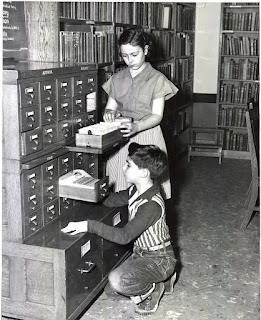
The public library was an important landmark in my childhood. It was in safe cycling distance, it was always warm, and it was the context for a ritualized, and mildly intimidating, interface with the adult world. I can clearly recall the heart-thumping point at which I would offer up my chosen books to be date stamped. I was in awe of the librarians who to my childish mind held the power to refuse me, point out my errors or even fine me. Invariably they were friendly, but they represented a powerful bureaucracy, an arm of local administration, that was strong and ought to be taken seriously. A successful visit to the library was rewarded by a subsequent rush of excitement - checking out was an experience like the end of a school day, clearing passport control or leaving a shop with just the toy you had in mind. But the pinch point at the library desk held all the power. It was the power that charged the anticipation as well as the release. The point where everything seemed to hang in the balance. With repeated visits and growing confidence I gradually became more and more interested in what happened at that point. The way in which a book's identifier - the book card, was deftly removed from a paper pouch glued to the endpapers, date stamped and then slipped with ease into my personal library card, snuggly held in alphabetical order in the custom-built wooden card index. As time went by I learnt more and more about the library system. Ways of classifying books, using card indexes and even requesting books that weren't in my particular branch. Home from my travels, in 1972, I was delighted to find that my mum had put in a request form for Herman Hesse's Magister Ludi - The Glass Bead Game. A postcard arrived at our home address on the 5th August that year with a hand franked two and half pence stamp. I know all this because the form dropped out of a book the other day. Evidently I used it as a bookmark and then forgot all about it. But the card is a fascinating record of a set of social and material literacy practices that were very much alive at the time, in libraries - and elsewhere too. The card - a reservation slip, a standard 6 x 3 inch postcard, serrated on one of its narrower edges at the point where it was detached from the counterfoil. One side with four pre-printed and indented rows of dots (for the address), the other with clearly labelled positions for the book's details - author, title, publisher and so on. The local branch name is ink-stamped on (oh, those ink stamps, so often the seals of officialdom!). All the specific details are captured in the distinctive flourish of my mother's handwriting. And one other feature that deserves a mention: two small holes and an impressed line in one corner, the scars of an earlier stapling, which tell something about a prior process of attachment. Such an efficient system, a marker of a sophisticated analogue literacy practice in its heyday, at a time when public libraries were generously funded. I could go on, but as I nostalgically turn this yellow-edged card in my hands I realise it's also charged with all those memories - returning home, my mother, reading Hesse, the smell of the public library, date stamps, stationery. It is slowly becoming other, its original and specific meaning is tucked into a card pocket in a much larger multidimensional catalogue.
Friday, May 03, 2019
Democracy of things
 In a democracy of things every object exists in relation to others. What's more all classes of objects have equal status although some can, of course, have more influence than others. Broadly speaking that is what is meant by DeLanda's much used phrase 'flat ontology'. Thinking about this it occurred to me that someone should document all the different attempts that have been made to give voice to non-human objects, those more or less silent members of this parliament of things. Admittedly some social science researchers have tried, and poets often touch upon it, but in fiction it is usually the preserve of writers of fables or children's stories. The anthropomorphic conceit - for that's what it usually comes down to, is more often than not concerned with bestowing human characteristics on animals. After all it offers a compelling way for us to understand ourselves - here Kipling springs to mind. Animals and their inter-relations become ciphers for human characters, their interactions and even their social organisation (Rikki-Tikki-Tavi for instance). But inanimate objects are much harder to voice. Rilke does this brilliantly by writing about a tin lid, of all things, '...a lid like this could have no other desire than to be sitting on its tin; this must be the limit of what it could imagine; a satisfaction that could not be surpassed, the fulfilment of all its wishes. It almost represents something approaching an ideal, having been twisted patiently and softly into place, to be resting evenly on the little matching protrusion and feeling the interlocking rim within you, elastic and just as sharp as your own edge is when you lie there on your own.' (Rilke, 2016:105). The composition is so finely tuned, but in the end, like all anthropomorphic writing it is, when it comes down to it, a sort of extended metaphorical reflection on the human predicament. I'm still looking for examples!
Subscribe to:
Posts (Atom)