Showing posts with label ideas. Show all posts

Thursday, April 09, 2026

Sold short

I'm most probably attracted to the short story form because it's all I can really manage to write myself. But although I can be impressed by what can be done with so little, as a reader I'm more at home with longer fiction, something that takes longer, and promises more of an immersive experience - something that builds. For all of the skill of a short story like The Swedish Match, I find myself wanting more. And then coming to Lydia Davis - let's face it, she's held in high esteem by the literati - I find something similar. The extremely short pieces, the microfictions, just frustrate me. I'm all in favour of experimentation but how might I read Ph.D, which I quote in its entirety because I can? 'All these years I thought I had a Ph.D. But I do not have a Ph.D.' Should I be amused, should I read it for a second time, or should I read it as a conversation with some of the other pieces in the same collection - A Letter to the Foundation, for example, which is firmly located in academic life - or Her Geography: Illinois, which is just as brief and is a similar sort of reflection on getting it wrong? Or maybe I'm not clever enough, because I've missed the point which could be about my own apparent need for a context and my sense of dissatisfaction with being at sea - of trying to find a context to make meaning out of, in the first place. Then perhaps I'm the one with a Ph.D who shouldn't have one. Dazzling and innovative are a couple of the glittering words that grace the dust jacket. I don't find that description works for Ph.D or Her Geography for that matter. But, I'm talking about myself as a reader, here - someone who thinks that such descriptions should be reserved for the observational acuity and lucid writing of The Cows and the craft and emotional intensity of The Seals, both of which are longer offerings in the collection 'Can't and Won't'.

Monday, November 10, 2025

The book


In spite of everything I may have written about the changes in literacy, the feeling of holding the book itself is still significant! The print copy of Rethinking Digital Literacy has arrived, and it feels important to hold it - even though it is light in weight when held against the hours of writing. It is a slim thing, but I'm proud of it and particularly appreciative of how it looks. I owe my thanks to my good friend for the great cover image and of course to my publisher, Edward Elgar, for doing all that publishers do and for their part in producing such a handsome volume. The book is, of course, available in digital format but I can't help thinking that readers would be missing out - even though they might be saving something like £45. But, having said that, I'm not really sure that I know what it is about print books apart from familiarity, nostalgia and habit that makes them seem so special. Rethinking Digital Literacy is an almost entirely digital thing. It was written and researched onscreen, on my iMac, at my stand-up desk. Open, on that desk, to my side, I would have had a notebook and pen, but that would be for a few scrawled reminders - that's all. It was a digital thing. It took form through tapping on a keyboard, it was saved sent, revised and checked digitally. I've never met anyone from the publishers - or even spoken to them on the phone. They might as well be machines or creatures from outer space as far as I know! I'm not complaining, I didn't feel as if I was missing out on anything, in fact I was undisturbed. The process was smooth, frictionless. I think of myself as being fairly measured. I don't go in for grand flourishes or big statements, but as the book developed and as it drew on some themes from Why Writing Still Matters, my previous book, I began to find myself arguing that there had been a revolution in writing - not just a revolution in how we produce text, but a revolution in the reproduction and distribution of text, accompanied by a discernible shift in the place of writing in the ecology of communication. As if that wasn't enough we are now obliged to take account of technological agency - not only the active work of search engines and algorithms, spell-checkers and other digital resources, but also the way in which AI and chatbots can create original text. The old monkey-typing idea- the idea that eventually (perhaps) a monkey's random keyboard tapping might produce the complete works of Shakespeare seems outworn now that AI can produce plausible and original Shakespearean English in a matter of seconds. All told, I've talked my way into a rather strong assertion. So whilst my ambition to write a powerful, popular book for a wide readership seems to have abated, I know that if I did it would be called The Writing Revolution or - perhaps its slightly weaker as a title - A Revolution in Writing. It would need someone to throw down the gauntlet before AI comes up with a version.

Saturday, October 18, 2025

Digital literacy - again?


When I first started thinking about the impact of new technologies on language, any idea of what might or might not be referred to as digital literacy was not really on my mind. I was convinced, however, that these technologies would change the face of written communication in a fundamental way. This was in the late '90s - and, as I studied the ways in which teenagers were beginning to innovate with the resources that were rapidly evolving, it seemed to me that we might soon have to think about literacy in new ways. A short piece, published in 2007 called 'Writing the future in the digital age', captures my thinking at the time. And in this piece I did use those two words 'digital literacy' and began to engage with the debate about what it might mean for how we talk about writing and reading - as well as the broader semiotic landscape. What were the implications for education in particular? There was plenty of opinion, both radical and conservative back then and in that sense nothing much has changed. But I noticed, as time went on, that a lot of effort was being spent on trying to pin down the term - particularly by those who wanted to influence policy and practice in schools. Instead, what interested me was the direct experience of children and young people and the ways in which new communication played out in a rapidly changing social, cultural and linguistic milieu. My linguistic training had led me to an understanding that whilst spoken language changed quite quickly - over the course of a lifetime - written language, being more strictly codified, was much slower to change. But here, new written forms were popping up all over the place, with novel conventions of address, abbreviation, new methods of distribution and - because of rapid connectivity - new ways of relating to one another. To call it a revolution in writing seemed too bold, but it was certainly a time of rapid change. I'm now of the opinion that a good argument could be made for calling digital literacy a revolution in writing and I've made my peace with the term and all its multiple meanings. Revolution wasn't on my mind in my last book, 'Why Writing Still Matters', even though that work was concerned with describing and analysing the changing face of written communication. But when Edward Elgar asked me to write a book called 'Rethinking Digital Literacy' I gradually came round to that way of thinking. Because I really wanted go into all the different layers, and all the various implications of this shift in communication, it seemed economical to start using 'digital literacy' again and to try to get a grip on the sweeping changes that it's caught up in. In this new book I finally am suggesting that we're in the midst of a revolution in writing!

Sunday, September 29, 2024

Method or madness?

Can inspired teaching be reduced to method or does it always require inspired teachers? The most influential educational models today duck this question by placing their trust in curriculum and through policing teacher compliance with testing regimes. The best teachers, according to this model, are those who efficiently and consistently get good results in high stakes testing. But there was a time when quality in education meant something different and when the key site of educational debate was method. Now method has been relegated to the sidelines. The old arguments for student-centred education and discovery learning, now bundled up as 'progressive', have been safely stowed away in the stock cupboard to gather dust. As a way of thinking about knowledge or about learning processes they have been shelved. The idea of disrupting power, of education as a critical force or some sort of act of emancipation have gone out of fashion. Education is there as an economic investment in a stable future rather than as a force for social change. You may still hear enthusiastic university lecturers talking about facilitating rather than transmitting knowledge, preferring to be the 'guide on the side' rather than the 'sage on the stage', but that's in the arena of adult learning. Christopher Zalla's film Radical resuscitates this seemingly moribund debate. Here the teacher is inspiring, his method - well, it's radical - and it delivers the goods in test results. The brilliantly drawn teacher, Sergio Juarez, who prefers to be known as Sergio, turns the tables in an underachieving primary school in Mexico, where social forces, crime, poverty, corruption and high stakes testing seem to have the students well and truly trapped. Sergio literally turns the tables (into imaginary boats) and then gets rid of them altogether. He does the same with curriculum requirements - turns them upside down, then gets rid of them. He is passionate, inspired, sometimes frustrated, and maybe even slightly crazy. But all along he is desperate to find ways for his students to realize their full potential. Not once in the film does he express any overtly political views, despite the fact that what he is doing is deeply political - there's just no dogma attached to what he does. He appears to be driven by an unwavering belief in learning and knowledge as a fundamental human right. That's it. Well, that and the internet. His vision is inspiring, but it's not as if there aren't obstacles - the initially sceptical principal, the dismissive colleague, the corrupt official and so on. Also there is the grinding poverty, the oppressive forces that restrict the students, their lack of self-belief - the injustice of it all. Radical the movie is sometimes a little simplistic in its analysis, in its avoidance of politics, and occasionally veers towards the sentimental. But Sergio's passion is brilliantly captured and the evolution of his relationship with the principal is delicately handled and heart-warming. It's based on a true story and that gives weight to the argument that Zalla's film is making. Still the argument rests on method - re-packaged from A Radical Way of Unleashing a Generation of Geniuses. It's not exactly Friere's Pedagogy of the Oppressed, more like a neoliberal fantasy - but that would be straying into the politics of education which the movie doesn't do. This is about education and method, but it could just as well be about a very brave and inspired teacher who believes in his students. In the end, it's thought provoking and there's so much to discuss. I wonder how this movie would play in a teacher education course today?
 

Saturday, August 10, 2024

Monitoring reading

I've been reading fiction throughout my life and I seem to have developed a number of strategies for evaluating - or perhaps it might be better to say monitoring - what I'm reading as I go along. I don't think they'd have universal appeal or that they might just simply work for anyone without any modification, but they work well enough for me and just because of that they may be worth sharing. So here we go. First of all I want to be won over by a writer, and I want that to happen fairly quickly - in the first couple of pages at least. I want to enter the world of the writer. Nothing too flashy but just enough to make me want to carry on. Maybe it's a gentle hint of what might follow, a voice that appeals, a setting or interaction that intrigues me. Then after the start I tend to apply what I call the 100 page rule. At this point, do I understand what's going on? Do I feel sufficiently hooked in to continue? Do I want to know what happens next? Can I get some sort of purchase on the different characters - can I remember who they are? In the past I've just abandoned what I'm reading if it fails the 100 page rule. Nowadays I'm a little more forgiving and may persevere for a while. And then next, about halfway through, regardless of the length of the thing it's the halfway point - I'm asking myself 'Is it worth carrying on?' or have I just had enough? Life is short enough. My default tendency is to give a writer the benefit of the doubt. I know enough about writing to know how much effort is required and just how hard it is to say what you want to and how easy it is to fall short. Writers should be given the benefit of the doubt. But this halfway point is very significant to me. It usually helps me to distinguish between the very good and what's good enough. Of course, you never really know until the end - that's just the way it is. By way of example, at the moment I'm reading Colm Tobin's The Blackwater Lightship. The first couple of pages are excellent. That's definitely a tick, then. By page 100 I note that I'm completely absorbed. It's certainly got more to give. At the halfway mark I have Declan, a central character, at his grandmother's bleak abode, dying of AIDs. Present, a couple of friends and various members of his fractious family. Is it worth continuing? Well I'm not put off, but neither can I see much in terms of resolution for the family. How will it end? Declan's got a one way ticket - there can be no surprises there. Sad or tragic though it may be, he will die. Things hang in the balance but nothing much can change by the logic of the book's own narrative. Yet the second half manages to open up the back stories of the characters in a way that is so much more plausible than other two parters (Lauren Groff's Fates and Furies would be an example). This gives Tobin's novel additional depth and nuance. It looks like there won't be an easy settlement but as Declan's health becomes progressively worse, the three generations of women move closer to understanding one another. It's as close to a resolution as we're going to get and the writing is very good. There's a small dazzling window when Tobin's narrator captures Declan's sister's despair: 'Imaginings and resonances and pain and small longings and prejudices. They meant nothing against the resolute hardness of the sea ....It might have been better, she felt, if there had never been people, if this turning of the world, and the glittering of the sea, and the moving breeze happened without witness, without anyone feeling, or remembering, or dying, or trying to love.' Bleak, but blindingly good - I guess that's what Tobin intended.


Thursday, June 20, 2024

Let's hear it for the trees

There's a hypnotic, meditative quality to Perfect Days which foregrounds the Koji Yakusho character's quiet immersion in simple everyday life as a Tokyo toilet cleaner. He is surrounded by busy people, but also by natural beauty. A touchstone here is the sunlight leaking through trees, summed up by some beguiling cinematic images of that komorebi effect. Quiet acceptance seems like a template for contentment and it has been suggested that Wim Wenders is taking a stand here. But what do we read into some of the other motifs? The cassette tapes he plays in the car each morning - those lo-fi analogue recordings of a previous generation that haunt the movie? Or the delicate suggestion that his past and his family relationships may not be so straightforward? And all those imaginative toilet designs that we encounter? Critics have tended to focus on the beauty of the film and have celebrated the portrayal of a character seemingly at peace with the world, turning away from, or escaping from the mess. But, perhaps inevitably, there's more beneath the placid surface of the film. It takes us away from toilets, from toilet cleaning and from Tokyo, such a potent symbol of the modern world. It could be argued that Perfect Days makes an uneasy settlement with the modern world, in the same way that the Koji Yakusho character may have made an uneasy settlement with his life. Some parallels can be found in another slow and quiet film - Here from the Belgian director Bas Devos. The central characters, a Romanian construction worker and a Chinese bryologist develop a romantic connection in natural beauty walking through the woodland around Brussels. The trees and the mosses come to the foreground, They are beautifully filmed as modern life speeds by in the background - trains ceaselessly moving rootless people from place to place. Here is another sideways glance at modernity. The character Stefan is more troubled than Wim Wender's toilet cleaner, but his life is just as simple and his motivations are nothing but generous - he cooks up soup and walks miles to deliver it in plastic tubs to his friends. Here may be overlooked because Devos is not so well known and because it may be siloed as art house, but it is still a real achievement. On the other hand Wim Wender's huge reputation has already insured that Perfect Days gets plenty of attention. But both films deserve to be taken seriously, both show what a feature-length film can do, and both have important messages for us. And let's hear it for trees - they don't feature in the credits, but they are major actors in both these wonderful, thought-provoking films.

Sunday, December 10, 2023

Killers


Perhaps Martin Scorsese is playing with conventions, but 3 hrs 26 mins sounds like a very long movie. Killers of the Flower Moon is that long but I can honestly say that it didn't drag, the evening just had to be rearranged to accommodate it, and that's no bad thing. The murders, the casual racism and the downright evil intent of William Hale are dramatisations of real-life events that took place in the 1920s and were explored in David Grann's book of the same name Killers of the Flower Moon: The Osage Murders and the Birth of the FBI. The film script is based on the book. But although we get a bit about the FBI, the film concentrates on the strongly drawn characters and the atrocities that they unleash. Leonardo diCaprio, as Ernest Burkhart, is excellent at playing a character who is weak, confused and easily manipulated by William Hale (Robert deNiro) whose charitable mask hides a seething caldron of malice.  Most sources categorise the film as a Western and there's plenty to be said about that - how the genre has evolved and what it means now. I don't find it a particularly useful box to put this film in, but through a series of co-incidences, work on the mostly grim encounters between white settlers and Native Americans has been on my mind a lot recently. Delving into the work of Sebastian Barry had taken me into the brutal world of the Indian Wars - a bloody chapter in American history, which Barry handles so well. In Days without End he manages to weave in delicate intimacy, love and yes, even gender fluidity, with the trauma of human atrocity without lessening the impact or significance of either. I didn't need Faber to include the first chapter of A Thousand Moons in that book, but I went on to read it anyway. Equally brilliant writing. So although reading the two, one after another, was no co-incidence at all, I didn't think of either in terms of a Western - and good for Faber, they don't go down that route, either. Then, in a second-hand bookshop, I picked up West by Carys Davies. If anything was at work it was subliminal. I just wanted something fairly short, something with a lively narrative and a quick flick through suggested that's what I'd get. What a great first novel it is too. It's short, there's a strong storyline and some pitch-perfect writing. Always fascinated by writing about writing I thought she has a particularly deft touch in looking at that particular settler practice from a different perspective. One of her central characters has a Native American companion who dispassionately observes the act of writing 'the dip of the point of one of his half-bald feathers into the ink, the sound that was like the working of the claws of a small creature on a leaf or the smooth bark of a tree.' Wonderful! With a title like 'West' it's easy to think of it as a Western, but it's so much more than that. And again it exposes colonialism and the bloody violence of the settlers, the land grab, the fight for domination, the inhumanity of those who think of themselves as civilised or somehow superior. And then we watch the news.

Sunday, October 09, 2022

Remote island fiction

You could imagine a particular kind writing workshop. There's an assignment: sketch out a story set on an island. Have two main characters, and a small cast of locals. The main characters go to the island, some events unfold and then they return to the mainland. End of story. It doesn't seem like much, but there's still plenty of possibility. Amy Sackville's novel Orkney and Audrey Magee's The Colony are both framed in this way, but pull in very different directions, as if to illustrate this possibility. Orkney is a tale of enchantment and loss - inward, psychologically oriented; The Colony a set piece on cultural dominance and exploitation, outward-looking, political. But first, more on similarities. Both stories are set on remote islands of what might be called the Celtic fringe of Europe. Orkney, as its title suggests is set on a Scottish island - probably Westray, whereas Magee's island is somewhere off the Irish coast. Both contain lyrical descriptions of the island seascapes in ways that thicken the narrative. Magee has one of her characters scramble 'on hands and knees along the cliff's edge to peer at caves and archways cut by the ocean' whereas Sackville's studies the 'flats and crevices between the ridges', which are 'strewn with snake-like seaweed'. And both have epigraph's by clever people that signal their orientation: Nietzsche for Magee and Cixous for Sackville. The narrator of Orkney is a professor on the brink retirement, but the island of his experience is refracted through the mysterious, almost mythical presence of his young wife and former student. The Colony dwells most consistently on the character of Mr Lloyd, the artist. Although we repeatedly see the island through Mr Lloyd's eyes there are a number of disrupting devices at work; the character JP, a French linguist studying the island variety of the Irish language, several of the islanders themselves, and the brief almost journalistic accounts of the Troubles - or to be more precise, the deaths of ordinary people caught up in sectarian violence, and these accounts are interspersed with the narrative. The plot of Orkney has none of this structural complexity, it dwells on the slightly uncomfortable Lolita-ish relationship between Richard the professor and his lover, it draws us in like an obsession or an addiction. We are hypnotised, we are enchanted, just like Richard, as slowly his young lover dissolves into pure myth. She - and we never learn her name - she seems to slowly escape his grasp, to fade away, until she finally disappears. Readers are left with the enigmatic sense of Richard's young wife and the character of Richard himself, aloof, misanthropic, obsessional, not particularly attractive, but at the end of his tether, 'I am a cancelled man. I cannot see what I should do with the days ahead; I cannot see tomorrow morning even.' It is as if he is about to be erased, too. 


Reading The Colony straight after Orkney is one thing. But I wonder what it might be like to do it the other way round? Would it force a different set of comparisons? Or are they just very different kinds of writing, with different purposes, different preoccupations? I would prefer it that way, but reading both, so close together, made me wonder about the attraction of what might be thought of as remote island fiction. There are plenty of examples of it, and they're not all recent. Perhaps it's simply that a specific and circumscribed setting helps to sharpen a writer's focus. But it also seems that the symbolic separation from the mainland that the island motif provides actually offers us new perspectives on the mainland itself.  The poetic, the lyrical Orkney could be read as a critique of our dull, grey conformity, the ways in which we can be trapped (is that what Richard really stands for?). The island is nothing if not beautiful, haunting and dangerous, whereas Richard's life before the island is...well, boring. Standing on The Colony we see a mainland that is deeply marked by political domination and struggle in ways that also play out in social, cultural and linguistic worlds. In Sackville, Orkney can safely remain a placemarker for the romantic imagination and folklore (that's hopeful), but Magee's island exists in a dynamic relationship with the mainland. What will become of the language, of the lives of the islanders, their creative and economic ambitions? It is a different story and it poses different sorts of questions.

Friday, August 19, 2022

Half full and half empty

In one way or another a work of fiction is always subject to the gravitational pull of the time in which it is made. Whether we're thinking of its material form as Ozeki does, or whether we're thinking of its subject matter, shape and substance are important. A print book has a particular heft and the 550 pages of The Book of Form and Emptiness lend it a certain weight. The extent to which that weight is simply ballast could be what distinguishes good writing from the rest. The Book of Form and Emptiness faces a challenge common to much contemporary fiction that directly addresses the current milieu. To put it simply, issues like environmental catastrophe, the inequities forced on us by global capitalism and the rise of national populism do not readily present us with opportunities for resolution or narrative closure. The predominant cultural story, if it's not straightforward disaster porn, is one of unsustainability and collapse rather than one of noble decline or a utopian back-to-nature simple life. Ozeki piles on the tragedies, both personal and social. I'd not encountered the term 'psychic diversity' before, but it takes its place alongside disability, mental health issues, substance abuse and poverty. If loss and grief act as a pivot for the book, hoarding, self-harm and even gender fluidity also play a part. Nearly all the principle characters are in some way lost, confused or misguided. Exceptions are the author of the fictional book-within-a-book 'Tidy Magic', Cory the children's librarian, and the unnamed woman in the library who is always typing away on her laptop - perhaps typing the book itself. Reading all this was a lot to digest, particularly since it included the post-modern device of having the book itself addressing the characters and the reader and even reflecting on the nature of books themselves. Served up with a side dish of new materialism, there was a lot here on the agency of objects, enchantment, vibrant matter and so on - as if Ozeki had taken a crash course with Jane Bennett. As a result I could have done without the potted biography of Walter Benjamin and quotations from his essays - and the Borges garnish that was liberally applied.

The Zen that the author claims suffuses the book is hard to see amongst all this clutter. Its most overt appearance is in the figure of Aikon, the Marie Kondo like author of Tidy Magic who dispenses advice on how to fold your t-shirts and underwear. At times I longed for an Aikon editor who might clear a path for the characters and events that were building some momentum. But perhaps that's unfair. The prophetic old Zen master may be a stereotype, but he is important in his own way. And Benny's koan is the question 'What is real?' which forms an interesting counterpoint to the critique of consumerism that flavours the book. They come close to being brought together when Ozeki asks 'What gives things the power to enchant and is there a limit to the desire for more?'. To combine these thoughts with the idea that things, both made and unmade, have agency sets an almost impossible question...and if a book, too, is agentive what then? And how do you square a critique of consumerism with Benjamin's obsession with collecting books? Perhaps these are just meant as a collection of ideas to think about. All told, books and libraries have a central place in this fictional world, but there are unresolved tensions even here. Early on Ozeki observes that within this 'social hierarchy of matter, we books lived on top'. But the past tense is telling. Benji's mother, Annabelle, is laid off as media goes digital, and towards the end something similar is happening with the thinning out of library shelves. There's some print nostalgia at work here, but Ozeki is up front about this. In the end perhaps, The Book of Form and Emptiness is a timely reflection on the ways in which books shape our lives in different ways.

Saturday, February 05, 2022

Literacy practices in libraries


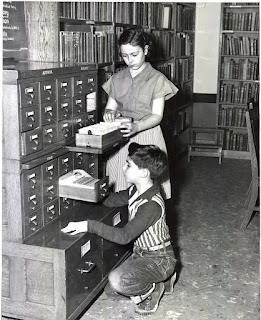
The public library was an important landmark in my childhood. It was in safe cycling distance, it was always warm, and it was the context for a ritualized, and mildly intimidating, interface with the adult world. I can clearly recall the heart-thumping point at which I would offer up my chosen books to be date stamped. I was in awe of the librarians who to my childish mind held the power to refuse me, point out my errors or even fine me. Invariably they were friendly, but they represented a powerful bureaucracy, an arm of local administration, that was strong and ought to be taken seriously. A successful visit to the library was rewarded by a subsequent rush of excitement - checking out was an experience like the end of a school day, clearing passport control or leaving a shop with just the toy you had in mind. But the pinch point at the library desk held all the power. It was the power that charged the anticipation as well as the release. The point where everything seemed to hang in the balance. With repeated visits and growing confidence I gradually became more and more interested in what happened at that point. The way in which a book's identifier - the book card, was deftly removed from a paper pouch glued to the endpapers, date stamped and then slipped with ease into my personal library card, snuggly held in alphabetical order in the custom-built wooden card index. As time went by I learnt more and more about the library system. Ways of classifying books, using card indexes and even requesting books that weren't in my particular branch. Home from my travels, in 1972, I was delighted to find that my mum had put in a request form for Herman Hesse's Magister Ludi - The Glass Bead Game. A postcard arrived at our home address on the 5th August that year with a hand franked two and half pence stamp. I know all this because the form dropped out of a book the other day. Evidently I used it as a bookmark and then forgot all about it. But the card is a fascinating record of a set of social and material literacy practices that were very much alive at the time, in libraries - and elsewhere too. The card - a reservation slip, a standard 6 x 3 inch postcard, serrated on one of its narrower edges at the point where it was detached from the counterfoil. One side with four pre-printed and indented rows of dots (for the address), the other with clearly labelled positions for the book's details - author, title, publisher and so on. The local branch name is ink-stamped on (oh, those ink stamps, so often the seals of officialdom!). All the specific details are captured in the distinctive flourish of my mother's handwriting. And one other feature that deserves a mention: two small holes and an impressed line in one corner, the scars of an earlier stapling, which tell something about a prior process of attachment. Such an efficient system, a marker of a sophisticated analogue literacy practice in its heyday, at a time when public libraries were generously funded. I could go on, but as I nostalgically turn this yellow-edged card in my hands I realise it's also charged with all those memories - returning home, my mother, reading Hesse, the smell of the public library, date stamps, stationery. It is slowly becoming other, its original and specific meaning is tucked into a card pocket in a much larger multidimensional catalogue. 

Saturday, October 02, 2021

Going slow

It's been a while. Perhaps it seems as if I'm a blogger on a go-slow, but really it's just the sign of a changing relationship with what I write. Recently posting has become a way of rehearsing thoughts that later become more extended pieces of writing - but somehow or other I didn't need to do that for the book Stacking Stories (out soon!). So that's where my energies have gone, writing that. But I still like the blog. I like it for its continuity, or to be precise for the way it maps change. Colin and Michele once described it as a 'wunderkammer' in their typology of blogs, but it long since changed direction. Gradually it became more performative. I tried to capture where I'd been, what I was reading and what was getting published. In other words it surfed the breaking wave of self-promoting academic identity performance (yuk!). Even quite recent posts - up to and including this one - seem to draw attention to what I've been up to in my professional life (such as this!). But I've also tried to stay faithful to the notion of capturing the main gist of what I'm thinking about, what inspires me. And it perhaps goes without saying, writing in one way or another always seems to come to the top of the pile. Producing it, consuming it, the two inextricably woven together. Everyday notes, graffiti, literature, sky-writing, logos, subtitles, digital, non-digital - the lot. That has to be the next (the last?) major project, translating that fascination into something that is both insightful and readable. Will I get round to it? I think so, although my current fascination with the Uruguayan writer Mario Levrero might be trying to tell me something. His short book Empty Words and the bible-sized tome The Luminous Novel are masterpieces in exploring the many ways you can avoid writing what you really want to write - or, how that avoidance can itself become a thing of fascination. Following that model I should probably post regularly about how I'm not getting round to starting work on that substantive topic. But I don't want to make a promise that I don't think I could keep.

Friday, June 25, 2021

Works in progress

I've come to think of all work as work in progress. A busy couple of months have seen me mulling over what things in the literacy world look like after lockdown, and several things are out there already including this bulletin and this contribution to a UKLA symposium. At the same time I've been working for the Journal of Early Childhood Literacy on our pro-Black initiative and wanted to show my appreciation to the wonderful Susi Long who has been convening an important group. One of the most significant aspects of this discussion for me is the idea that returning to normal is not a viable option if normal involves perpetuating old injustices and inequalities. Bettina Love is an uncompromising and forthright campaigner for this perspective, and of course she's right. I'm not yet sure how my writing intersects with this - that too is work in progress. In the mean time I'm helping to bring an old project to print, a project that operationalises the stacking stories idea that Cathy and I have been working on for a number of years. There's a lovely bit in this collaborative work that evokes rich memories for anyone who has ever taught. 'Most teachers can relate to the experience of arriving in a classroom, perhaps at the start of a school year - four walls, a cupboard if you're lucky, and a collection of desks and chairs - of rooting around in store rooms and drawers, sifting though resources of variable age and quality, shunting furniture about to create pleasant spaces or groupings, and playing with texture and colour for a less institutional feel.' Some of the resources you find in dusty cupboards and dingy stock rooms have their own histories. In the second school I taught in I found a class set of books called 'An Introduction to the King's English'. Which king, I wondered? Could that be George V? The book was published in 1932! This certainly wasn't work in progress; it was a museum piece. As a seasonal gesture, one of the book's colour plates is shown above. It's entitled 'At the Seaside' and it shows an English holiday scene - an idealised portrait of family life between the wars. Dad reads a broadsheet and smokes a pipe whilst mum keeps an eye on the children making a sandcastle. The page opposite informs us that dad is Mr Jackson, mum is Mrs Jackson and the children are Tom and Kate. Students of the King's English practice sentences rehearsing words like 'father', 'mother', 'sister' and 'children'. It perhaps goes without saying that not all families looked like that in Hyson Green in the 1970s.

Thursday, April 22, 2021

Three short pieces

One. Events pass through novelty and nowness to become history, obviously. I'm thinking of when doing things or going places one perhaps registers either to one's self or whoever you're with, that you're here. This is happening, I'm in Santiago, Singapore, Cyprus or some other place, doing this and conscious of doing it, too. And then looking back on it, that was life, that was what happened, the novelty or uniqueness flattening off, smoothing out. It settles down into the narrative of a life. Not only is it unrepeatable, after all we already knew that didn't we? but it settles down into ordinariness in a way we didn't quite expect somehow. That was what we did. We went to different places and did different things. it was all gradually absorbed like sugar into the sum total of experience. What at the time seemed remarkable or unusual gradually became part of the texture of things. There's a sort of doubling effect, events are at the same time both very special and rather ordinary. But yes, we did these things. Didn't we? Two. Variations on the blind man's cane. Husserl or Heidegger? No actually Merleau-Ponty: 'The blind man's stick has ceased to become an object for him'. The cane has become an extension of the senses. The hammer (probably Heidegger?) recedes as it becomes an everyday tool. We only realise how invisible such things have become when they go wrong, break. The cane snaps. The head falls off the hammer. We miss the nail and strike our thumb instead. So much of Pandemic experience has been like this. The head fell off the hammer of our lives. The everyday gets suspended, at least for a while. We quickly call conditions the new normal and then slowly they become normalized. So normal we stop noticing them (face masks). A different sense of the everyday arises. We get accustomed to it, slowly forgetting how things were or romanticising our memory of how they were. We lockdown. And then lockdown eases and the way things scurry back to normality is unsettling too. Our memories are short, we are quick to adapt, in fact adaptation is our strength. Three. Blind spots, literally blind spots. The bits we don't see we quickly fill in. Our reality like rickety Super-8 footage, badly spliced, jump cut, ill-matched film stock with different colour tones, sometimes out of focus, the sound out of sync. Is it really like that, reality? Yes, all of that spliced in with random bits of information and all slicked over with the gel of consciousness. Consciousness pulling it altogether, imposing pattern, predictability, superimposing meaning. Making sense out of nonsense. Stitching it together, smoothing it over always making it normal. That was life. It was what we did.

Sunday, October 25, 2020

The spread : breadth and depth

Having a personal library could well become a thing of the past - and it's certainly a luxury, a rarefied form of consumerism and something that can function like an identity marker. I say this because I've often been more interested in the time or place that associates with a particular title than the content. And along with this there's the strange business of the scraps of paper that have been used as makeshift bookmarks before that book was abandoned and its restless reader moved on. I've found everything from train tickets to old computer punchcards and postcards lodged in mine. And amongst these ephemera I've also come across my own notes on paper and card. In one book I recently found half a card which said 'Wishing you a speedy recovery'. It wasn't clear who was being wished a speedy recovery and from what, but on the reverse side I'd scrawled the following: 'mechanistic theories of learning individual treatment that a comp. programme may not provide.' I think it's the kind of compressed study note that's often served me well. It doesn't really mean anything at all to me now, but at the time it was something that I was taking from what I read. I do the same sort of thing now, and I imagine it as a helpful way of distilling the essence of what I'm reading. Essence is probably the wrong word, because I'm actually referring to the meaning that I'm taking away, which is a more personal matter. And this meaning may be very different to the one intended by the author - for a start it's much narrower. But so much academic work depends on this process of narrowing down, the process of selecting from, and reducing another source. This is relatively easy in a small, focused area in which a body of literature can be read, analysed and synthesised but I think that there are always problems of scale. When the output is diverse and rapidly changing this is altogether harder to achieve. It would be a real challenge to do this across my personal library, for instance. Which brings me full circle, in fact, to the latest addition to my library which is Ben Lerner's acclaimed novel 'The Topeka School'. I enjoyed reading 'Leaving the Atocha Station' but this is altogether a more complex, more ambitious work of auto-fiction. The theme that concerns me here is what he calls 'the spread'. Briefly, in Lerner's world of high school debating 'the spread' is an important tactic. The spread, in the narrator's words, is 'to make more arguments, marshal more evidence than the other team can respond to within the allotted time'. As the novel unfolds the spread becomes an important trope and it stands in for the way in which we can feel paralysed by torrents of information, complex demands on our attention and so on. The popular idea of 'overwhelm' is something similar. And it is rather different from the personal library and the notes on scraps of paper which are attempts - and only attempts - to select, simplify and perhaps to go deeper into things. The spread is wide, overwhelming, destabilising and, in Lerner's world at least, it characterises the times we live in.

Thursday, September 24, 2020

The Meaning Makers

I never met Gordon Wells in person, but as a long-standing admirer of his scholarship I was deeply moved to read about his tragic death. It was one of those unfortunate coincidences - I heard the sad news just as I was agreeing changes on the draft of a piece I’d written. Mine was a piece that underscored the enduring influence of his work. As is often the case with writing, I needed to go through the process to clarify my own thinking, and that led to a fuller appreciation of his influence. Wells had a lasting effect on me as a teacher and researcher. Writing about The Meaning Makers, first published in 1986, it was necessary to return to the work, and I was pleasantly surprised to find it as fresh, engaging and relevant today as it was thirty-four years ago when I first encountered it. Subtitled ‘children learning language and using language to learn’, The Meaning Makers is nothing short of a landmark text. It is based on fifteen years of longitudinal research, all rather diminutively referred to as the Bristol Study. Fifteen years is almost unthinkable under current funding regimes, but it certainly helps in getting some depth. And the work of Wells and his team certainly had depth. The research was rigorous and carefully theorized, providing detailed evidence of how children’s language and early literacy developed at home and at school. It also strongly suggested how such development might be effectively supported. In his work Wells referred to a wide range of child language research, building on the insights of Britton, Rosen and Barnes in seeing language and learning from a Vygotskian perspective. Alongside this he repeatedly turned to the work of Bruner, developing a social constructivist view of meaning which was vividly illustrated through carefully selected extracts from his extensive fieldwork. Transcripts are chosen with care and subjected to close analysis in Wells’ writing and this provides an important model for all who follow in his footsteps. For me the simple message that children are active meaning makers remains a powerful guiding principle. That principle, and the convincing evidence used to illustrate it underscores Wells’ significant contribution to language and literacy studies.


Saturday, March 25, 2017

Moved?

Recent interest in affect has come from a number of different directions. Sedgwick’s appropriation of Tomkins’ psychological perspective has been particularly influential, whereas Brian Massumi develops ideas that are rooted in the philosophy of Deleuze and Guattari. In The Politics of Affect Massumi emphasises the emergent and relational nature of affect. Affect he argues is pre-personal and happens as bodies come into contact. It is interesting then, in relation to this, that some cognitive scientists are now interested in things like gut reactions, intuitions and so on. Things, you might say, that we know, but that we don't know we know. Studies of interoperception are beginning to get some empirical purchase on the mechanisms that are at play in diverse arenas - in what successful gamblers, traders and negotiators do. It also seems that our bodies are able to mirror others when we establish empathy - it's not simply a conscious adaptation, although that happens, too, but what a body can do as the pupils contract or the heart rate shifts. So as social scientists have been suggesting for a while these things happen beneath, beyond or before rationalisation or representation. The challenge, then, is how to account for things that don't yet have words but seem to be an important part of inter/intra-actions, and of making things happen. Seventeenth century European philosophy explored this territory with both Descartes and Spinoza, despite there very different orientations, sharing the view that affects, feelings and concepts could all be classed as ideas. The notion that rationality, in the form of worded conceptualisations, align with individual, social and cultural progress has carried forward into contemporary times. But perhaps that implied hierarchy can't be sustained. Not that we should necessarily begin to privilege gut feelings, intuitions and all the rest, but perhaps we should begin to acknowledge that they play an equal and important part in daily life..

Thursday, January 01, 2015

Builders' stilts


I often think that discussions of new media place their emphasis on either representation or technology but rarely both. Thinking about the technological function of so-called everyday objects can therefore be an interesting point of departure. Colleagues whose work focuses on the digital tend to overlook the fact that technologies are implicated in such basic things as food preparation and consumption, domestic chores, and so on - indeed in the full range of daily activity. And as Latour's work implies, non-humans are therefore active in all aspects of our lives. These builders' stilts work well when plastering a ceiling and certainly reduce the labour of climbing ladders and trestles, saving on both time and effort. Whether or not they turn plasterers into cyborgs is debatable, but they do serve as an illustration of how our relationship with the world is constantly modified by the things we make and use. The plasterer isn't particularly concerned with meaning making - he's just getting the job done. Well, we might well ask whether a smartphone or laptop is any different, and why. After all, it's all stuff. In the closing minutes of the film 'Transcendence', when the internet goes down, there's a lovely image of someone using a keyboard as a doorstop. Is that act about giving new meaning to old stuff or just getting a job done? In an early paper, Latour refers to the way in which we delegate to non-humans. From this point of view, re-purposing a keyboard as a doorstop is perhaps just an act of delegation. One that uses the physical affordances of a piece of plastic with letters on it to keep a door open. On the other hand, I could thing of many other uses of builders' stilts - but keeping in touch with colleagues in Australia or Canada wouldn't be one of them!

Wednesday, December 18, 2013

(Con)text

Political speeches, presentations, ritual invocations, announcements, radio broadcast and so on are closed one-to-many forms of communication in which interaction is constrained through the ways in which the speaker occupies a position of power in relation to the audience. Often enough, although not exclusively, their textual power is achieved through appropriation of the linguistic structures of writing and in fact part of the process of their production may involve the use of scripts, notes, prompts, the inclusion of quotation from written sources, or the memorisation of sacred texts. Casual conversation,with its diversions, its vagueness, hesitation and the prevailing condition of incompleteness is tinctured by provisionality and is in contrast more open, more democratic and more context-dependent. These contrasts, however, are extremes on a continuum and perhaps, because of this, the in-between ground is as interesting as the extremes. We often use the context dependent/independent continuum as a way of differentiating between texts, but really we have to accept that text must always have a context. Perhaps it's more a case of foreground and background. In much of the casual traffic of texts it almost seems as if the text (by which I mean, in this case, the linguistic element) is an elaborating detail that surrounds the action. When we're fixing something perhaps, we are involved in action and that's foregrounded. The linguistic detail attaches to that. In other instances - reading a novel or writing a paper, it seems that we work the other way round. The linguistic content is central and reference moves both within the text as well as to the world, real or imagined, that is outside it. It can be no different with digital text, except that it may be the case that there is more possibility for extra-linguistic material to become part of the situation. Perhaps, by moving away from a text-centric way of looking at things we are simply becoming more interested in action, activity and relationship, and maybe they are the underplayed dimensions of communication.

Monday, December 02, 2013

The grassy knoll

Visiting Dallas 50 years after the Kennedy assassination could be a significant experience. After all, the shooting was a defining moment in contemporary life, wasn't it? But today looking down on that rather familiar-looking stretch of road, standing on the grassy knoll, gazing up at the box-like structure of the book depository, up to the sixth floor, it all seems rather flat and clean. Sterile, you might say. The memorial fountains are bathed in full sunshine. The sky is a deep blue. It's so neat and clean it's hyper-real. Museum staff are on the streets selling facsimiles of the Dallas newspaper of 22/11/63, but those events have already been swallowed up by history, they are long gone. So, how is it that we can best relate to recent historical events? The most familiar way, I suppose, is to think about what we were doing on that particular day. That helps to pinpoint it, to remember, to tie it to our experience in order to make it more real. In this case I can remember it well. We had been walking in Bradgate Park. It was a cold day, and my father had the gas fire on full when he tuned in the radio for the six o'clock news. That was how he kept up, it was like a religious ritual - listening to the BBC on the wireless (and that's what he called it, the wireless). He was shocked by the headlines, nodding his head saying 'Crikey',or something like that. But my mother's reaction made a much stronger impact on me, because when she came in the room, the rest of the news was playing. Aldous Huxley had died, and that upset her more, and I think she made the mistake of saying so. My father ridiculed her, as he often did. But Huxley was one of her literary heroes, and there was no denying that. Huxley was a towering figure, in more ways than one, and his death was inevitably rather overshadowed by Kennedy's, which is a shame. But they weren't the only newsworthy deaths that day. C.S. Lewis, the author of the Narnia books, which I had read, and loved, also died that day. And in my still impressionable young mind, I understood my mother's viewpoint completely. Narnia was brilliant; Kennedy was just someone on the news. I'd never been to Dallas, but I had been to Narnia. That was a strange day then: Huxley first, then about 10 minutes later Lewis, followed an hour later by Kennedy. Each died in a very different way, each left a distinctive legacy. I'd very much like to return to Narnia in the same way that I first did, slipping between the fur coats into that snowy landscape, but the warm Texas sunshine seems to place it far out of reach. In some ways it's all in the past.

Place hacking

Like many cities that prospered in late Victorian times, the centre of Nottingham still has those imposing multi-storey buildings or chambers that served as the office blocks of that era. In my youth, these were the premises of solicitors, surveyors, small businesses and suppliers, and they were often half hidden behind anonymous-looking doors set in between the shops, banks and department stores of the city centre, accessed through a labyrinth of winding corridors and dim stairwells. They were, in some way at least, the private areas of that urban environment. And in my teen years, when the city seemed like a playground, my friend and I filled many an exciting afternoon exploring these spaces. Sneaking down passageways, tip-toeing up linoleum-covered stairs, opening creaking unlabelled doors, the unexpected and unannounced thrilled us in the very moment, at every turn. We would never wittingly take the same route twice.  Our exploits were halfway between playful investigation and trespass. One moment blundering into a typing pool, a reception desk, the back room of a shop, an office workers' tea station, a stationery cupboard; another stumbling into a jumble of brooms, mops, cans of cleaning fluid and tin buckets.These spaces weren't exactly private, but neither were they public. What's more we had no good reason for being there in the first place. Part of the fun lay in that. We might get caught, or challenged (and sometimes we were - and that, of course, was half the fun), but at the same time we would be rewarded by a different view of the city, some novel connection, some unexpected learning, spilling out onto a different street. But after all where were we in this city in our youth? Too young for pubs, sometimes too noisy, too raucous for the cafés and tea shops, and still unqualified and woefully ill-equipped for the world of work. Nothing bad came of it. And it gave us the taste of freedom, as we worked our way between and outside the lines of what was expected; it filled time that was otherwise unaccounted for, school having become too tedious, too regimented, altogether too much. That youthful diversion now has a name: it's called urban exploration. In fact, it was reading about urban exploration (or place hacking), in Bradley Garrett's  excellent ethnography 'Explore Everything', that brought all this back to me. In a strange sort of way it offered me an intelligent rationale for something that had seemed like a half-forgotten, and somewhat quirky adolescent pursuit. At that time, I am sure that we didn't know quite what we were doing or why we were doing it, we certainly didn't discuss it, we just did it. It was fun. Yet we were 'reclaiming the city', blissfully unaware of Debord, or the situationists, or any guiding theory or politic, for that matter. If it was covered in the underground press of the time, I certainly missed it and so did my friend. And so all this makes me think how we may often do quite reasonable, intelligent things without exactly knowing why - at least at the time. Either that or we have an astonishing capacity to make sense out of the most random of things, thereby dignifying our seemingly unending acts of human foolishness. But once something like this is given a name, explored in a thoughtful way, it seems to articulate the motive - or at least part of the motive that propelled it in the first place. That journey of reading and recalling urban exploring reminded me of how my longstanding interest in visiting and sometimes photographing ignored, dilapidated and abandoned buildings took on new meaning when I read about the ideas of 'ruin porn' and bunkerology, how my regular and random zigzag walks around Sheffield looked and felt different when they were rethought as psychogeography. Now, or so it seems, I know why it interested me in the first place. Did a name, a theory, bestow new meaning upon it? Or was the meaning there, already awaiting its later discovery - in some way immanent? Did the incoherent blind interest simply gain respectability through a post-hoc rationalisation? Or more likely, or at least more attractively to me as an academic, did the act of reflection, in a dialogic relationship with others who have done and thought about similar things, help in bringing into being new experiences, and new perspectives on old experiences? A new way of looking. And does all this - this process of re-thinking, help us in imagining possible future actions, experiences, diversions or misdemeanours? I don't know, but either way one thing is certain, I will continue to explore, in my own way, buoyed up by what I have read, what I have talked about and what I have thought. Perhaps, just perhaps, that constitutes an invitation, too. After all, those old Victorian buildings are still there somewhere, as are both our current and our remembered experiences and actions!