In spite of everything I may have written about the changes in literacy, the feeling of holding the book itself is still significant! The print copy of Rethinking Digital Literacy has arrived, and it feels important to hold it - even though it is light in weight when held against the hours of writing. It is a slim thing, but I'm proud of it and particularly appreciative of how it looks. I owe my thanks to my good friend for the great cover image and of course to my publisher, Edward Elgar, for doing all that publishers do and for their part in producing such a handsome volume. The book is, of course, available in digital format but I can't help thinking that readers would be missing out - even though they might be saving something like £45. But, having said that, I'm not really sure that I know what it is about print books apart from familiarity, nostalgia and habit that makes them seem so special. Rethinking Digital Literacy is an almost entirely digital thing. It was written and researched onscreen, on my iMac, at my stand-up desk. Open, on that desk, to my side, I would have had a notebook and pen, but that would be for a few scrawled reminders - that's all. It was a digital thing. It took form through tapping on a keyboard, it was saved sent, revised and checked digitally. I've never met anyone from the publishers - or even spoken to them on the phone. They might as well be machines or creatures from outer space as far as I know! I'm not complaining, I didn't feel as if I was missing out on anything, in fact I was undisturbed. The process was smooth, frictionless. I think of myself as being fairly measured. I don't go in for grand flourishes or big statements, but as the book developed and as it drew on some themes from Why Writing Still Matters, my previous book, I began to find myself arguing that there had been a revolution in writing - not just a revolution in how we produce text, but a revolution in the reproduction and distribution of text, accompanied by a discernible shift in the place of writing in the ecology of communication. As if that wasn't enough we are now obliged to take account of technological agency - not only the active work of search engines and algorithms, spell-checkers and other digital resources, but also the way in which AI and chatbots can create original text. The old monkey-typing idea- the idea that eventually (perhaps) a monkey's random keyboard tapping might produce the complete works of Shakespeare seems outworn now that AI can produce plausible and original Shakespearean English in a matter of seconds. All told, I've talked my way into a rather strong assertion. So whilst my ambition to write a powerful, popular book for a wide readership seems to have abated, I know that if I did it would be called The Writing Revolution or - perhaps its slightly weaker as a title - A Revolution in Writing. It would need someone to throw down the gauntlet before AI comes up with a version.
Showing posts with label materiality. Show all posts
Monday, November 10, 2025
Sunday, December 22, 2024
The guide
Saturday, January 27, 2024
Don't lean on me man
Scribbled notes on a scrap of lined paper sold for £89,000 the other day. They were the draft lyrics for Rock n Roll Suicide and Suffragette City – complete with the added revisions ‘Hey man!’, ‘Don’t lean on me man’ and ‘Outasight’. The everyday nature of the materials and the rather unremarkable addition of those words might seem trivial or even banal if it were not for the huge impact of Bowie’s songs on popular culture. That scrap of paper, those hastily scribbled jottings are like visible traces of a creative process in vivo. Those songs echoed around bedrooms and shared houses, bedsits and squats, family homes and student flats. They were sung along to, played, replayed and performed time and again, spooling outwards, as it were, from those hastily scribbled lines. Of course, it wasn’t just the lyrics, it was the voice and the music too, the distinctive sound of that particular recording, distributed on vinyl, in its instantly recognisable cardboard sleeve. And it goes without saying, the RCA supply chain ensured that copies were there, ready and available in the racks and trays of LPs that like-minded people habitually flicked through when they went to their favourite record store, back in the day.
Matter of little significance has, over time, become a much sought after collector’s item - the value of that scrap of paper far outstrips the value of the raw materials it’s made from, and the ways in which the words themselves wound their way around the feelings and impulses as well as the hopes, beliefs and dreams of a generation of listeners is difficult to capture because of its inevitable multiplicity. It may well have been the soundtrack of many people’s early lives - but then what lives? How did the lyrics come to mean in different contexts, how were they understood - how were they heard, misheard, disliked, detested? Material history can be a bit like that, for although we might agree on the importance of a particular artefact, its meaning is fundamentally unstable inviting interpretation, re-interpretation and misinterpretation. Music in popular culture seems to inhabit the outer reaches of such instability because of the way in which it is often woven into significant personal events, stitched in to one’s particular state of mind, the recreational drugs, relationships, lifestyles and ambitions of the time. Perhaps music in general does this, seamlessly attaching itself to the memories and affects, the distinctiveness of a life. After all this is key to the success of Desert Island Discs, now 81 years old. The 8 track format is such a convenient hook to tell the story of one’s life - or at least a version of it.
With an aspiration to be a writer, poet or wordsmith and a nascent literary sensibility I was drawn to the words that punctuated the soundtrack of my early life. That soundtrack was made of vinyl. Singles and EPs that span around at 45 rpm, LPs at 33.3 rpm. Mostly I first heard stuff on pirate stations, on a transistor radio, on Top of the Pops or round at friends’ houses. But the LP soon became something to own. The record sleeve had the all-important supplementary information. The aesthetic of the art work, the names of the musicians, the way they looked, the way they dressed and how they had their hair - the instruments they played, who sang, who wrote the songs and of course, the lyrics themselves. No longer inaudible or misheard, there they were, nearly always on the back of the sleeve or on a pull-out, and you could read them, sing along or just pour over their meaning, if you could fathom it out. Some were more self-consciously poetic than others, some were just rubbish, but nonetheless huge clouds of creativity billowed out of that early flowering of rock music. It seemed at the time that the lyrics carried valuable messages. If they were not poetic they might gesture towards expressions of lifestyle, of taste, of belief and in doing so fashioned the habits of mind of a generation. Whimsical and romantic, uncompromising and rebellious, conceptual, quirky, hedonistic, we were served up with a range of possibilities, a wardrobe of identities that might distinguish us from the mainstream. Only a few at the time saw how the subtle threads of capitalism were part of this, establishing a marketplace in which even the costumes of anti-capitalism could be bought.
And now, just the words remain – like a dog without a bone, an actor out on loan (it’s all there somewhere, even if the melody is hard to sing!). Skeletons, threadbare outfits. At an earlier auction the lyrics for Bowie’s Starman sold for £203,500. Unlike Suffragette City, these look like neat copy – presentable handwriting on graph paper with misspellings corrected, probably provided for publication of the official lyric sheet. They don’t have quite the same feel as the Rock n Roll Suicide and Suffragette City lyrics – they’re more polished, more self-conscious, but their market worth is still interesting, and given that an early demo of the song went for £41,000, a fifth of the price, it seems like the material trace of writing is an important marker for the collector, being closer perhaps to an autograph than a ghostlike voice, written by the hand of an icon, don’t lean on me man.
Thursday, October 05, 2023
Why writing still matters, too
For the cover of Why Writing Still Matters I wanted an image that conveyed some of the messages that are to be found in the book - and that's quite a big ask. This image of Tom Price's wonderful piece called Network, which is in the Yorkshire Sculpture Park, was an obvious candidate. It might make you think of writing as it is becoming - writing with technology, which is consistent with the book's subtitle, 'Written Communication in Changing Times'. The fact that I'm in the picture as well is a bit of an in-joke. But in the end we went for the more abstract image which is credited to Nick Oakes but doesn't actually get any commentary. It's a photograph of initials and names carved into a tree trunk near the Alhambra in Spain. I like it because it references an everyday, but unofficial use of writing - using your name as if to say 'I was here, too' - here for as long as this writing surface remains. It will outlast the act of inscription, but anything further is uncertain. It is the trace of an action - a penknife gouging out the crusty bark of a tree. Someone leaves their mark, announces their existence, expresses their frustration, pledges their love or whatever. I like it because it can be read in different ways, and because it might provoke all sorts of different reactions. The specific detail of its origin and author(s) are unknown. The fact that it has been coloured with the primary colours that Miro was so fond of adds another dimension for me. That and the place in which the photograph was taken - I have fond memories of visiting the Alhambra. Visiting and queuing. Once we waited for 6 hours! It can be like that at the height of the tourist season. But, it's always worth it. The Alhambra and the Generalife are a potent reminder of Moorish rule in Europe and an important part of Spain's architectural heritage. A jewel in the crown of Andalusia. Of course, none of this is in the photograph, but it's what I bring to the photograph. And somehow when you put all that together you get more of a sense of what writing is, what writing does and then maybe, perhaps, why writing still matters.
Saturday, February 05, 2022
Literacy practices in libraries
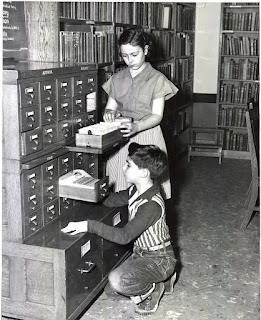
The public library was an important landmark in my childhood. It was in safe cycling distance, it was always warm, and it was the context for a ritualized, and mildly intimidating, interface with the adult world. I can clearly recall the heart-thumping point at which I would offer up my chosen books to be date stamped. I was in awe of the librarians who to my childish mind held the power to refuse me, point out my errors or even fine me. Invariably they were friendly, but they represented a powerful bureaucracy, an arm of local administration, that was strong and ought to be taken seriously. A successful visit to the library was rewarded by a subsequent rush of excitement - checking out was an experience like the end of a school day, clearing passport control or leaving a shop with just the toy you had in mind. But the pinch point at the library desk held all the power. It was the power that charged the anticipation as well as the release. The point where everything seemed to hang in the balance. With repeated visits and growing confidence I gradually became more and more interested in what happened at that point. The way in which a book's identifier - the book card, was deftly removed from a paper pouch glued to the endpapers, date stamped and then slipped with ease into my personal library card, snuggly held in alphabetical order in the custom-built wooden card index. As time went by I learnt more and more about the library system. Ways of classifying books, using card indexes and even requesting books that weren't in my particular branch. Home from my travels, in 1972, I was delighted to find that my mum had put in a request form for Herman Hesse's Magister Ludi - The Glass Bead Game. A postcard arrived at our home address on the 5th August that year with a hand franked two and half pence stamp. I know all this because the form dropped out of a book the other day. Evidently I used it as a bookmark and then forgot all about it. But the card is a fascinating record of a set of social and material literacy practices that were very much alive at the time, in libraries - and elsewhere too. The card - a reservation slip, a standard 6 x 3 inch postcard, serrated on one of its narrower edges at the point where it was detached from the counterfoil. One side with four pre-printed and indented rows of dots (for the address), the other with clearly labelled positions for the book's details - author, title, publisher and so on. The local branch name is ink-stamped on (oh, those ink stamps, so often the seals of officialdom!). All the specific details are captured in the distinctive flourish of my mother's handwriting. And one other feature that deserves a mention: two small holes and an impressed line in one corner, the scars of an earlier stapling, which tell something about a prior process of attachment. Such an efficient system, a marker of a sophisticated analogue literacy practice in its heyday, at a time when public libraries were generously funded. I could go on, but as I nostalgically turn this yellow-edged card in my hands I realise it's also charged with all those memories - returning home, my mother, reading Hesse, the smell of the public library, date stamps, stationery. It is slowly becoming other, its original and specific meaning is tucked into a card pocket in a much larger multidimensional catalogue.
Friday, August 28, 2020
Drawing on something
I took up drawing again about a year ago - I say again because I haven't really done any since my teens. Armed with a pocket-sized sketchbook and a couple of pencils we sat outside cafes in Ortigia as I sketched people passing by, photographing the Church of Santa Lucia, delving into their holiday rucksacks, chatting with their friends and on their smartphones. They weren't up to much - my sketches, that is - but I had a particular project in mind, and I wanted to find my way into drawing people. You have to start somewhere. As with my earlier attempts, half a century before, I realised that I don't have much that you might call technique. In fact I don't think I'd really want technique even if it was on offer. I just want to discover what works for me. I want to watch my drawing evolve. Of course it's not quite as simple as that. It's not all about first hand discovery. As art critics have often pointed out we are always governed by what we have seen before. What we draw or paint looks right because we have seen something like it previously. Still it emerges afresh on the page as we draw. We do it ourselves, and that's a creative act whether it's 'good' or just good enough. It's our own expression of something. Anyway, in those intervening years - those between my early drawing and my current rekindled interest, I have been preoccupied with writing. Not particularly good or even interesting writing, but writing nonetheless, and most of it professional or academic in nature. And the most important thing to emerge from all this writing is the realisation that what attracts me most is not actually its originality (although of course that helps) but the creative self-expression itself - trying to represent things in my own way, in my own voice. As with drawing, my writing doesn't have a preoccupation with technique - at least not in a self-conscious sort of way. It's just constantly refining itself. And of course it refines itself in the light of what I read. That's not quite the same as saying it's all imitation, but I think it always draws on something, even if I might not be sure exactly what that is. The word expression seems to capture that, and if I were to write another book that would be a driving theme. Writing - technology and expression or something like that. Even in writing that it would be perfectly obvious that I'd be drawing on something.
Sunday, July 21, 2019
Mark making
'Traces left by our ancestors from 25,000 years ago' the softly spoken guide explains. 'Wow' whispers the American woman in breathy response. But what exactly are we to make of this statement, this 25,000 years ago? It's calculable but still somehow incomprehensible, out of reach - so many generations ago. Let's face it, it's hard enough to imagine the recently deceased let alone those we have never met. And yet here is the gracefully drawn outline of a horse. A carefully executed red ochre line on the wall of the cave. 'We know how but we don't know why' the guide says emphatically. Science can tell us the exact composition of the materials - charcoal, brushes, sticks, hands and pigments. And it can also give us a pretty accurate idea of when this particular horse was drawn, but the purpose, the motivation for making this image escapes us. Yet it is obviously, yes undisputedly the form of a horse. That much speaks clearly and unambiguously across unknowing time. And since we are all convinced that the ability to draw like this is peculiar to the human species, which ever you look at it, this is an act of human communication. Whether its survival in this labyrinth of limestone caves is accidental or not makes little difference. Perched on our millennial ridge we gaze into the mists of human time, knowingly squinting at a hazy horizon. We were here before, leaving our mark.
Saturday, March 02, 2019
Writing and knitting
I've spent a considerable amount of time recently (with Cathy Burnett) trying to develop a credible account of meaning making from a sociomaterial perspective. That journey has taken me down some fascinating byways including cross-species communication, machinic semiosis and into the possibilities of message exchange without sentience. But however you carve it up, it seems that what we call literacy is an exclusively human accomplishment, even when we fully acknowledge the use of signs and symbols in nonhumans. Thinking of literacy like that isn't human exceptionalism - it's just the way it is, a distinction. It's helpful to think of that distinction with respect to text - the word in English derives from the Latin textilis (woven), so we might say text is that which is woven. The etymology is shared with textile (fabric or material) and indeed much has been made of this elsewhere, and part of it is no doubt connected with the historic materiality of the book. The parallels are interesting to think with. Take something like knitting, similar to writing in that it is a human accomplishment. OK, so the artistry of weaver birds is impressive, spiders make impressive webs, and so on - but they are just not the same thing. Knitting is learnt behaviour with a variety of forms and techniques - but it is just an abstract idea without the material dimension - the yarn in all its variety, colour, production and origins and the technology required to knit it together, whether simple (two or three sticks or needles) or complex (automated, machine-powered, programmed). Of course you could elaborate on the process, all the different steps required in making a garment, for instance, but that is the basic process. The garment is, of course, analogous to the text, that which is woven. A garment is a more or less durable product designed to fulfil a particular purpose, and from the point of completion has what amounts to a life of its own. It can be moved across space and time, given, sold, lent, re-purposed or destroyed. It can be cut, copied, shrunk or lost. It assembles, reassembles and disassembles. It is dependent on an entangled process and on complex mechanisms of transmission and exchange - and in this sense is just like text. Thinking like this suggests that the semiotic domain of the social should not be purified and distilled for the purpose of study. Texts are mutable objects in heterogeneous assemblages with human, nonhuman and non-semiotic objects, they emerge out of these entanglements affect them and are affected by them.
Friday, December 21, 2018
Who needs pockets?
Denim used to be a signifier of rebelliousness, and that may partly explain why I’ve been wearing blue jeans for the last 50 years. Not the same pair I hasten to add, but successive variations on a theme. Small but important shifts in length, leg-style and waistband have reflected the various whims of the fashion industry, but really they’re more or less the same thing. Perhaps no longer so edgy - in fact they’ve somehow accrued a sort of staid, conservative image, unsurprising perhaps, given how little they’ve changed compared to everything around them and in them. The other day, though, it occurred to me that the pockets seem to be getting shallower. Either that or my hands are growing, which seems extremely unlikely. And that reminded me of how pockets used to be stuffed with loose change, a rarity these days when all you need is plastic. Nearly everything I buy goes on a card. And apparently there are places now that will only accept card payment. Phone, watch and contactless transactions are on the rise - your pockets may be empty, but you can still pay. It’s part of the sublimation of everyday interaction, the cashless society. But pockets are here to stay. I mean where else would you put your hands when slouching against the wall? And where are going to keep that all important rectangle of plastic?
Friday, December 14, 2018
Biometrics on the move
I've often wondered why the seating in airports is so uncomfortable. Is it to prepare you for the inevitable discomfort of the journey ahead or is it just a total failure of imagination? Anyway here we are again in our serried ranks, this time in San Francisco, uncomfortable as usual when there's an announcement. US immigration are staging a 'biometric exit operation' just before boarding. Just when you thought you'd escaped notice and could slink off they're tracking your departure. In the end it's not as bad as it sounds. You just step up - when you're told, of course - and stand on two large yellow footprints glued to the floor while they take your picture. That's it, and off you go. They could have just announced that instead, 'We'll take your picture as you leave'. Biometric exit operation sounds better, but then again it's slightly more honest. Yes, they take your picture, it's simple....and then. It's the and then bit which is hidden. Hidden, like so much in our machine age. You have to imagine how your image becomes data, matched by face recognition software, tallied against finger and thumbprint records and passport details that connect your age, sex and nationality with where you've been and what you said you were doing, and it's all done behind the scenes. Then and there you just get a polite but slightly officious person in uniform who presses a button before telling you you're done. And this because you are - you're done again.
Saturday, February 17, 2018
Here come the non-humans
It's not just the fact that we're sailing in the wake of Latour's Re-assembling the Social - the growing appetite for all things socio-material or post-human represents an impulse to think differently about our place in the world. Suddenly, or so it seems, the non-humans have risen up to challenge the endeavours of social science. Is it strictly social anymore, you might well ask? That challenge, if taken seriously, is a challenge to what we focus on in research, how we go about studying it, analysing and even reporting it. Conceding to material agency must surely be an all or nothing affair. I've just been reading Adams and Thompson (2011) on 'interviewing objects' - yes, that's right, interviewing objects. Well, the sort of objects they are concerned with are technological, and if we allow them the temporary grace to separate (human) subjects so cleanly from (technological) objects, they make a compelling argument. I resonated with this observation, for instance, 'The technological milieu is shaping substantially - insinuating itself, habituating us and simultaneously informing and interpreting - how we act in and perceive the world (2011:13), and I enjoyed reading about the 'invitational quality of things'. I remembered a conversation with Julia a while back when she wondered out loud if the idea of affordance still worked in a socio-material universe. I suppose in a way an affordance is rather weaker than an invitation. Perhaps it suggests less agency? I can't help thinking that Twitter's 'What's happening?' prompt is a bit more like an invitation, and similarly that the little red dot that says 158 next to the envelope icon on my phone is an invitation - an invitation to worry or to read and delete. So, here come the non-humans, and really when you think about it they're all over us; they have us surrounded.
Saturday, July 08, 2017
Technology and the war machine
Iraqi security forces, and Peshmerga fighters together with Sunni and Shia militia are about to take possession of Mosul, liberating it from IS. Defeat is imminent, and has been for about a week now. This part of the conflict dates back to October 2016, and the ground forces are part of an alliance that is backed by US-led airstrikes. Deleuze and Guattari seem unlikely prophets in this context, but still what they say has predictive force: 'The State has no war machine of its own; it can only appropriate one in the form of a military institution, one that will continually cause it problems.' (1987, 391). Technology and weapon-speed, which they also write about, are an integral part of this war machine. Technology may not be evil, but it has a chameleon-like nature. If you want to taste the flavour of modern warfare Ghaith Abdul-Ahad's piece called The Baghdad Road is hard to beat. You can taste the dust, sense the confusion, the weariness and the machinic quality of it all. Technology, of course, plays a massive part in the war machine, accelerating weapon-speed. One officer talked to Ghaith while he 'pinched and zoomed a satellite map on his tablet'. Later he writes how other officers have 'smartphones and tablets arrayed around them' like 'children playing a video game'. A fighter called Ali moves from building to building. If there's resistance he sends the co-ordinates and 'friendly' planes dispense heavy bombs within minutes. Slowly they inch to victory, destroying buildings, rooting out IS, injuring and killing innocent civilians. For all its sophistication it's a primitive affair.
Saturday, March 25, 2017
Moved?
Recent interest in affect has come from a number of different directions. Sedgwick’s appropriation of Tomkins’ psychological perspective has been particularly influential, whereas Brian Massumi develops ideas that are rooted in the philosophy of Deleuze and Guattari. In The Politics of Affect Massumi emphasises the emergent and relational nature of affect. Affect he argues is pre-personal and happens as bodies come into contact. It is interesting then, in relation to this, that some cognitive scientists are now interested in things like gut reactions, intuitions and so on. Things, you might say, that we know, but that we don't know we know. Studies of interoperception are beginning to get some empirical purchase on the mechanisms that are at play in diverse arenas - in what successful gamblers, traders and negotiators do. It also seems that our bodies are able to mirror others when we establish empathy - it's not simply a conscious adaptation, although that happens, too, but what a body can do as the pupils contract or the heart rate shifts. So as social scientists have been suggesting for a while these things happen beneath, beyond or before rationalisation or representation. The challenge, then, is how to account for things that don't yet have words but seem to be an important part of inter/intra-actions, and of making things happen. Seventeenth century European philosophy explored this territory with both Descartes and Spinoza, despite there very different orientations, sharing the view that affects, feelings and concepts could all be classed as ideas. The notion that rationality, in the form of worded conceptualisations, align with individual, social and cultural progress has carried forward into contemporary times. But perhaps that implied hierarchy can't be sustained. Not that we should necessarily begin to privilege gut feelings, intuitions and all the rest, but perhaps we should begin to acknowledge that they play an equal and important part in daily life..
Saturday, February 06, 2016
Personal, colonial
I'm back! Back from what friends fondly refer to as my gallivanting, which roughly translated means making the most of my time to explore new places, or places that interest me - alternatively rendered as going to warm and exotic locations just because I can. This time Sri Lanka. And from my humble iPhone snaps this Hillman was the best, parked up on a sidestreet it strongly resonated with my 1950s boyhood whilst also being totemic of the whole colonial legacy. Corny as hell, I know, but cars seemed so important to me back then. That beige two-tone was the colour of my childhood and the taste of milky tea all wrapped up in one. Sri Lanka, or Ceylon as we then called it, was something we did in geography as a prelude to getting on with life. So much for innocence. In Sri Lanka the communication system, both road and rail, put in place by the British, constituted an elaborate net to capture the country, to suppress resistance and to strip the hillsides first for coffee and later, when that failed, for tea. The road system is still there, you can see some well-preserved classic cars and tea is still big business. But amongst all that are centuries of culture, a whole history of art and architecture as well as an exquisite and diverse natural habitat. Returning to work might seem dull in comparison if it weren't for the enthusiasm of colleagues, the promise of new projects and the slow closing stages of previous work, all of which may well get reported on here in due course. As a corrective, before I stop for a cup of tea, I do want to make it clear though that I am not remotely interested in classic cars but it's just that I learnt at quite an early age that my father earnestly believed that owning a Hillman would make him happy, that it would be a step up in the world. That was abandoned when he splashed out on an MG in cream and British racing green...and just as I know Sri Lanka as Ceylon, these sorts of things remain with you.
Sunday, March 08, 2015
Discourse/methodology
Discourse and Digital Practices - the outcome of a lively symposium in Hong Kong, organised by Rodney Jones and his colleagues, is out now in the UK. In my chapter, I took some of the iPad data (also published here), and tried to relate my analytical methods to the more familiar practices of discourse analysis. Whether or not I succeed in doing this is, of course, for readers to decide, but to me it felt a little like retracing my own footsteps. I was trying to think through how discursive practices, media narratives, digital technologies, adult-child relationships, notions of literacies... and so on, all mesh together in the story-sharing episodes captured on video. In doing this, I probably focused too intently on the micro-analysis, applying a rather simplistic multi-modal framework to make sense of the interactions between adults, children and iPads. So although this generated interesting thoughts about pointing and touching, it bypassed embodiment and feeling altogether. But more importantly it excluded the intervention of researchers, ignored the representational nature of video and foregrounded human interaction. I was drawn into a comfortable world - one in which we can watch and describe 'fluctuating modal hierarchies' (Norris, 2004) from outside. But recently, and particularly in my collaborative work with Cathy, that idea that there are distinct actions, interactions and even episodes 'out there', waiting to be described, labelled, and interpreted becomes rather problematic. It's not that I've come to embrace a rather extreme form of social constructivism in which everything dissolves into being a sort of collective hallucination (although it must be said that the time spent looking at virtual worlds often made me question the distinction between the virtual and the actual, and sometimes to the extent that there seemed very little difference), but more that the work on multiplicities, socio-materialism and post-humanism that we've been reading prompts some rather challenging thoughts about what we do as literacy researchers - well, let's say social science researchers in general - with our dominant structuralist accounts of meaning-making and our almost doctrinal acceptance of social constructivism.
Sunday, February 08, 2015
Cutting
Scissors. A whole book could be written about them. And maybe it has - but what layers of interest! Perhaps a starting point could be the surge of enthusiasm for hand-finished scissors. Ever since videos about Sheffield putters went viral they've been unable to keep up with the orders. Demand is peaking. Putters, the 'putter-together-res' of scissors are makers. And yet by avoiding some of the craft romanticism that colours Ingold's account, they show the intimate and fluid gathering together of the human and the material. You see skilled hands at work, the small adjustments, the smoothing off of the fash, those rough extrusions around the join in the mould. And then, the more 'arty' video produced by Storying Sheffield eschews commentary and in so doing invites you to experience, even to feel in a very different way. To feel (of course, once removed) the texture. As Sedgwick suggests it is '...sedimented, extruded, laminated, granulated, polished, distressed, felted or fluffed up.....to perceive texture is to know or hypothesize whether a thing will be easy or hard, safe or dangerous to grasp, to stack, to fold, to shred, to climb on, to stretch, to slide, to soak' (Sedgwick, 2003:14) - or in the case of scissors, to cut, to snip. to trim. At the same time this is all woven in with a deep sense of the local, the tradition of that which is 'Made in Sheffield', and the ways in which that extends and has extended outwards, to the Bowie knives and bayonets of combat and the cutlery that famously travelled the world before trade slumped, workers were laid off and mass unemployment set in. But what an interesting turn of events, as our narrator explains; 'That's internet for you - i'n't it?' Obviously not a going back, a return, but nonetheless a new twist in an ongoing story. A different cut. Can we think about humans and technology again, please?
Thursday, January 01, 2015
Builders' stilts
I often think that discussions of new media place their emphasis on either representation or technology but rarely both. Thinking about the technological function of so-called everyday objects can therefore be an interesting point of departure. Colleagues whose work focuses on the digital tend to overlook the fact that technologies are implicated in such basic things as food preparation and consumption, domestic chores, and so on - indeed in the full range of daily activity. And as Latour's work implies, non-humans are therefore active in all aspects of our lives. These builders' stilts work well when plastering a ceiling and certainly reduce the labour of climbing ladders and trestles, saving on both time and effort. Whether or not they turn plasterers into cyborgs is debatable, but they do serve as an illustration of how our relationship with the world is constantly modified by the things we make and use. The plasterer isn't particularly concerned with meaning making - he's just getting the job done. Well, we might well ask whether a smartphone or laptop is any different, and why. After all, it's all stuff. In the closing minutes of the film 'Transcendence', when the internet goes down, there's a lovely image of someone using a keyboard as a doorstop. Is that act about giving new meaning to old stuff or just getting a job done? In an early paper, Latour refers to the way in which we delegate to non-humans. From this point of view, re-purposing a keyboard as a doorstop is perhaps just an act of delegation. One that uses the physical affordances of a piece of plastic with letters on it to keep a door open. On the other hand, I could thing of many other uses of builders' stilts - but keeping in touch with colleagues in Australia or Canada wouldn't be one of them!
Wednesday, April 16, 2014
Baroque Philadelphia
When Cathy and I worked on the data that later became Points of View, we experimented with deconstructing the notion of 'the event', partly because we found it hard to define any clear boundaries between different instances of meaning-making in the material we were dealing with, and our multiple readings of the data, the stacking stories we developed, highlighted increasing levels of complexity, rather than coalescing around a single version of what was happening in classroom virtual world play. We struggled to find a word for what we were observing - maybe occurrences or action sequences might work - otherwise just call it the project! Part of the problem with the idea of 'events', which we haven't so far articulated, is the way in which they tend to associate too easily with 'activities' or 'routines' in the world of literacy education. And one thing that is clear about the virtual worlds work is the way in which it challenges just those sorts of boundaries, planned learning sequences, activities, objectives and all the rest. In our AERA presentation, we deepened our baroque reading of the data, using this to critique simple, reductive models of literacy in classrooms. Cathy introduced the notion of a baroque pedagogy, an exuberant expression of free roaming gameplay, one that is hard to describe, hard to understand, but thoroughly absorbing for participants. But we also used baroque techniques to illuminate the heterogeneity of meaning-making in classrooms, and that, I think, will be at the heart of the next paper that we're working on.
Sunday, April 13, 2014
Modal aggregates
Norris's work on modal aggregates is a powerful way of conceptualising the iPad data that I've recently been writing about. Although her argument that multimodal perspectives destabilise the primacy of language in social interaction is not exactly new, the focus on action, as a unit of analysis, helps to highlight the shifting dominance of modes - how, in her words, modal hierarchies fluctuate. In the sorts of multiparty interactions that occur between children, adults and iPads, we can see how deictic gestures, at times dominant, give way to spoken language, onscreen visual movements, object-handling and so on. Accepting that overall meanings are always greater than the sum of these modal parts, this perspective helps to incorporate materiality and embodiment into the analysis in useful ways. There are some limitations, though. The analytical work that Norris (2012) engages in places humans as social actors at the centre of the interaction, thus following in the footsteps of earlier sociolinguistic approaches, but in doing this objects are cast as rather mute associates. For example, in Norris's data, a painting is moved (object-handling mode), pointed at (deictic gestural mode), and then talked about. But when scripted material objects - like iPads - are so deeply woven into activity, I think we need a broader perspective, one which shows how things (such as technologies) can generate, initiate, or participate in action. Perhaps it would help to focus on developing accounts of action sequences with different trajectories - the vibrating alert from a mobile phone that heralds an incoming text message, prompting some email checking, a phone call and so on, for example. Thinking about fluctuating hierarchies in modal aggregates might well be a useful way of approaching and understanding the emerging patterns of communication associated with new technologies. This could then lead to a more sophisticated account of how objects participate in social interaction, bringing what we read in Latour to bear upon our discussions of multimodality and discourse analysis.
Monday, December 02, 2013
Place hacking
Like many cities that prospered in late Victorian times, the centre of Nottingham still has those imposing multi-storey buildings or chambers that served as the office blocks of that era. In my youth, these were the premises of solicitors, surveyors, small businesses and suppliers, and they were often half hidden behind anonymous-looking doors set in between the shops, banks and department stores of the city centre, accessed through a labyrinth of winding corridors and dim stairwells. They were, in some way at least, the private areas of that urban environment. And in my teen years, when the city seemed like a playground, my friend and I filled many an exciting afternoon exploring these spaces. Sneaking down passageways, tip-toeing up linoleum-covered stairs, opening creaking unlabelled doors, the unexpected and unannounced thrilled us in the very moment, at every turn. We would never wittingly take the same route twice. Our exploits were halfway between playful investigation and trespass. One moment blundering into a typing pool, a reception desk, the back room of a shop, an office workers' tea station, a stationery cupboard; another stumbling into a jumble of brooms, mops, cans of cleaning fluid and tin buckets.These spaces weren't exactly private, but neither were they public. What's more we had no good reason for being there in the first place. Part of the fun lay in that. We might get caught, or challenged (and sometimes we were - and that, of course, was half the fun), but at the same time we would be rewarded by a different view of the city, some novel connection, some unexpected learning, spilling out onto a different street. But after all where were we in this city in our youth? Too young for pubs, sometimes too noisy, too raucous for the cafés and tea shops, and still unqualified and woefully ill-equipped for the world of work. Nothing bad came of it. And it gave us the taste of freedom, as we worked our way between and outside the lines of what was expected; it filled time that was otherwise unaccounted for, school having become too tedious, too regimented, altogether too much. That youthful diversion now has a name: it's called urban exploration. In fact, it was reading about urban exploration (or place hacking), in Bradley Garrett's excellent ethnography 'Explore Everything', that brought all this back to me. In a strange sort of way it offered me an intelligent rationale for something that had seemed like a half-forgotten, and somewhat quirky adolescent pursuit. At that time, I am sure that we didn't know quite what we were doing or why we were doing it, we certainly didn't discuss it, we just did it. It was fun. Yet we were 'reclaiming the city', blissfully unaware of Debord, or the situationists, or any guiding theory or politic, for that matter. If it was covered in the underground press of the time, I certainly missed it and so did my friend. And so all this makes me think how we may often do quite reasonable, intelligent things without exactly knowing why - at least at the time. Either that or we have an astonishing capacity to make sense out of the most random of things, thereby dignifying our seemingly unending acts of human foolishness. But once something like this is given a name, explored in a thoughtful way, it seems to articulate the motive - or at least part of the motive that propelled it in the first place. That journey of reading and recalling urban exploring reminded me of how my longstanding interest in visiting and sometimes photographing ignored, dilapidated and abandoned buildings took on new meaning when I read about the ideas of 'ruin porn' and bunkerology, how my regular and random zigzag walks around Sheffield looked and felt different when they were rethought as psychogeography. Now, or so it seems, I know why it interested me in the first place. Did a name, a theory, bestow new meaning upon it? Or was the meaning there, already awaiting its later discovery - in some way immanent? Did the incoherent blind interest simply gain respectability through a post-hoc rationalisation? Or more likely, or at least more attractively to me as an academic, did the act of reflection, in a dialogic relationship with others who have done and thought about similar things, help in bringing into being new experiences, and new perspectives on old experiences? A new way of looking. And does all this - this process of re-thinking, help us in imagining possible future actions, experiences, diversions or misdemeanours? I don't know, but either way one thing is certain, I will continue to explore, in my own way, buoyed up by what I have read, what I have talked about and what I have thought. Perhaps, just perhaps, that constitutes an invitation, too. After all, those old Victorian buildings are still there somewhere, as are both our current and our remembered experiences and actions!
Subscribe to:
Posts (Atom)