Showing posts with label books. Show all posts

Monday, November 24, 2025

Rethinking AI


One of the problems of writing about technology is the speed at which it changes. Back in the early years of digital literacy it seemed as if there was a bit of a scramble to keep up with blogging, peer-to-peer music sharing, Friends Reunited, Flickr, the early stirrings of social media, gaming culture and virtual reality. But before Buzzfeed, Bitcoin and AI - and certainly a long time before platforms and algorithms began to dominate the scene, things seemed more straightforward, perhaps more app-specific. This broadening of concerns is a recurrent theme in Rethinking Digital Literacy. But one of the struggles involved in trying to get an overview is that details may get overlooked. Having touched on AI in Why Writing Still Matters, I worked hard to develop that theme in the new book, but the more I think about it the more I feel the need to develop those ideas a bit further. I think I'm successful in pointing out some of the big issues - the limitations of AI, the pitfalls in using it, the potential distortions and of course the massive and wasteful energy costs that accrue from large numbers of people asking what are, in all probability, banal questions that could easily be answered in other ways. There are larger questions - questions that probably lie outside the ambitions of Rethinking Digital Literacy most of which circle around notions and definitions of agency and intentionality, and what we think intelligence and computing are in the first place. The vast computing power of a well-trained Large Language Model hangs on an extremely complex and sophisticated predictive guessing game of which word comes next in any given sentence. And what an achievement that is! But it's not how I go about thinking or writing. There is no representational model of the world, no genuine sense of what is valuable, no hierarchy of values, no overarching intentionality and little of that erratic, whimsical fuzziness that leads to creativity and invention, perhaps just as often as it leads to frustration. It seems that the doom narrative - that AI will rapidly discover that humans are wasteful, inefficient and obsolete and then dispense with them altogether - reflects a somewhat negative self-evaluation of the human condition rather than the likely future of computing. This wasn't written by ChatGPT and only partially reflects a desire to increase the profile and sales of Rethinking Digital Literacy.


Tuesday, September 02, 2025

Gabriel?

Gabriel - I think of it as a literary name, a name that you'd expect to find in a novel, but rare in everyday life. So to add to my thread of literary coincidences, meeting a character called Gabriel in two different novels shouldn't be too surprising. But reading one after another there's always the danger of contamination. Fortunately though, the Gabriel or 'Gabe' of Maggie O'Farrell's excellent Instructions for a Heatwave is radically different to William Boyd's accidental spy in Gabriel's Moon. The similarities begin and end with the name. Both authors are leading exponents of contemporary English fiction and both do character very well, although their approaches are quite different and quite distinctive. In these two novels O'Farrell explores relationship through interaction, through inter-relation and social behaviour, and whilst this features in Boyd, he ends up taking us down a more analytical, psychological path. There are, of course, all sorts of ways that the impression of character can be conveyed. Modern novelists have often used descriptions of facial expressions and features, physical bearing and movement to identify and communicate something about character. O'Farrell has some delicate touches in describing how the family in her fiction dress - and this is important in capturing an era, principally focused on the Summer of 1976. From her I learnt what a sprigged dress is - and how well it sums up the Laura Ashley era. Some writers can't seem to hold back on this topic. Think of Flaubert who has 'a Polish girl in a salmon-coloured velvet spencer' with a 'gauzy skirt over pearl-grey stockings encased in pink boots edged with white fur', but then again this is him describing a fancy dress ball! But in Boyd it seems overdone. A double agent in a 'crisp white shirt and Royal Artillery tie', a minor character in 'a simple, close-fitting white dress', an artist in 'an olive green cotton drill suit with a dark orange silk tie', a barman in a 'starched double-breasted jacket ', a waiter in a 'cerise jacket' and the enigmatic Faith in 'navy blue pedal-pushers with a matching short blouson jacket' - all in the space of ten pages. Is Boyd giving wardrobe instructions for some future film adaptation or is he trying to capture something of the spy genre? Or is he inventing his own genre? After all Gabriel's Moon is described as the first of a trilogy of Gabriel Dax stories. What characters wear and how they wear it can supply important detail to the reader, it can anchor them to a particular culture or point in time, but in the hands of a skilled writer it can also convey a character's age or social status and something more subtle about their relationship to the world. I'm not sure that Boyd's descriptions do any of that work, but in other respects Gabriel's Moon is a very readable book. I'll sign up for the next one.

Saturday, August 10, 2024

Monitoring reading

I've been reading fiction throughout my life and I seem to have developed a number of strategies for evaluating - or perhaps it might be better to say monitoring - what I'm reading as I go along. I don't think they'd have universal appeal or that they might just simply work for anyone without any modification, but they work well enough for me and just because of that they may be worth sharing. So here we go. First of all I want to be won over by a writer, and I want that to happen fairly quickly - in the first couple of pages at least. I want to enter the world of the writer. Nothing too flashy but just enough to make me want to carry on. Maybe it's a gentle hint of what might follow, a voice that appeals, a setting or interaction that intrigues me. Then after the start I tend to apply what I call the 100 page rule. At this point, do I understand what's going on? Do I feel sufficiently hooked in to continue? Do I want to know what happens next? Can I get some sort of purchase on the different characters - can I remember who they are? In the past I've just abandoned what I'm reading if it fails the 100 page rule. Nowadays I'm a little more forgiving and may persevere for a while. And then next, about halfway through, regardless of the length of the thing it's the halfway point - I'm asking myself 'Is it worth carrying on?' or have I just had enough? Life is short enough. My default tendency is to give a writer the benefit of the doubt. I know enough about writing to know how much effort is required and just how hard it is to say what you want to and how easy it is to fall short. Writers should be given the benefit of the doubt. But this halfway point is very significant to me. It usually helps me to distinguish between the very good and what's good enough. Of course, you never really know until the end - that's just the way it is. By way of example, at the moment I'm reading Colm Tobin's The Blackwater Lightship. The first couple of pages are excellent. That's definitely a tick, then. By page 100 I note that I'm completely absorbed. It's certainly got more to give. At the halfway mark I have Declan, a central character, at his grandmother's bleak abode, dying of AIDs. Present, a couple of friends and various members of his fractious family. Is it worth continuing? Well I'm not put off, but neither can I see much in terms of resolution for the family. How will it end? Declan's got a one way ticket - there can be no surprises there. Sad or tragic though it may be, he will die. Things hang in the balance but nothing much can change by the logic of the book's own narrative. Yet the second half manages to open up the back stories of the characters in a way that is so much more plausible than other two parters (Lauren Groff's Fates and Furies would be an example). This gives Tobin's novel additional depth and nuance. It looks like there won't be an easy settlement but as Declan's health becomes progressively worse, the three generations of women move closer to understanding one another. It's as close to a resolution as we're going to get and the writing is very good. There's a small dazzling window when Tobin's narrator captures Declan's sister's despair: 'Imaginings and resonances and pain and small longings and prejudices. They meant nothing against the resolute hardness of the sea ....It might have been better, she felt, if there had never been people, if this turning of the world, and the glittering of the sea, and the moving breeze happened without witness, without anyone feeling, or remembering, or dying, or trying to love.' Bleak, but blindingly good - I guess that's what Tobin intended.


Sunday, December 10, 2023

Killers


Perhaps Martin Scorsese is playing with conventions, but 3 hrs 26 mins sounds like a very long movie. Killers of the Flower Moon is that long but I can honestly say that it didn't drag, the evening just had to be rearranged to accommodate it, and that's no bad thing. The murders, the casual racism and the downright evil intent of William Hale are dramatisations of real-life events that took place in the 1920s and were explored in David Grann's book of the same name Killers of the Flower Moon: The Osage Murders and the Birth of the FBI. The film script is based on the book. But although we get a bit about the FBI, the film concentrates on the strongly drawn characters and the atrocities that they unleash. Leonardo diCaprio, as Ernest Burkhart, is excellent at playing a character who is weak, confused and easily manipulated by William Hale (Robert deNiro) whose charitable mask hides a seething caldron of malice.  Most sources categorise the film as a Western and there's plenty to be said about that - how the genre has evolved and what it means now. I don't find it a particularly useful box to put this film in, but through a series of co-incidences, work on the mostly grim encounters between white settlers and Native Americans has been on my mind a lot recently. Delving into the work of Sebastian Barry had taken me into the brutal world of the Indian Wars - a bloody chapter in American history, which Barry handles so well. In Days without End he manages to weave in delicate intimacy, love and yes, even gender fluidity, with the trauma of human atrocity without lessening the impact or significance of either. I didn't need Faber to include the first chapter of A Thousand Moons in that book, but I went on to read it anyway. Equally brilliant writing. So although reading the two, one after another, was no co-incidence at all, I didn't think of either in terms of a Western - and good for Faber, they don't go down that route, either. Then, in a second-hand bookshop, I picked up West by Carys Davies. If anything was at work it was subliminal. I just wanted something fairly short, something with a lively narrative and a quick flick through suggested that's what I'd get. What a great first novel it is too. It's short, there's a strong storyline and some pitch-perfect writing. Always fascinated by writing about writing I thought she has a particularly deft touch in looking at that particular settler practice from a different perspective. One of her central characters has a Native American companion who dispassionately observes the act of writing 'the dip of the point of one of his half-bald feathers into the ink, the sound that was like the working of the claws of a small creature on a leaf or the smooth bark of a tree.' Wonderful! With a title like 'West' it's easy to think of it as a Western, but it's so much more than that. And again it exposes colonialism and the bloody violence of the settlers, the land grab, the fight for domination, the inhumanity of those who think of themselves as civilised or somehow superior. And then we watch the news.

Sunday, October 01, 2023

Paper matters, too


In Why Writing Still Matters I spend some time tracing the invention and development of paper as a writing technology, but not with the detail and enthusiasm that Basbanes applies in On Paper. But I do note that after the French Revolution writing paper began to appear bearing the names of new government offices and departments. Sometimes this was lavishly produced from engravings of the motif Liberty, Egality and Fraternity. Pictorial writing paper subsequently began to make its appearance on the correspondence of traders and shopkeepers, signalling a sort of sophistication or professionalism. By the early 1800s good quality writing paper was beginning to become available in England. Headed paper with embossed and ornamental designs was often printed with decorative or coloured borders. Some of this high quality paper was watermarked and used for invitations, greetings and to promote social events. Although the written messages inscribed on them were important, the quality and decoration on the paper carried an additional message - distinctive, expensive, tasteful, carefully chosen. Paper and printing were important to the prolific French novelist Balzac. This is partly because of his professional background as a printer, and partly because he was a keen observer of the practices of the Parisian literary world of his time and the gradual diffusion of literacy which was shaping the social and political life of the time. His concerns add texture to Lost Illusions, even when they stretch the bounds of credulity. When David, the printer's son proposes to his sweetheart he accompanies this with a lengthy discourse on his new ideas about paper making. 'Paper, which is no less wonderful a product than printing, of which it is a basis, had long been in existence in China when it penetrated through the underground channels of Asia Minor' he declaims. And this is just the beginning! This proposal speech spans five pages. What it offers us in terms of a detailed history of papermaking far outweighs its potential in the arena of courtship.

Sunday, September 10, 2023

Why Writing Still Matters

My new book Why Writing Still Matters was published by Cambridge University Press last week. I haven't actually seen a copy yet - distribution being something slightly different from printing and publication, but I'm fairly certain it exists in that particular material form. And that's actually a significant transformation because up until this point in time it has been entirely digital. From proposal through to draft and final chapters it has been a thing on a computer screen. During this time the 10 months worth of writing has found its way up and down the country, across to New York and then out to Puducherry (formerly known as Pondicherry) for proofing. I mention all this because it's directly related to a major theme in the book. I wanted to explore, to think about and perhaps rethink writing in the context of digital communication. Does writing still matter? Of course, it will come as no surprise that I do think that it still matters - but of course, how, why and in what ways is central to the book. I don't make much of the double meaning of 'mattering'. With the rise of new materialism that's become rather old hat, but nevertheless my book does dwell on the materiality of print and digital technology. And still I find myself keen - perhaps too keen - to actually hold the thing. It has had an ephemeral existence for too long. I want to feel its substantial form, its heft. I want to see it occupying some space on my desk, my windowsill, the kitchen table. I want to take it with me in the car and watch others browse through it. And I want to give a copy to some of those who have contributed to its development. It's almost as if its 'thingness', its existence as a work only becomes complete when it achieves a certain material form. Why should that be the case? A common sense way of thinking about this is to recall that I did actually set out to write a book. I wasn't thinking of an extended blogpost, a free-to-use extended pdf essay, a beer mat or anything else. I was imagining a book all along. I shouldn't be so surprised. An observation, that can be found in the book, is that we live in a sort of halfway house, in which pen and paper happily co-exist with keyboards and screens. Our local high street probably still has a stationer's that stocks pencils, pencil sharpeners, pencil cases and all the other peripheral devices associated with what is sometimes referred to as traditional literacy. We might need to Google 'stationers near me' to find it, but that's my point. Back to the book - Why Writing Still Matters ends up being something like a cultural history of writing. My rather unsystematic tracing of writing through its long history is a way of illustrating many of the amazing and inventive uses - and staggeringly tragic misuses - of the written word. Its reach and its influence. Writing itself is value-neutral and like any technology, it is malleable. But it has become an established part of how we develop perspective, how we legislate, how we govern and build knowledge. It's part of how we unite around a common cause. It's part of informed debate. Of course, it's a whole host other things too - and not all of them are so positive. But perhaps an education in and through writing is the best we can have. I hope I have contributed to that understanding - but all that aside, I have another hope, too. I hope those who get to the book will enjoy reading it as much as I enjoyed writing it.

Sunday, October 09, 2022

Remote island fiction

You could imagine a particular kind writing workshop. There's an assignment: sketch out a story set on an island. Have two main characters, and a small cast of locals. The main characters go to the island, some events unfold and then they return to the mainland. End of story. It doesn't seem like much, but there's still plenty of possibility. Amy Sackville's novel Orkney and Audrey Magee's The Colony are both framed in this way, but pull in very different directions, as if to illustrate this possibility. Orkney is a tale of enchantment and loss - inward, psychologically oriented; The Colony a set piece on cultural dominance and exploitation, outward-looking, political. But first, more on similarities. Both stories are set on remote islands of what might be called the Celtic fringe of Europe. Orkney, as its title suggests is set on a Scottish island - probably Westray, whereas Magee's island is somewhere off the Irish coast. Both contain lyrical descriptions of the island seascapes in ways that thicken the narrative. Magee has one of her characters scramble 'on hands and knees along the cliff's edge to peer at caves and archways cut by the ocean' whereas Sackville's studies the 'flats and crevices between the ridges', which are 'strewn with snake-like seaweed'. And both have epigraph's by clever people that signal their orientation: Nietzsche for Magee and Cixous for Sackville. The narrator of Orkney is a professor on the brink retirement, but the island of his experience is refracted through the mysterious, almost mythical presence of his young wife and former student. The Colony dwells most consistently on the character of Mr Lloyd, the artist. Although we repeatedly see the island through Mr Lloyd's eyes there are a number of disrupting devices at work; the character JP, a French linguist studying the island variety of the Irish language, several of the islanders themselves, and the brief almost journalistic accounts of the Troubles - or to be more precise, the deaths of ordinary people caught up in sectarian violence, and these accounts are interspersed with the narrative. The plot of Orkney has none of this structural complexity, it dwells on the slightly uncomfortable Lolita-ish relationship between Richard the professor and his lover, it draws us in like an obsession or an addiction. We are hypnotised, we are enchanted, just like Richard, as slowly his young lover dissolves into pure myth. She - and we never learn her name - she seems to slowly escape his grasp, to fade away, until she finally disappears. Readers are left with the enigmatic sense of Richard's young wife and the character of Richard himself, aloof, misanthropic, obsessional, not particularly attractive, but at the end of his tether, 'I am a cancelled man. I cannot see what I should do with the days ahead; I cannot see tomorrow morning even.' It is as if he is about to be erased, too. 


Reading The Colony straight after Orkney is one thing. But I wonder what it might be like to do it the other way round? Would it force a different set of comparisons? Or are they just very different kinds of writing, with different purposes, different preoccupations? I would prefer it that way, but reading both, so close together, made me wonder about the attraction of what might be thought of as remote island fiction. There are plenty of examples of it, and they're not all recent. Perhaps it's simply that a specific and circumscribed setting helps to sharpen a writer's focus. But it also seems that the symbolic separation from the mainland that the island motif provides actually offers us new perspectives on the mainland itself.  The poetic, the lyrical Orkney could be read as a critique of our dull, grey conformity, the ways in which we can be trapped (is that what Richard really stands for?). The island is nothing if not beautiful, haunting and dangerous, whereas Richard's life before the island is...well, boring. Standing on The Colony we see a mainland that is deeply marked by political domination and struggle in ways that also play out in social, cultural and linguistic worlds. In Sackville, Orkney can safely remain a placemarker for the romantic imagination and folklore (that's hopeful), but Magee's island exists in a dynamic relationship with the mainland. What will become of the language, of the lives of the islanders, their creative and economic ambitions? It is a different story and it poses different sorts of questions.

Saturday, February 05, 2022

Literacy practices in libraries
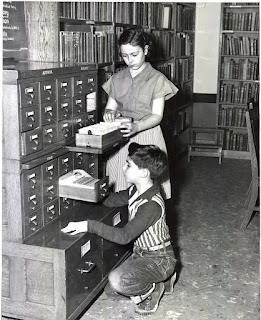

The public library was an important landmark in my childhood. It was in safe cycling distance, it was always warm, and it was the context for a ritualized, and mildly intimidating, interface with the adult world. I can clearly recall the heart-thumping point at which I would offer up my chosen books to be date stamped. I was in awe of the librarians who to my childish mind held the power to refuse me, point out my errors or even fine me. Invariably they were friendly, but they represented a powerful bureaucracy, an arm of local administration, that was strong and ought to be taken seriously. A successful visit to the library was rewarded by a subsequent rush of excitement - checking out was an experience like the end of a school day, clearing passport control or leaving a shop with just the toy you had in mind. But the pinch point at the library desk held all the power. It was the power that charged the anticipation as well as the release. The point where everything seemed to hang in the balance. With repeated visits and growing confidence I gradually became more and more interested in what happened at that point. The way in which a book's identifier - the book card, was deftly removed from a paper pouch glued to the endpapers, date stamped and then slipped with ease into my personal library card, snuggly held in alphabetical order in the custom-built wooden card index. As time went by I learnt more and more about the library system. Ways of classifying books, using card indexes and even requesting books that weren't in my particular branch. Home from my travels, in 1972, I was delighted to find that my mum had put in a request form for Herman Hesse's Magister Ludi - The Glass Bead Game. A postcard arrived at our home address on the 5th August that year with a hand franked two and half pence stamp. I know all this because the form dropped out of a book the other day. Evidently I used it as a bookmark and then forgot all about it. But the card is a fascinating record of a set of social and material literacy practices that were very much alive at the time, in libraries - and elsewhere too. The card - a reservation slip, a standard 6 x 3 inch postcard, serrated on one of its narrower edges at the point where it was detached from the counterfoil. One side with four pre-printed and indented rows of dots (for the address), the other with clearly labelled positions for the book's details - author, title, publisher and so on. The local branch name is ink-stamped on (oh, those ink stamps, so often the seals of officialdom!). All the specific details are captured in the distinctive flourish of my mother's handwriting. And one other feature that deserves a mention: two small holes and an impressed line in one corner, the scars of an earlier stapling, which tell something about a prior process of attachment. Such an efficient system, a marker of a sophisticated analogue literacy practice in its heyday, at a time when public libraries were generously funded. I could go on, but as I nostalgically turn this yellow-edged card in my hands I realise it's also charged with all those memories - returning home, my mother, reading Hesse, the smell of the public library, date stamps, stationery. It is slowly becoming other, its original and specific meaning is tucked into a card pocket in a much larger multidimensional catalogue. 

Saturday, December 04, 2021

Powerpoint fiction....anybody?


If you'd told me that the novel I was about to read contained over 60 pages of Powerpoint slides using some of the standard insert graphics you get, I think I'd change my mind and pick something else. Haven't we all had enough of Powerpoint? Surprisingly though, Jennifer Egan makes this device work so well in A Visit from the Goon Squad that I actually found myself really enjoying it. It's one of the many small triumphs in this Pulitzer Prize winner - a work that is packed full of insights and intrigues. I'd missed it when it won in 2011, but came to it late through the first chapter, Found Objects, which appeared as a short story in the New Yorker. It could be argued that the freestanding piece Found Objects has the edge. After all, it's tightly written and only hints at the broader landscape of events. In that sense it's more open for the reader. You can speculate all you like about Sasha, the focal character, about what is lost, found or stolen in her life and the fragmented dialogue with her therapist works very well in prompting this sort of perspective. I like the economy of the short story form for some of these reasons. I think George Saunders writes about making every word count in a short story - and that's why Found Objects works. Egan's stand alone tale raises all sorts of questions most of which are answered in the novel, so I suppose if you're the sort who hopes for some sort of closure in fiction you'd prefer A Visit from the Goon Squad; but both are very good. After several unsuccessful attempts to surf the wave of enthusiasm for Richard Powers, Egan has re-established my flagging confidence in American fiction.

Wednesday, March 17, 2021

A hall of mirrors

Narrative fiction has become an important site for exploring interiority and the complexities of self-reflection. The conscious separation of author from narrator always present in fiction opens possibilities that twentieth century writers have been keen to exploit. Think of the unbelievable narrator of 'The Good Soldier' or the pathological one that tells us all about 'Lolita'. Stefan Zweig is a master of this art of separation. In his short stories and novellas he taps into psychological revelations by creating a series of layers of narration. Sometimes in this hall of mirrors we wonder who is who. In 'Fantastic Night', for instance, the narrator opens a sealed packet that contains the story of a Baron who has just died. The Baron's tale is something of an epiphany, but the way in which it is told allows for a forensic exploration of the self. Initially, or so it seems, the Baron is as hesitant about his writing abilities as he is about himself - but, of course, this is all beautifully written by Zweig. Take this, for example, 'But once more I feel I must pause, for yet again, and with some alarm, I become aware of the double-edged ambiguity of a single word.' Who is it that is really experiencing this ambiguity we wonder? Is it our Narrator, the Baron, or the author himself? The reader is destabilised. And a couple of sentences later, this sense of separation is extended further 'I have just written "I" and said that I took a cab at noon on the 7th of June 1913. But the word itself is not really straightforward....'. Well, no, it certainly isn't - however you think about it! He goes on '...I am by no means still the "I" of that time, that 7th of June, although only four months have passed since that day, although I live in the apartment of that former "I" and write at his desk, with his pen, and with his own hand'. All this is elegantly crafted - but we can't help but think of Zweig himself, sitting at his desk in Vienna, or wherever he was in 1922, writing about pretending to be a man who has opened a package containing the story of someone who has experienced a dramatic shift in his sense of self. Our attention is drawn to what writing is and what writing can do, at that same time as asking us who we really are. In this sense I can see parallels with Foucault's extended commentary on Velazquez's 'Las Meninas'. Zweig's 'Fantastic Night' disrupts our certainties about the world as well as being an excellent storyteller.

Sunday, October 25, 2020

The spread : breadth and depth

Having a personal library could well become a thing of the past - and it's certainly a luxury, a rarefied form of consumerism and something that can function like an identity marker. I say this because I've often been more interested in the time or place that associates with a particular title than the content. And along with this there's the strange business of the scraps of paper that have been used as makeshift bookmarks before that book was abandoned and its restless reader moved on. I've found everything from train tickets to old computer punchcards and postcards lodged in mine. And amongst these ephemera I've also come across my own notes on paper and card. In one book I recently found half a card which said 'Wishing you a speedy recovery'. It wasn't clear who was being wished a speedy recovery and from what, but on the reverse side I'd scrawled the following: 'mechanistic theories of learning individual treatment that a comp. programme may not provide.' I think it's the kind of compressed study note that's often served me well. It doesn't really mean anything at all to me now, but at the time it was something that I was taking from what I read. I do the same sort of thing now, and I imagine it as a helpful way of distilling the essence of what I'm reading. Essence is probably the wrong word, because I'm actually referring to the meaning that I'm taking away, which is a more personal matter. And this meaning may be very different to the one intended by the author - for a start it's much narrower. But so much academic work depends on this process of narrowing down, the process of selecting from, and reducing another source. This is relatively easy in a small, focused area in which a body of literature can be read, analysed and synthesised but I think that there are always problems of scale. When the output is diverse and rapidly changing this is altogether harder to achieve. It would be a real challenge to do this across my personal library, for instance. Which brings me full circle, in fact, to the latest addition to my library which is Ben Lerner's acclaimed novel 'The Topeka School'. I enjoyed reading 'Leaving the Atocha Station' but this is altogether a more complex, more ambitious work of auto-fiction. The theme that concerns me here is what he calls 'the spread'. Briefly, in Lerner's world of high school debating 'the spread' is an important tactic. The spread, in the narrator's words, is 'to make more arguments, marshal more evidence than the other team can respond to within the allotted time'. As the novel unfolds the spread becomes an important trope and it stands in for the way in which we can feel paralysed by torrents of information, complex demands on our attention and so on. The popular idea of 'overwhelm' is something similar. And it is rather different from the personal library and the notes on scraps of paper which are attempts - and only attempts - to select, simplify and perhaps to go deeper into things. The spread is wide, overwhelming, destabilising and, in Lerner's world at least, it characterises the times we live in.

Saturday, July 25, 2020

Book pairing

Continuing on the theme of books that provoke surprising connections when read together I want to recommend pairing Marilyn Strathern's work on Relations with anything by Henry James (from Daisy Miller onwards). I've always been struck by the Jamesian use of the term 'vulgar' - in part because it resonates with a family joke, (which I won't go into) - but mostly because it's one of those words that surfaces repeatedly in The Awkward Age, The Golden Bowl, The Wings of the Dove and in some ways becomes James's signature theme. Relations, people and behaviours that are below the norms of an idea of respectability all fall into his category of the vulgar. For James the vulgar is a register of social distinction at a time in which it is being tested in New and Old World sociality as well as by shifting generational impulses and family tensions. Purdy's 1968 essay 'Henry James's use of vulgar' in the journal American Speech explores some of this and is particularly good at teasing out the different connotations of the word. Strathern, however, has an entirely different project in mind as she problematises the place of relations in and beyond anthroplogy. Charting the rise of relationality as a way of looking at and ordering the world she is optimistic about new ways of thinking about relations - a re-enchantment through language.

Friday, March 13, 2020

Two at a time

A long-established habit of mine is to have two books on the go at the same time. More often than not one of them will be fiction, but then that’s not always the case. Whatever the combination might be at any one time I often tend to find that the two different texts interact with one another in unpredictable ways. And what’s more their subject matter or themes can often connect with what I’m writing about in my professional life, and I suppose that’s down to the sense I’m actively making in the moment, as it were. Reason aside, it feels like a productive way of proceeding. But then there’s always room for exceptions, and the two I’ve just completed over the last few days have combined in altogether surprising ways and ways that don’t relate to anything I’m writing about at all. Michel Serres’ book Hominescence, which I commented on before, is a really engaging overview of those recent shifts that have led to a changed experience of what it means to be human, to be globally connected and to have become an all-powerful species on the planet. And then Europe: the first 100 million years, by palaeontologist Tim Flannery, traces the long and diverse history of fauna on our continent – including for example wisent, aurochs, elephants, big cats and a long succession of hominids and hybrids. Of course, Flannery works on a larger timescale in which periods of interdependence, species dominance and extinction move across the landscape of Europe like shadows cast by moving cloud. In some senses you could say that Hominescence expands on Flannery’s final chapters, and certainly some of Serres’ ethical considerations gain traction when we consider the variety of rewilding projects and ecological conundrums that are described in the Europe book. But what unites the two authors is actually a sense of optimism. Flannery is stronger on detail when it comes to climate change but he still believes that humans can turn things around. And although there’s a wistful tone to Serres’ recollections of pre-war France there’s still a strong commitment to the future possibilities of global connection. And now that very idea of inter-connected humanity comes to the fore when considering responses to the Coronavirus pandemic. It could well be a test case for hominescence. Can we work together across national and political boundaries to do what is best? Only time will tell. And in the meantime it’s a case of what to read next and that will become even more significant to me if we decide to increase social distance. What better way to spend the time; two at a time.