Friday, October 31, 2008

Template society


Rejoice

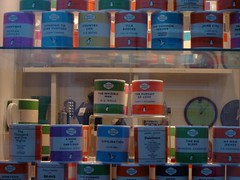
We inhabit a culture in which choosing from a pallette of pre-written templates is common place. I'm just about to start some work on profile pages - which are apparently a template design which was originally borrowed from dating sites. The profile page is a sort of writing frame in which personalisation is constituted in terms of low-level choice with sufficient opportunites to perform a sort of cut-down identity. Gunther Kress extends the idea of templating to the wider social environment, using supermarkets as an example. Food for thought....

Wednesday, October 29, 2008

Remixes


Hot Bikes Madeira Drive Brighton

The DJ metaphor, and its associated ideas of sampling and remix have now been adopted in a number of contexts to explain how new cultural material is generated: in young children’s writing (Dyson, 2003); in the production of AMV (Ito, 2006); and in the writing of fanfiction (Jenkins, 2006). At root the basic idea is nothing new. Mahler’s use of Frère Jaques in his 1st Symphony, Luis Buñuel’s Last Supper sequence in Viridiana and the work of the brothers Grimm all suggest themselves as examples of the same phenomenon. How do we create something new? Use the materials to hand.

Monday, October 27, 2008

Participation


Spent force

Jean Lave's seminal paper on socially-situated learning (in Mind, Culture and Activity) not only explains the limitations of psychological accounts of individualised learning but also points out the inadequacy of traditional accounts of apprenticeship. The emphasis on learning as changing identities is clearly made, but my favourite quote is in the conclusion - '...learning, wherever it occurs, is an aspect of changing participation in changing practices'. Its a tightly expressed re-formulation of the whole paper. The trouble is I think you have to read the paper in order to fathom its significance! Be that as it may, its helpful in unravelling what happens when individuals collaborate in learning spaces.

Friday, October 24, 2008

Possibilities


Preparation

I was in Bristol on Monday at this seminar, and although I enjoyed it, I was struck by how little new stuff was being discussed. On the train down I reviewed a really interesting piece on chat, and this tied in with what I’ve been reading on IM as research tool (pdf here). It seems to me that there’s relatively little going in terms of research into interaction in virtual worlds, so when a friend drew my attention to The Journal of Virtual Worlds Research I began to imagine the possibilities. Well, prepare to be disappointed. There is nothing that really focuses on interaction but there are pieces by Rheingold, Benedikt and Schroeder. Worth watching, then.

Wednesday, October 22, 2008

Scratching the surface


In stone on Howard Road

I probably made few friends today by going off on one about the perils of thinking of software apps as tools for learning. The trouble is I have started to become suspicious of our rather glib use of the tool metaphor in education. To be sure the idea of tool-mediated learning has an impeccable pedigree in the work of Vygotsky, those who influenced him, worked with him and those who followed him. But if we shift the ground to think of learning as participation through the endeavour of shared communication, I think interactive apps are then better conceived of as spaces for learning. In an everyday sense, a tool is usually thought of as an instrument - an instrument with a mechanical function by which a human agent moves, shapes or marks parts of the physical environment. So perhaps the idea of the tool is entirely appropriate to a theory of learning as construction, and also, incidentally, in an educational discourse in which success is thought to be measured by impact. But learning through participation and interaction moves the focus to the inter-relationship between individuals, the spaces in which this occurs, and the texts through which they negotiate meanings.

Sunday, October 19, 2008

Learning space


Sun, rain, water

It seems to me to be quite daring to explain to a group of hard-boiled teachers that the course they have just joined is a loosely-bounded learning space! Just tell us what we have to do to pass and spare the academic piffle, is how imagine their inner thoughts. But because I want to maximise the possibility of participation and ownership, it seems important to be purposefully vague - to create a negotiable online, offline communicative space for reflection. Richard, as always, acts as a sort of agent provacateur, keeping my own learning experience fresh and pleasantly frustrating. So that's how it feels starting off a new Masters group. Yesterday we played with a sandbox wiki on the theme of music. What interested me was the way in which this exercise enabled the particpants to draw on their varied cultural resources. So, for example, the students embedded YouTube clips of the Algerian Tonbak and the Basque Txalaparta. Richard, for his part, was in the late 6Os with the Bonzo Dogs. Plenty of fun and plenty of incidental learning then - and a certain amount of authentic participation in a loosely- bounded learning space!

Friday, October 17, 2008

Literacy coach


reading bus

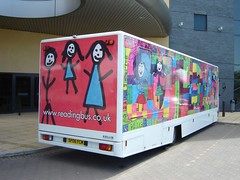
I listened to Cathleen Kral talking about literacy coaching in Boston Public Schools today. The Boston literacy coaching scheme has attracted a lot of attention and there are some sound principles underpinning the approach, but somehow the whole coaching metaphor seems to me to be a bit problematic. Then again I suppose 'lead literacy teacher' or 'literacy consulant' can be difficult, too. I'd like to hear more about how literacy is actually defined in this scheme, because the examples of key words and think alouds seem very oriented to instructional print-literacy routines. Here literacy is the handmaid of content knowledge. A broader view of curriculum and a wider concept of literacy is needed if we are to better serve children and young people in my opinion. Here's the NCTE on the Boston programme and more background (PDF).

Tuesday, October 14, 2008

Mediascape


Birthday Zogg

There’s a lot of hype around the new Igor animation film, but nothing more virtual than the game (make your own monster here, and mail to a friend). The full platform game offers quite a bit more, though. But that’s entertainment, whereas the Forbidden City is genuine edutainment. I’ve yet to have a full look round, but it looks smart. OK you can’t stop off for a Tsing Tao, but at least you’ll get a feel for the place, and you get to dress up too!

Saturday, October 11, 2008

Honey Monster topped!


Eco-friendly

Yes, the Sugar Puff Honey Monster was publically executed by the Mighty Boosh live on stage at the City Hall, Sheffield on Thursday! Sitting astride a giant hairdryer, Noel Fielding decapitated the Monster. Following threats by the comedy duo to take legal action against Sugar Puffs for stealing their vocal style they dealt a hammer blow to plagiarism, using their most deadly weapon... stagecraft! Will the Honey Monster strike back? I notice that the YouTube video of the public execution has been removed, so evidently someone is getting twitchy.

Wednesday, October 08, 2008

Communities of practice


mushroom maker

A number of us working to understand how social participation in Web 2.0 spaces actually works have tried to apply Wenger's concept of communities of practice. Sometimes this approach has been contrasted with Gee's notion of affinity spaces. Neither quite work well enough. So I've been moving away from both ideas, preferring instead the idea of participation and networking around social objects. But I was interested to note that Wenger has been working on a project (and a book of that project) which takes community as the starting point and then, rather like Wellman, begins to explore how digital communication extends or expands that sense of community. You can get an overview in the Digital Habitats project blog, and following the inks allows you to download some of the material for a closer reading.

Sunday, October 05, 2008

User-generated meaning


Fans of urban dictionary, which is based on user-generated content, may be surprised (or even horrified) that the owners have decided to cash in by producing a print version. As the online front page says, Urban Dictionary is the slang dictionary YOU WROTE. But the small print tells you that: When you post Content on the Website, you agree to grant the Company an irrevocable, perpetual, worldwide, royalty-free, fully sublicenseable, non-exclusive license to copy, distribute, sell, publicly display, publicly perform and make derivative works etc etc. All this doesn’t really bother me, but it is just another example of how, in our enthusiasm to participate, it is so easy to overlook who owns our content. And on that note, I wonder if Blogger owns the words in this post?

Wednesday, October 01, 2008

Penguin club


book mugs

Lauren Fingeret's paper in the latest edition of The Reading Teacher is important because it shows how the use of film, in this case the March of the Penguins, can be integrated into the curriculum. That's not to say that I believe that learning facts about penguins is in itself important, or that I agree with the unqualified satements about high-quality documentary. But it rocks just because it is a very simple but persuasive empirical account of how a popular film can, with a sensitive and appropriate pedagogy, be completely integrated into early years practice.

Tuesday, September 30, 2008

Conspicuous consumption


Ruth and Hannah

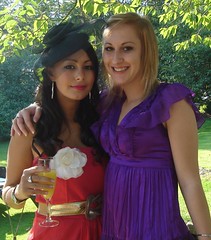
Allconsuming is a useful add-on to my blog, acting as a way of sharing and displaying what I'm reading, watching and listening to. Unlike some members of that social network I choose not to share my taste in food, drink and so on. So perhaps there's a subtle deceit, or at least a conscious decision to display a certain sort of taste to mark a certain sort of identity. Consumption is, though, a much more complex affair than some of those in media studies lead us to believe. Appadurai is very good at examining the choreography and chronologies of consumption using, I think, Christmas as an example. So I was interested in how all this played out at a family wedding this weekend. But I was also struck by the ways in which consumption and production intersect, particularly in these social rituals. It's almost as if performance is dependent upon the careful interweaving of consumption and consumption, whether we're considering food and drink, location, clothing or the vow-giving ceremony itself.

Monday, September 29, 2008

Google me


Black

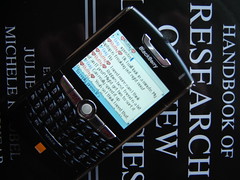
I love my Blackberry and have, so far, successfully resisted the i-phone. But it looks as if the handheld is about to really take off with the launch of the Google Android operating system. What’s hot is that people will be writing programs for this software system and they won’t be locked down by Apple’s corporate interest. This is explained here. Textually has the headlines as well as a pic of the HTC Dream, the first commercially available piece of kit that runs Android. Admittedly it’s not strong on design; but makes up for this with promise. Available in the UK next year. Well let’s see. Meanwhile read Jeff Jarvis in today’s Guardian going through a list of myths about new media like a knife through butter.

Thursday, September 25, 2008

Goodies and gadgets


ready or not

Well that's a damn fine description of technology. I came across it marking a student dissertation that quotes Gipson, who goes on about the: "absence of clear definition of what is going to be done with the "goodies and gadgets". As a result, too often the technology is never really utilised to support and enhance teaching and learning. At the heart of this is the fact that technology is simply grafted on to the existing program and against the existing school design and infrastructure. Consequently, technology often either exists as a tangential activity occurring in discrete computer labs, or as an ancillary activity in some classes." I think he's got it just about right (see it all here). What are you going to use it for? Will it be worthwhile? This is where I want to go next with virtual worlds research. Meanwhile, there's still the day job to do!

Tuesday, September 23, 2008

Second


casual
n.

The second edition of Desirable Literacies is out! I know because Jackie had a copy on her desk. I have a chapter there on early reading, and it was really interesting doing a re-write. Nearly 10 years have elapsed since I originally wrote the chapter and whilst I reckon my writing is about the same, my ideas have gone through some sort of transformation. It would be really good to do a reflective commentary, but it's unlikely I'll find the time. But here's the headlines. Then I was immersed in the world of picture books as if they were a solution to every problem. Then I saw print literacy as the fundamental issue (I was a print literacy capitalist). Then I saw home and school as two completely separate domains and despite the occasional liberal get-out phrases, I thought that we should colonise homes with schooled literacy pedagogies. Now picture books seem quaint, print literacy one of many, and home, school and community as overlapping worlds. What was a one-way street is now a busy intersection; what was single and reasonably straightforward is now multiple, contested and devilishly complex. And so without further ado, here's a link to the publisher's blurb.

Saturday, September 20, 2008

More or less the same


Stunning

I’ve been participating in this ESRC Seminar Series, which is generating useful session reports. This is the first one. I like Neil Selwyn’s idea of a ‘soft determinist’ view of technology. For example he suggests that ‘This soft determinist view sees technology impacting on social situations which are, to a degree, malleable and controllable. Rather than the internet improving learning, it can be said that the internet can help improve learning, acknowledging the possible existence of other contextual factors, whilst retaining the notion of technological effects.’ (2008 p.20). So that’s a bit more of a subtle analysis than mine, here, but more or less the same, really.

Thursday, September 18, 2008

Fashion writing


text wear

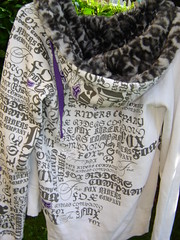
We’ve got quite used to seeing writing on clothing. We have labels on the outside, slogans, names of bands and sports stars, and (perhaps more recently), random words as decoration. Ruth’s jacket, in the picture, is a dense collage of different fonts. I noticed here how gothic fonts are enjoying a bit of a renaissance. For many they have nazi associations, although as this suggests, they have a richer history than that: Blackletter particularly. That sort of style, formerly associated with Goths and heavy metal styles now seems to have been appropriated by rappers. This piece gives a commentary on these typographical matters and the changing fortunes of gothic scripts.

Wednesday, September 17, 2008

ICT and


red shoes

I keep on reading things that work on the assumption that ICT or the internet is a unitary, autonomous phenomenon. Now I’ve always found Markham’s threefold categorisation really useful . She looks at how you can see the internet as a tool, the internet as a place or as a way of being and this framework is a good analytical tool for looking at policy discourse or even interview data. But it’s framed in the singular and that’s not so helpful. I think matters are made worse when writers attribute agency or effects to technology. Statements like: ICT is causing a revolution in how we think about learning or the internet is transforming social relationships are particularly suspect. After all it is human subjects who construct these technologies and human subjects who choose to, and choose how to make meanings with them.

Sunday, September 14, 2008

Evidence


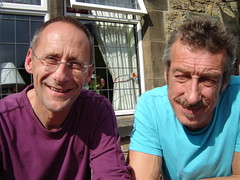
Friends

Reading Living with the Djins I was reminded of what the Muslim kids I used to teach told me about the good angel and the bad angel. It’s a perfect example of how religious and folk beliefs carry powerful messages about particular kinds of literacy. The good angel, who sits on your right shoulder, writes down all your good deeds, whilst the angel on your left shoulder records evil deeds. This is the evidence that is used on the day of judgement. The book(s) of your life become the enduring and authoritative record in the incontrovertible medium of literacy.