
Showing posts with label new literacy. Show all posts
Showing posts with label new literacy. Show all posts
Friday, June 25, 2021
Works in progress


Saturday, February 22, 2020
Undoing the digital
 Reading through the proofs of our new book Undoing the Digital is an interesting experience that throws up a whole range of reactions and feelings. These are probably familiar to many academic colleagues - perhaps to writers in general - but I've never come across much on the topic. What a mixed bag my reactions are, though! There's a familiar sense of achievement - Cathy and I delivered our manuscript, on time, and there's the proof in the requisite number of words, little black congregations of symbols spread fairly evenly across a respectable number of white pages. That's a good feeling - perhaps not quite as good as the feeling of holding the printed thing - what we call, rather anachronistically, the book itself, but nearly as good. And then there's the reading of it. Quite good at first, well at least not bad, and then the bits that don't quite follow on - or aren't fully formed or sufficiently well expressed, the bits where you would like to have another go, but sadly it's too late for that. Then there's the bits that are just about OK, not strikingly original of course, but just about all right (oh, and of course, one or two embarrassing bits - but heigh-ho best put that in brackets!). And in one or two parts there is the sense that we're saying something new as opposed to simply rephrasing or rehearsing our understanding of other people's work. After all it's so hard, as I think Deleuze once said, to come up with anything that's truly original. But the good news is that this volume brings together the ideas that Cathy and I have been working with over the last five years. And that's a set of ideas or conceptual tools that are deployed in papers we've published in that period of time, smuggled in somewhat awkwardly under the flag of 'sociomaterialism' - the best we can do to give a general sense of where we're coming from. I suppose we've always felt that the journal article format for all its strengths doesn't really offer the opportunity to explore things in full detail. We hope that the book does that, we hope readers enjoy it, and we hope it provides some background context to what's already 'out there'. It's currently carrying an April publication date, so it should materialise in May and it can be pre-ordered!
Saturday, June 23, 2018
New media in the classroom

Sunday, March 03, 2013
Signs of movement

Tuesday, September 04, 2012
On books

In writing about popular literacies and digital culture there is often a need to underline the ways in which the dominant discourses and practices of print literacy are privileged by schools and wider society. Quite specific adult-child interactions with picture story books have been normalised in the literature of early literacy, and because of this some educators (myself included) have emphasised the importance of other ways of meaning-making and other kinds of literacy. By adopting broader and newer definitions of literacy it may sometimes seem that we are against traditional forms - but this is actually not the case. With a new project on the use of interactive storybooks on iPads, some of these misapprehensions may clear. Here we'll be looking at young children doing book-sharing with adults - differently mediated of course - but arguably the same thing. Last year I worked with colleagues evaluating a Booktrust project based on book gifting for 11 year olds. The evaluation of this, the Booked Up project, is here. And currently I'm working with a team who are looking at Bookstart (aimed a younger children). So these conjunctions between new, traditional, narrow and broad definitions of literacy are very much on my mind. Although the study of children's literature sometimes seems to be a bit of a rarefied discipline, it continues to make an important contribution. Perhaps there is a need for more discussion between some of the factionalised camps of literacy educators. Reading Michael Rosen on Sunday, I was struck by how his idea that what we call children's literature '... are interventions in society's debate about bringing up children' would be an excellent starting point. What other literacies make such interventions? Critical literacies, digital literacies, multiliteracies....
Saturday, August 04, 2012
Return of the Trashmaster

I'm putting the final touches to my paper on the The Trashmaster machinima, and its been fun returning to this. There's a delicate balancing act between writing about The Trashmaster and referring to GTA IV. I had to underline the moral panic surrounding the latter and in researching this found the following - in a recent case it was suggested that a 19 year old convicted of a number of attacks on women ‘may have been influenced by the virtual reality game’. The Sun newspaper reports how ‘A copy of Grand Theft Auto was found at his home by police’. Just take a look at the report (spare a few minutes to stare at The Sun) and you'll see how the report is interspersed with a number of images from GTA game series as if to highlight the media effects, rather than the actual suffering and the complexities involved.
Sunday, July 29, 2012
Digital competence

In some ways last week's Digital Literacies meeting at JISC confirmed my suspicion, that our current terminology is reaching the end of its shelf-life. Nobody seems sure whether to yield to Paul Gilster, who probably has the longest standing definition, whether to go for a new definition (which one?), or whether to find a new term altogether. Predictably, I thought the literacy folk held the trump card in returning to fundamental questions about meaning and representation. Anusca Ferrari, with the European Commission perspective, explained how digital competence has become the key concept for them - partly because digital literacy has become tied up with issues of inclusion and exclusion. So once again literacy associates with a deficit! Reading some of the documentation (the JRC work and the latest JISC leaflet), I'm struck by the ways in which digital literacy/competence is constructed as: a) a constituent part of employability - enhance your CV, get a job, contribute to the economic future and b) an ingredient of new knowledge practices (much vaguer in definition but suggesting that the way we access, use, create and disseminate knowledge has changed). Ideas that are found in other iterations of digital literacy, such as creativity, participation, social change and citizenship are not so much in evidence here. What happened to the fun? Of course, that has to be excluded....
Thursday, December 08, 2011
Unlearning literacies

Wednesday, November 30, 2011
Mobile literacy

I've been reading David Parry's call for what he calls ‘mobile literacy’ (here). He identifies three areas of focus. These are understanding information access, understanding hyperconnectivity and understanding the new sense of space. The first is about encouraging students to use mobile devices to search for (and presumably evaluate) information, and to appreciate the differences and similarities between this and desktop searches. Hyperconnectivity is about using and understanding how social media can connect learners with those outside the immediate classroom context in advantageous ways (selective use of Twitter is offered as an example). And finally, the new sense of space is about developing an appreciation of how mobiles can be used to mediate one’s experience of the material/physical world through so-called augmented reality applications and the whole gamut of data-enriched geo-location.
Saturday, July 30, 2011
Baroque literacies?

The picture is supposed to evoke the idea of ponds within ponds (Leibniz) and the following are some of the ideas I'm working on, beginning with the idea that the human subject is embodied and all activity is situated (there is little choice in this, after all, at least from a phenomenological poit of view). And then, as a result there may be little gain in ‘looking up’ to more abstract theory, but a compelling richness in ‘looking down’ into the complexities and interconnections of embodiment and situated activity itself. Rather than moving in the direction of coherence and convergence this suggests a view of literacies informed by the notion of ‘baroque complexity’ (Kwa, 2002) - one that may provide a more nuanced account of how digital texts enter the communication economy of contemporary literacy practices. Drawing generously on the work of Deleuze (1993), Kwa outlines three characteristics of the baroque: 'First the historic baroque insists on a strong phenomenological realness, a 'sensuous materiality'. Second, this materiality is not confined to, or locked within a simple individual but flows out in many directions, blurring the distinction between individual and environment. And third, there is also the baroque inventiveness, the ability to produce lots of novel combinations out of a rather limited set of elements, for instance as in baroque music.’ (Kwa, 2002:26). So Kwa’s version of the baroque encourages us to ‘look down’ at the detail rather than to ‘look up’ for some broader picture (Law, 2002). In practice that may well mean seeing the ways in which the broader patterning of practices such as the global flows of information, shifting power relations and so on are inscribed or become manifest in specific situations. To be continued....
Thursday, July 21, 2011
Of maps and brains

Sometimes when you're on a journey you glance at the map to see exactly where you are, and at that point become suddenly aware of how far you've travelled. Sometimes, too, you can see the exact point at which a particular choice - a fork in the road, for example - took you in a particular direction and into a distinctive kind of landscape. I had the impulse to check the map at this year's UKLA conference in Chester, when I was listening to Usha Goswami. Her explanations of neuropsychology and what it tells us about early reading were lucidly presented, but they seem to be located in another territory. It is a territory in which 'the brain' is a central feature and in which stories of how the brain works and how it develops are told. Checking my metaphorical map, I find I'm accustomed to a completely different set of landmarks, in a very different country. It's a far more densely populated place - one in which meanings are negotiated and exchanged, in which stuff is used in all sorts of ways, and one in which irregular and complex shapes form and re-form as practices evolve. I can't find the fork in the path, though. But I suppose my interest in language variation, in the stories we write and tell and in the impact of the digital on these things all presuppose a sociocultural orientation. I am in different territory and I'm glad I am, but I'm also pleased to know that some people are interested in brains. The map would be inadequate without their work.
Thursday, June 02, 2011
Post-modern literacies

I'm reading a pre-publication version of Colin and Michele's New Literacies (3E) at the moment. The opening sections provide a really useful map to 'where we are' and 'how we got there' in literacy studies. They've just about got it right with a definition of literacies as 'socially recognized ways in which people generate, communicate and negotiate meanings, as members of Discourses through the medium of encoded texts'. I know it doesn't exactly trip off the tongue and I suppose that nearly every phrase needs translating (which is, as you'd expect, what haoppens in the book). I still have a problem with the social spread of new literacies and wonder to what extent the exciting practices which appear to be the popular everyday practices of children and young people are actually niche interests. On a more abstract level I enjoyed reading about Andreas Reckwitz's work on practice theories and made a note to follow this up. The football analogy reminded me of Bourdieu which sent me scurrying back to The Logic of Practice. Bourdieu, at least in the translations that I read, can be hard going, but one of his clearest pieces (Chapter 4 ibid) actually uses the football metaphor to good effect. But here he is on 'practice', the principle of which is found 'in the relationship between external constraints which leave a very variable margin for choice, and dispositions which are the product of economic and social processes that are more or less completely reducible to these constraints, as defined at a particular moment.' (p.50). That makes me think twice about agency in cultural (re)production and is something to pit against remix and participatory culture.
Saturday, April 30, 2011
Advantageous practice

In an article co-written with my colleague Cathy Burnett we've been problematising the notion of critical literacy - particularly in the context of social media. We've drawn on Greenhow and Robelia's notion of 'advantageous practice' which raises all sorts of interesting issues. One thing we're keen to avoid is the idea of teachers telling students what they think is best - a pitfall, as we see it, of some critical approaches. They end up by being uncritical to the extent that they try to force particular ways of reading texts, and particular ways of seeing the world. So advantageous practice is perhaps best seen as a dialectical process, based in an enquiry into how one is positioned in and positioned by social context, with a view to seeking ways in which these positions can be influenced in a positive and worthwhile way - one that is likely to benefit the communities and social networks of affiliation. Advantageous practices are then likely to be situated and often localised in character, although they may well relate to larger national and transnational concerns.
Monday, April 18, 2011
Looking back
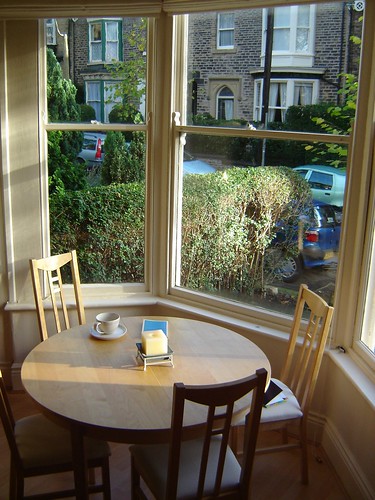 window, a photo by on-the-run on Flickr.
September 1994 should be regarded as a landmark in the recent history of literacy studies. Or maybe it should be spring 1996. Either will do, because the autumn of 1994 was when the New London Group first met, and 1996 the date when their jointly authored paper ‘A Pedagogy of Multiliteracies’ was first published in the Harvard Education Review. To explain: New London is the name of the place in the US where the group met, where Courtney Cazden, Bill Cope, Norman Fairclough, Jim Gee and Mary Kalantzis, joined forces with Gunther Kress, Allan Luke, Carmen Luke, Sarah Michaels, Martin Nakata and Joseph Lo Bianco to discuss how literacy pedagogy might adapt to suit the changing context of the late twentieth century. Despite the impressive range of expertise it was an ambitious undertaking, but one that was nothing if not generative and, with the benefit of hindsight, highly influential. By the time the book Multiliteracies was published, the project had gathered momentum, had attracted new voices and was beginning to influence debate amongst literacy educators in much of the English-speaking world, and elsewhere too. At this year's AERA conference the group re-formed -well not all of them - but it was an impressive line-up. There was a fair dose of nostalgia, some great photos of New London in which they all (surprise, surprise) looked much younger and plenty of evidence that they all have more to contribute. Maybe the multiliteracies banner is a little jaded, but it's influence is still felt.
Sunday, April 17, 2011
Migrations
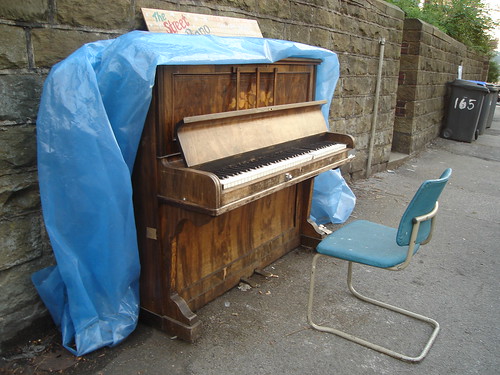
Constance Steinkuehler talks about her work as migratory ethnography, and this description conjures two possible descriptions of research in digital worlds. One is practice- (or text-) focused and would turn the lens on how particular literacies and textual formations migrate across sites and between communities, whereas a second interpretation would look at how people migrate across sites over a period of time. They both have some relevance to what I've been thinking about Flickr lately - sparked by the fact that my subscription is up for renewal. Basically I started thinking about whether my subscription is justified by my usage and my level of participation in the Flickr community. Funnily enough just after my renewal reminder when I was wondering whether Flickr had had its day, I got Flickr mail from someone who was interested in the Street Piano photographs - wanted to initiate something similar at an arts festival and was asking for permission to use my pictures. This fascinated me - I'd already written about how the Street Piano became a 'slippery narrative' weaving its way between the real and the digital - and here it was again entering a new phase of migration! And this just at the point when I was considering leaving Flickr. I've now reconsidered; but it does make me think how Web 2.0 does produce rather transitory audiences/producers. Bloggers come and go, I deserted Last.FM in favour of Blip.FM and I find I've lost interest in Twitter. It would be interesting to trace people's migrations, to understand why they move and which practices they take with them into new environments. At least people continue to tickle the ivories!
Saturday, April 02, 2011
Crowdsourced music
Imogen Heap's latest composition has a creative take on music in the digital age. Making extensive use of social media she has encouraged audience involvement in her latest work 'Lifeline' by incorporating the sounds and words sent to her. Now you could be picky and say that this is just a sophisticated marketing ploy, an easy way of gathering material and highly dependent on free contribution rather than open participation - but that would be unfair. The whole process springs from a different way of looking at the world, and one that reminds me of Colin and Michele's idea of mindset 2.0. In essence there's a distinctively new relationship between producer and consumer here, and a radically different take on where ideas come from and who owns them. Crowdsourcing is an interesting way of describing this because it leads us to ask for more precision in determining who the crowd is in the first place. The crowd here isn't 'the public' but it is 'a public'. It's not everyone, but it could be anyone. Similarly the crowd is not the audience but it may be part of the audience. No, the crowd is composed of a fluid coming and going of people who are part of a transient and distributed network - inhabitants of what Gee calls an 'affinity space'. There are clearly some resonances with other emerging social and political groupings, but I suppose the distinctiveness is around leadership and authorship (or ownership). Heap's achievement is, after all, still hers albeit with a little help from her friends, but it's framed by new ways of thinking about things, new practices and shifting networks of connection. Sell our sounds back to us, Imogen, or set them free: that's the question.
Thursday, March 31, 2011
Augmented reality
The way Layar can deliver additional location-based information is a real bonus if you're in the right place with the right kind of phone, but all the same some of the more extravagant claims made about augmented reality warrant careful examination. Surely an augmentation would involve a heightened sense of reality whereas most AR apps are just clever annotations. In a way reality is diminished if you stare at it through the window of your phone. That's not to claim its of no use; it's just a matter of definition. Of a different order, of course, is the headset or the reality goggles. The BMW video shows AR goggles in operation. Surely, the ultimate toy for boys! I watched this with interest knowing full well that if I was working on an engine bolts would fly off, tools would malfunction, things would go wrong that no amount of augmentation could fix.
Tuesday, January 18, 2011
The cult of the book
Defacing books still fills some people with horror. It's amazing how often people get quite hysterical about marking one's place by turning the corner of a page or scribbling in marginalia. One of the key articles of faith in the cult of the book is to create rituals to secure its power. Carefully place it on a polished shelf and make sure it keeps good company; wash your hands before beginning your reading; hold it carefully so you don't damage its spine etc etc. Many of these rituals humanise and sanctify the book. But as we know, books have a chequered history. Marginalia go back a long way and the pointing finger doodle or manicule has attracted plenty of academic interest. More recently creative types have been glueing, sawing and cutting books up to make interesting works of art (there are some examples here). In comparison Jonathan Safran Froer's 'Tree of Codes' consists of kinder cuts. If, however, you prefer wordplay that is even gentler you need stop-motion wordplay with dingbat.
Thursday, November 25, 2010
Easy reader

Last night I bought 'You are not a Gadget'. It was one of the simplest bits of shopping I've ever done. First of all I was just curious to see if they had it in the Kindle bookstore. Less than 20 seconds later I saw that they had, and by exerting some gentle pressure with my thumb on the choose button my bank account was lighter by just over £10:00 and I was reading Jaron Lanier's book, still not quite sure whether I really wanted to or not. You could say I was curious. It has a lite style but a strong message, and one that fits the idea of technological determinism like a kid glove. But it made me think about how easily Amazon had relieved me of £10.00. Now I like the Kindle. I like the easy reading that it enables, and I don't have a problem with easy shopping. But the thing is that these things are seemlessly bundled together and I suppose that's where markets and meaning meet. And when all is said and done, I am what I consume.
Friday, November 05, 2010
Do I have some principles?

Well yes I do. But these are principles that guide my interest in literacy. I feel a list coming on. Here goes: 1. What children and young people produce/consume or read/write is an important starting point for those who work with, care for and educate them. 2. An important function of education has always been (and continues to be) concerned with encouraging learners to read and write (produce/consume) the 'right sort' of things in the 'right sort' of ways. 3. Whether as moral correction, or for intellectual development or to prepare them as future (present?) citizens literacies matter. 4. Children and young people engage in a whole range of literacy practices that are not always recognised by adults and by the education system and often meet with their disapproval. 5. The boundary between informal/formal and vernacular/official literacies is becoming increasingly blurred, particularly as we recognise its permeability and the importance of building upon what learners already know and do. 6. Meaning-making in digital environments is at the frontier of these new configurations. Mmm...are they principles?
Subscribe to:
Posts (Atom)