
Showing posts with label music. Show all posts
Showing posts with label music. Show all posts
Sunday, October 28, 2012
How open is open?


Sunday, March 18, 2012
Pleasure or inclusion?
Frank Cottrell Boyce has a good piece in today's Observer in which he is critical of our national obsession with testing and educational competitiveness. His argument is a valorisation of the imagination and of the pleasures of literature. But although he aligns himself with Plan B (above) - the articulate voice of the underclass, Boyce has a mainstream message. Literature is so easily absorbed into education and into the curriculum, continually generating and regenerating cultural capital. But what of Plan B, this is a harder message - to pun on his name, we don't have one, do we?
Wednesday, December 28, 2011
What's cooking?
I'm not sure where the media obsession with food came from - it seems to fill the newspapers and swamp the TV schedules. Perhaps I shouldn't be that surprised. Food is, after all, the original consumer product. We consume it, we digest it....and we want more. That's as close as you'll get to a seasonal message on this blog! But I do think this particular mash-up is excellent. That's good entertainment value, and I consumed that!
Wednesday, May 11, 2011
Guitar hero?

Well, maybe not. But this is me in full swing with my new midi controller. What you can't see is the way I'm hooked into Garageband, playing digital instruments and samples (my favourite percussion is taken from an audio-file of the porridge-spoon rocking in the bowl!). To the extent that I'm researching my own learning I'm finding that my own, rather limited, skill with the old technology of strings and frets has an interesting iterative relationship with my midi play. Because the midi has different affordances, I can do a whole range of new things - and I'm still discovering them. I also have to learn new skills of preparation (eg: clipping samples, importing them, stitching together a rhythm track) as well as new skills of performance. Yet at the same time all this brings a new understanding of what I can and can't do in a more traditional environment. It's almost as if the learning and reflection happens because of this back and forth movement. This all gets framed up in my favourite arena, which is live improvisation with my partner-in-crime!
Friday, April 15, 2011
Identity blues
Dorothy Holland and William Lachicotte have a great chapter in the 2007 Cambridge Companion to Vygotsky. They identify two tracks in identity theory, one is organised around the idea of a coherent sense of self and can be traced back to Erikson - with obvious connections to notions of psychological well-being. The other runs back to Mead, the formations that take place through social interaction and symbolic communication and suggests the possibility of plural identities. This allows the crafting of identities that may be a sort of bricolage of different social roles, a more creative way of inhabiting the various postions and roles afforded us by society. I don't know how far that confers us with agency, but it makes me quite happy to be a 50-something academic who attends conferences and loves live music. The video of Little Freddie King was taken at the French Quarter Festival in New Orleans on my Blackberry as I went (?) from one meeting to the next.
Saturday, April 02, 2011
Crowdsourced music
Imogen Heap's latest composition has a creative take on music in the digital age. Making extensive use of social media she has encouraged audience involvement in her latest work 'Lifeline' by incorporating the sounds and words sent to her. Now you could be picky and say that this is just a sophisticated marketing ploy, an easy way of gathering material and highly dependent on free contribution rather than open participation - but that would be unfair. The whole process springs from a different way of looking at the world, and one that reminds me of Colin and Michele's idea of mindset 2.0. In essence there's a distinctively new relationship between producer and consumer here, and a radically different take on where ideas come from and who owns them. Crowdsourcing is an interesting way of describing this because it leads us to ask for more precision in determining who the crowd is in the first place. The crowd here isn't 'the public' but it is 'a public'. It's not everyone, but it could be anyone. Similarly the crowd is not the audience but it may be part of the audience. No, the crowd is composed of a fluid coming and going of people who are part of a transient and distributed network - inhabitants of what Gee calls an 'affinity space'. There are clearly some resonances with other emerging social and political groupings, but I suppose the distinctiveness is around leadership and authorship (or ownership). Heap's achievement is, after all, still hers albeit with a little help from her friends, but it's framed by new ways of thinking about things, new practices and shifting networks of connection. Sell our sounds back to us, Imogen, or set them free: that's the question.
Thursday, March 03, 2011
Images
I love Michael Constanza’s video of Hope Sandoval on this YouTube clip. The dreamy quality goes so well with the track. It’s interesting how readily music and image combine in new media. I'd love to write a bit more about music; I had so much fun doing that chapter in the Web 2.0 book. And image has been very much on my mind of late. So for my latest project I’m looking for a reliable way of streaming live video. I’ve been experimenting with U-Stream which does the job quite well. I also learnt today about Screencast-o-matic which seems to do everything I used to do with Jing, but not what I want to do on the project, but I’m looking into that one, too.
Saturday, October 23, 2010
DJs go digital
töken experience from yöyen munchausen on Vimeo.
Well of course they went digital years ago - at least as soon as CD-Js took over from turntables. I first saw this when Shuiab Meacham and his kids rocked the Crucible in Sheffield. Apart from obligatory glances in the rearwiew mirror (making CDs sound like scratched and pitted vinyl) and nostalgia in the form of the decks-are-best crew, DJs have moved on with the technology using what the boffins come up with and the sound companies can sell. DJEmmaLou told me about the touchscreen interface in the video which takes DJ-ing into a new space. There is some talk of gestural music interfaces, but at the moment all we have is haptics (here). In my imagination the truly gestural DJ will also be a dancer whose movement in space triggers the sound we hear. Now that would be a hard act to follow!Monday, April 12, 2010
Lounge rocks
In a short break from the more serious blog reflections, here's YouTube working its magic again - lounge music from the archive, complete with some helpful subtitling. It makes it so accessible across all imaginable cultural divides. Well, most anyway!
Friday, November 27, 2009
Making it #3 - smartmob meme
It quite intrigues me that the whole concept of the smartmob, popularised by Howard Rheingold, has been adopted by traditional media to advertise itself. So last year we had the Tmobile phone company flashmob at Liverpool Street station and then this year the filming of a flashmob dance in Covent Garden. The video above shows an amateur take of the Covent Garden shoot (to promote Sky TV). Ruth auditioned and got paid for this. You can see her on the top right! So does old media eat new media or is it just a different way of making it?
Tuesday, August 11, 2009
DJ literacies as process
The practices of music production and consumption have always fascinated me. In writing about literacy, DJ-ing and remixing have become popular metaphors, as for example in the work of Dyson (2003) and Lanshear and Knobel (2006). They have also been used to describe the Web 2.0 user/developer (Boutelle, 2005). But I want to re-focus on the DJ and what might be called DJ-literacies. The short video segment shows a successful London-based DJ, preparing his material. Note how the tracks are downloaded from specialist sites, assembled on CD, catalogued on word-processed labels ready for remixing on digital decks in performance. There’s a whole string of literacy events that lie behind the live recontextualizing. To me this illustrates how a focus on digital literacy as text can be rather reductive, concealing the depth and complexity (or the absence of these!) of everyday practices. And that's a call for a richer description!
Saturday, April 18, 2009
Get a copy!

Here a shopper browses for a good read at the bookshop in San Diego. Mmm what about the Web 2.0 book? The music-sharing chapter is interesting. We enjoyed writing that partly, I suspect, because it was an area we hadn’t given much thought to before. All those issues about ownership copyright, and distribution are fascinating. I don’t think we use the word piracy and that’s good because, as this article rightly points out, RL pirates steal by force and acts of violence not just by sneaking a copy. As I’ve observed before, the whole area of copying is interesting in its own right. The social order depends on when, what and how much is appropriate to copy. This is true of fashion, essay-writing, music and speech to name but a few instances. To get by you need to copy in socially approved and regulated ways. Selling fake designer goods, plagiarism and illegal copying can get us into trouble. Style, quotation and cover versions can earn us plenty of approval. And then of course we freely redistribute stuff as part of the circulation of cultural goods. So Emma recommended Jazztronik via this YouTube video. I’ll raise that with Far Too Loud (not so commercial, but also on YouTube!).
Sunday, March 22, 2009
Transnational

This is a wonderful photograph of one of our administrators on the Masters programme here in Sheffield. She was born in Beijing, and here she is trying on a sombrero in Mexico! For me its an image of the upside of the transnational. But having recently spent some time in Cambodia, the Channel 4 documentary on forced evictions in Phnom Penh brought home the downside. We saw the poverty of Dey Krahorm when we were there, but we didn’t see the background. Foreign investors cashing in on the growth of tourism seem to be in league with officials in moving the poor out of view. Violent struggle is not uncommon. Welcome to the cruel world as Ben Harper used to say.
Friday, February 20, 2009
It's not about anything really
Roots Manuva returns to school to rewrite his identity as someone who might just be described as an exponent of British conscious rap. There’s an intriguing bit at the end where Roots says 'That school gave me so much really. It’s not about.' And then the fade out, but you can just hear 'It’s not about anything really'. So after a whole day on Wednesday re-examining the resistance through rituals material (John Clarke was excellent), this could just be the postmodern response. Anoop Nayak however has a more sophisticated stance on youth, and an interest in the reworking of global narratives in local contexts. I must have been inspired because I went right off and looked up Farrer’s paper, Disco Super-Culture: Consuming Sex in the Chinese Disco, but I won’t be reading it till Saturday evening! Is that the kind of thing that professors do?
Thursday, December 18, 2008
Lost in translation
So, after yesterday’s post and in the interest of balance, here’s the Hong Kong duo Fama. Now is that indie, or canto-indie? I’m no longer certain, but I suppose the danger of reporting on cultural hybridity is the danger that in translation you create the exotic. Now to me Fama seem more MOR, but maybe their message is more authentic, or is it just matters of taste that give Alice bad dreams? The more I wonder, the less I know.
Tuesday, December 16, 2008
Hong Kong rap
One of the most fascinating papers at Hong Kong Pop was Angel Lin’s sociolinguistic study of local hip-hop artist MC Yan. Fascinating because of the ways in which local artists work with (or appropriate) global trends and genres to fashion new cultural forms. MC Yan uses chou hau the unofficial language of the street to make strong statements, remixing familiar rhythms in his conscious rap. Watch the video!
Thursday, November 13, 2008
New technology
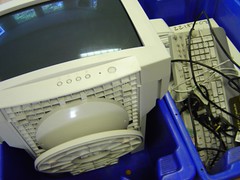
Wires and cables
If you've got the latest, don't assume everyone else has! That's what Jackie and I discovered today at the NFT : you need compatible software (so save it as the old version). In the end everything worked out OK, and the in-school out-of-school virtual worlds theme worked well. And then in my rush to get back I completely missed the Carnaby Street silent disco, but at least Ruth made it. A brave new world in which you can't even disturb the neighbours! Mmm that's new technology for you.
Thursday, August 21, 2008
Born to be random

Born to be wild
One of the attractions of music file-sharing is that the user can select the specific track wanted, rather than the whole bundle and go on to produce a personalised compilation of his or her own favourites. This practice of creating your own mix, which first emerged with the availability of cheap recordable audio tape is now reproduced online. Muxtape is a Web 2:0 music sharing site that encourages its members to exchange compilation collections. But alternative patterns of consumption are emerging all the time. The CD multiplayer brought in the idea of randomly shuffling through a bank of CDs, but as Naomi Alderman observes, the iTunes shuffle function takes randomness to a new level, as listeners are able to draw on their entire music library. But Alderman goes one step further in suggesting that 'we’re welcoming more randomness in our lives'. She gives a number of examples including the Flickr concept of interestingness. Now that’s interesting, or is it random? And how random is random, anyway? Shall I tag this Web 2.0 or random?
Thursday, June 19, 2008
Cue music
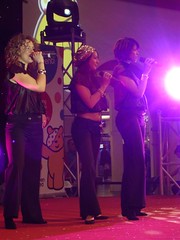
Brown Eyes 1
Technology has a key role to play in the history of music performance, recording and distribution. Within our own lifetime we have seen a massive expansion of radio-based music broadcasting (including the rather troubled emergence of the DAB format), rapid changes in music storage (from vinyl and reel-to-reel tape and on to eight-track, audio cassettes, mini disks, CDs and MP3 files) and changes in how live music is produced. All these changes have contributed to new ways of hearing music, and have transformed the role that music plays in our lives. Listening to our favourite tunes on an MP3 player or mobile phone allows us to take our music with us and this compares rather unfavourably to the idea of lugging a carrier-bag full of vinyl LPs around with us to share with our friends! It's an aspect of networked individualism - our music is delivered to us regardless of place, it has become highly portable. And so I think the way we use music in our everyday lives has had a sort of backwash effect on how we view live performance.
Thursday, February 21, 2008
Getting together

Ducks on ice
I like the idea that networking sites cluster around nodes or social objects - MySpace around music, Flickr round pictures and YouTube round video. Of course they also seem to add another dimension to pre-existing networks. Facebook, by contrast, is a bit different because the network itself seems to be the social object. Is that why I’m suspicious of Facebook? There’s a whole host of reasons for non-participation here; other bloggers just don’t get it; and then, of course, there’s the questionable data protection issues. But maybe there’s also got to be a limit. Blogging, Allconsuming and Flickr take some time –and then of course there’s the teaching blogs, the wikis…not to mention music sites like Clare Large’s intelligent audio.
Subscribe to:
Posts (Atom)