
Showing posts with label image. Show all posts
Showing posts with label image. Show all posts
Saturday, January 27, 2024
Don't lean on me man


Friday, September 21, 2018
Having been a teacher

Monday, April 01, 2013
Photo-sharing

Yes, I finally let go of my Flickr account last year, realizing that it no longer served any real purpose for me or, in fact, held my interest. There's a sort of archive of memory there, but a lot of it was rather ephemeral - or so it seems now, at least. Interestingly though, I'm using Instagram more intensively, and almost exclusively to share more intimate family-related images. In some ways it's a more traditional network. Barton & Lee pick up on a passage from Wellman that fits in very well with this: 'CMC supplements, arranges and amplifies in-person and telephone communications rather than replacing them ' (2001:18). This relates to our family use of Instagram which for me hybridizes the phone-call, the blog and the family photo album without replacing any of them. It all seems far more old-school than the sort of transformational social networking associated with Web 2.0 that I, and others, have written about extensively. Appadurai (2003) suggests that 'where natural social collectivities build commonality out of memory, virtual communities build memory out of connectivity.' - well he might just have produced a killer quote, but certainly the first half matches what we do on Instagram. We must be a natural social collectivity, then. For me this points to a very interesting research area which would look at how new media gets adopted and absorbed into family interactions. Next project?
Saturday, October 20, 2012
Don't think twice (it's all right)

Ever since I came across this apparently innocent, 'off-duty' pic of our PM, I've been thinking about the issues it raises. You have to be of a certain age to connect it with the original album cover, but it's quite clearly a visual quote from Dylan's Freewheelin' cover which was released some 49 years ago. Visual quotes have become quite a theme in contemporary visual art and, of course, cinema too - Woody Allen is probably the leading exponent of this, but my personal favourite is Luis Bunuel's 'Last Supper' scene in Viridiana. (I'm not sure, by the way, whether to describe this as quote, parody or remix, but like citation, imitation and plagiarism in the written form, it's a phenomenon that is certainly worthy of academic scrutiny). But all this aside, what exactly is going on here? According to the Guardian newspaper, the photograph has been carefully set up by Tory party publicists as an explicit attempt to capture our leader in casual mode. That's the point at which all this becomes very subtle. So, assuming this is true - and there's no reason to doubt it - we have to begin questioning even the most seemingly innocent media image, that is to question its level of authenticity. The 'loving couple' in Dylanesque embrace may have just 'popped out for a curry' but the artifice suggests an attempt to create more....but more what? More of a sixties type counter-culture figure, surely not! Or is it trying to tap into something deeper, like a subliminal tilt at youthful romance by riffing off an iconic image deeply lodged in the memories of mature voters? If this is the case, then we might quite rightly recoil at an intention to subtley massage our political opinions. Actually, having said that, I'm not completely convinced that is likely to alter my own attitudes to Cameron or to sway my anti-coalition political leanings, but maybe that's a different point. OK, well there's just one other avenue that opens up, and it's one that gives more positive credit to the photographer - a more innocent view. How clever, and how ironic to draw this visual parallel. All told, then, the image raises all sorts of questions; but of course the answer is blowing in the wind!
Friday, November 25, 2011
Who owns me?

This is me at Monday's conference. I didn't notice anybody take a picture (not that I mind), and then I found it later on in the week on the Cloudworks site. So I've re-appropriated it - but in so doing I was aware of the complexity. Does someone else own that image? Is it the person who took it ... or does it belong to Cloudworks? And then in an instant, by clicking it, I reclaimed it, and now decide to upload it to my blog. Mmm...now Google owns Blogger, and so is it the case that Google owns my image, as well as my thoughts, and my searches? In the end it's not very important to me, but in a week in which the Leveson Inquiry into phone-hacking and media intrusion has heard some frightening testimonies from those who have been pursued, you can't help reflecting on the underlying issues - the ease at which images can be captured and distributed is only one of these. Intent and affect must come into this though. John (yes, I think he was the clicker in question) meant no harm, and I certainly didn't feel any. So everything is OK; but when does this cross the border into become not OK? I hasten to add that I'd already given my permission to being video-recorded, and I have no problem with anyone's conduct at the event - I'm just reflecting on the issues! Cut and paste these words at your peril!
Monday, October 31, 2011
Uncanny valley

The Spielberg/Jackson Tintin certainly does 3D CGI animation well. But the movie hasn't gone down well with critics in the UK for two reasons: firstly, and this is an old debate, because it dumbs down Hergé (see Lezard here) and secondly, because of the CGI effect itself. I find the latter more interesting because I've been writing about visual realism, using Bolter & Grusin's (2000) notion of 'transparent immediacy'. They suggest that media-technology is advancing towards ever more life-like representations. So one critique of Tintin brings in Masahiro Mori's idea of the 'uncanny valley'. This idea suggests that the closer that representations resemble the real, the more that small inaccuaracies will derail us. Actually that didn't happen to me at all, but I'm glad to have learnt about the valley. You can read about that here.
Sunday, April 17, 2011
Migrations
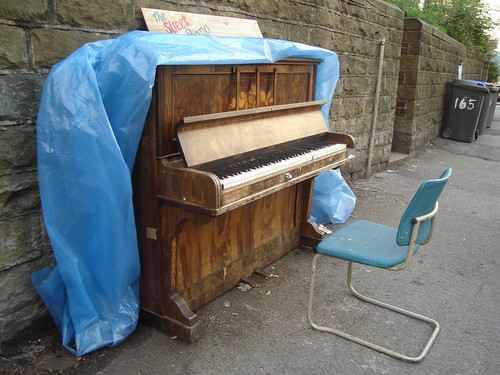
Constance Steinkuehler talks about her work as migratory ethnography, and this description conjures two possible descriptions of research in digital worlds. One is practice- (or text-) focused and would turn the lens on how particular literacies and textual formations migrate across sites and between communities, whereas a second interpretation would look at how people migrate across sites over a period of time. They both have some relevance to what I've been thinking about Flickr lately - sparked by the fact that my subscription is up for renewal. Basically I started thinking about whether my subscription is justified by my usage and my level of participation in the Flickr community. Funnily enough just after my renewal reminder when I was wondering whether Flickr had had its day, I got Flickr mail from someone who was interested in the Street Piano photographs - wanted to initiate something similar at an arts festival and was asking for permission to use my pictures. This fascinated me - I'd already written about how the Street Piano became a 'slippery narrative' weaving its way between the real and the digital - and here it was again entering a new phase of migration! And this just at the point when I was considering leaving Flickr. I've now reconsidered; but it does make me think how Web 2.0 does produce rather transitory audiences/producers. Bloggers come and go, I deserted Last.FM in favour of Blip.FM and I find I've lost interest in Twitter. It would be interesting to trace people's migrations, to understand why they move and which practices they take with them into new environments. At least people continue to tickle the ivories!
Friday, September 17, 2010
It's virtual, baby
Laila Shereen Sakr is thought provoking when it comes to virtuality. She argues that belief is crucial. Belief 'allows the virtual or the image to represent, refer to, or even engage with' the actual person. It's a telling statement about how technology can make the strange familiar. I can't even claim to explain how a digital image becomes pixels on the screen, let alone tell how it gets from A to B. The envious ghost of Johannes Gutenberg peers over my shoulder as I type and publish, but I can offer no commentary except about the keys I press and the mouse I click. Shereen-Sakr tells us that virtuality bridges the material world and the world of data. 'Virtuality is a negotaiation between materiality and information..', I keep thinking about that when I look at the video and reminding myself that it's virtual baby.
Friday, September 10, 2010
Multimodally Jung

Published in October 2009, Jung's Red Book is of interest to literacy scholars not simply because of its rich multimodal style. As you can read here, it was locked away in a bank vault for nearly a hundred years. Was it ever meant for publication? Well I suppose we'll never know. But what is really interesting is that Jung, who after all was a man of letters, chose this highly visual form to explore material, his own journey if you like, which would later inform more conventional scholarly work. You can see some more of the visual material here.
Friday, July 23, 2010
Mapping place

The map is not to be confused with the territory but it does nevertheless produce a virtual representation of it. Early aerial photography seems to have provided an interesting interruption to this distinction. As Hauser observes, ‘The most familiar of things.... were all made unfamiliar from the air. The aerial view flattened out the landscape, pictured it like a map, and with such resolution, such detail...but unlike maps they were records as well as diagrams, containing photographic information that was sometimes unexpected and always up-to-date.’ (Hauser 2007:105). Enter Google Maps and Streetview; and as I noted here, there is often the element of the unexpected even though it may not necessarily be up-to-date! But maps are a very useful way of knowing your place, where you started from and how to get to where you want to go, and Google has again begun to blur the boundaries between representation and view. Traditional maps reduce the excess of information through the application of measurement and symbolisation, and so become a material representation of space and of those objects in it that are seen as significant. A spatial map becomes a coded text. ‘Looking at a contour map, the student sees lines on paper, the cartographer a picture of a terrain.’ (Kuhn, 1970:111). The geographer’s map is always selective, drawing attention to certain aspects of place to the exclusion of others, and in this way it maps the relationship between significant objects. And I suppose it is this selectivity that tempted Borges to suggest the 1:1 map in his fast fiction ‘On rigour in science’ in which ‘the Cartographers Guilds struck a Map of the Empire whose size was that of the Empire, and which coincided point for point with it’ (Borges, 1998:325). Borges’ fictional map is subsequently deemed useless; in contrast, Google seems to have a very useful product.
Friday, February 05, 2010
Visual understanding
I was sent this YouTube link by a Twitter friend. A Ukrainian sand-artist, Kseniya Simonova. How’s that for unusual? Apart from the fact that it’s just a little bit too long, it’s pretty impressive. For me it played into that recurring debate about what the visual can and can’t do. Well for a start it’s pretty hard to work out the Ukrainian sand-artist thing without words; but then it is quite striking that as the images evolve and take shape they make a sort of narrative that holds our attention and engages us (maybe emotionally?). I suppose the meanings are quite open. The images invite us to reflect, but then they don’t direct our reflection in any way. Music and sound effects serve to thicken our interpretation of the visual. And since I’m now writing about media literacy, I started wondering about what sort of media knowledge you need to produce or consume something like this and then, to go further, what sort of reading a critical media literacy might yield. Well, I only wondered, but when I get just a little bit further on with this particular piece of writing I hope to share some of it before it reaches the full light of day.
Monday, January 18, 2010
A virtual perspective

Connotations of 'nearly', 'as if', or 'almost' readily associate with term virtual. Although the word has some more specific dictionary definitions as well as some more recent technical ones I think these everyday uses are a good starting point for theorising the virtual. Reflecting on the Avatar experience, I’ve been thinking how the whole way in which flat representations take on the semblance of 3D is an important aspect of the virtual. So the mathematical calculation of perspective, the idea of the vanishing point - in fact the whole history of representational art from the Renaissance onwards is conjured up. Culturally we have adapted to representing and reading space in a particular way. It seems perfectly natural to perceive depth of field - but is it really culturally acquired? We readily assume the first person point of view of the artist, the photographer or the camera. And at that point is what we see virtual? Does the medium become transparent? Bolter and Grusin (2000:25) when talking about this suggest that: 'If executed properly, the surface of the painting dissolved and presented to the viewer the scene beyond.' The project could be seen as one of becoming immersed in an alternate reality by forgetting that it is mediated in the first place. That's my experience of good theatre - I begin to forget the audience around me, that actors are just doing their job and so on - I'm temporarily 'in' the world that is unfolding.
Wednesday, December 30, 2009
Thinking visually

In a number of papers I've put forward the idea that digitally-mediated communication has led to the use of innovative, self-sponsored writing on an unprecedented scale. This is writing at the point of change, with new forms, structures, spellings and functions coming into being. Writing as self-expression, writing as identity performance and writing as negotiation or participation. I've argued that writing on screen is an important and ubiquitous characteristic of contemporary cultural worlds and defended this 'narrow' description of digital literacy. This has led some to assume that I am arguing for preserving the 'dominance of the written form'. This is untrue; I'm just more interested in writing, although of course I note that it often appears on screen in combination with the visual. Still I'm as sceptical about popular ways of visualising data as I am about unsubstantiated claims about visual thinking or visual literacy. It's clear that images do some things better than words. So I found this piece on visualising data very interesting. Scrolling down the comments I found one that I was about to make. So here it is: 'Just to play Devil's advocate: if visualization is so great, couldn't you have conveyed all the ideas in this article using just visualizations? Why did you use words? Specifically data visualization is good for very large quantities of data that cannot be easily interpreted or even presented in a short word format.' (Mark Krepicz). So, for the time being, I'll stick to words to develop my ideas, not because they're better or anything, but just because they work.
Tuesday, December 15, 2009
Visualisation
If you like the idea of wearing ridiculous glasses and seeing things in 3D you need some pretty expensive hardware - good graphics cards, offset projectors and so on. Wallwisher, on the other hand is free, flexible and fun (that's the three f's). But of course you can do things in a visualisation suite that you could never do in Wallwisher. But application aside, the world of 3D film can help to bring ideas about 'immersion' and 'virtuality' into focus (unintentional pun). It's interesting that 3D technology seems to emphasise the illusion of image. It's quite clearly an image but the difference is its dimensionality. I don't experience the same sense of place that I do in Second Life. Things are coming at me; but I'm not in it. The shared ground is that it's virtual in the sense that it's almost life-like. Real and not-real, both at the same time.
Saturday, September 26, 2009
End-game literacies

Even in the face of a family bereavement old media insists on re-cycling what they think we want to read. Obituaries of my brother have not been too kind. The literacies of power are everywhere at such times, even in the documentation which is recorded and signed, and then signed again. I remember Roy Harris in 'Rethinking Writing' claiming that your signature is the only thing you can't forge - but that's indeed what I thought I was being accused of at the Registry of Births and Deaths in Barnstaple. 'What does that say?' I was asked. 'My name.' I replied in all honesty. 'But what?' came the reply. And so I had to slowly write my name on some scrap paper to try to recall what exactly that scrawl was supposed to represent! Anyway literacy aside, the photograph shows the two of us outside the Captain's Table a week before he died.
Sunday, March 22, 2009
Transnational

This is a wonderful photograph of one of our administrators on the Masters programme here in Sheffield. She was born in Beijing, and here she is trying on a sombrero in Mexico! For me its an image of the upside of the transnational. But having recently spent some time in Cambodia, the Channel 4 documentary on forced evictions in Phnom Penh brought home the downside. We saw the poverty of Dey Krahorm when we were there, but we didn’t see the background. Foreign investors cashing in on the growth of tourism seem to be in league with officials in moving the poor out of view. Violent struggle is not uncommon. Welcome to the cruel world as Ben Harper used to say.
Monday, February 23, 2009
Participation and active consumption

Today this wonderful visual ethnography book arrived from Hong Kong, along with a beautiful card (thank you so much, Alice). It all played in so well with the James Farrer article that I mentioned in Friday's post, because the bar staff in Eric Ma and Ducky's work are using a public space to perform versions of a modern Chinese identity that recontextualise a global practice. The same happens in Farrer's account of the disco culture of Shanghai and elsehwere. Farrer's account is subtle in that it shows the stratification and differential participation that arises in the marketisation of China. There's also an interesting critique of Appadurai's notion of flows. Farrer argues that the metaphor implies that there are no obstacles or boundaries, whereas the disco work shows there are. What an interesting diversion!
Tuesday, February 10, 2009
Digital Provenance

In Spook Country, William Gibson talks about the connections being more important than the content. I don’t really pretend to understand what he’s getting at although I am struck by the resonance with social rather than informational technology. But it did occur to me that digital artefacts do make some interesting crossings. Take the picture of Ruth I posted before. It’s a self-shot taken on her Blackberry and sent to me through messenger. I bluetoothed it from my phone on to my laptop, and uploaded it to Flickr. Next day I posted it in my blog and there it is, each time re-contextualised and there, ready to be changed again. Replay and remix are not, as we know, particularly new but they are certainly more commonplace in new technology.
Monday, February 02, 2009
Media storm

It’s been snowing for about four hours now, and the road outside is a slushy mess. For once the forecasters were right. They’ve been telling us since Friday that we’re in for Big Snow. We were so well warned that it changed our experience of Saturday and Sunday until it became a weekend of waiting for the snow. Still there’s something quite special about being snowbound in a place when it so rarely happens. I hope you get the picture, it’s Amy Winehouse (courtesy of Emma and Ruth).
Saturday, January 03, 2009
Sorry I forgot!

In the rush to get away just after Christmas, I forgot to announce a short break in my posting activity! So this is stolen picture of where I am at the moment, a shot over the rooftops of Chau Doc in Vietnam. It's great to be able to have a break and get a taste of what it is like on the Mekong delta, and I have to say it's rather different to Sheffield. For a start it's pretty warm; there's more motorbikes and bicycles than cars; and the standard of living is pretty low. Having said that you can still buy flat screen TVs and mobile phones! Yesterday I saw European tourists photographing Vitenamese kids on their digital cameras. The kids were fascinated to see their own images, pulling faces, making v signs and so on. This morning, outside the hotel in Chau Doc the situation was reversed as a Vietnamese teenager came up to a young German family and took pics on their mobile phones! Tomorrow we'll get the boat up to Phnom Penh and from their down to Sihanoukville. No promises about regular postings, but a normal service will be resumed mid January!
Subscribe to:
Posts (Atom)