Showing posts with label photosharing. Show all posts

Monday, April 01, 2013

Photo-sharing


Yes, I finally let go of my Flickr account last year, realizing that it no longer served any real purpose for me or, in fact, held my interest. There's a sort of archive of memory there, but a lot of it was rather ephemeral - or so it seems now, at least. Interestingly though, I'm using Instagram more intensively, and almost exclusively to share more intimate family-related images. In some ways it's a more traditional network. Barton & Lee pick up on a passage from Wellman that fits in very well with this: 'CMC supplements, arranges and amplifies in-person and telephone communications rather than replacing them ' (2001:18). This relates to our family use of Instagram which for me hybridizes the phone-call, the blog and the family photo album without replacing any of them. It all seems far more old-school than the sort of transformational social networking associated with Web 2.0 that I, and others, have written about extensively. Appadurai (2003) suggests that 'where natural social collectivities build commonality out of memory, virtual communities build memory out of connectivity.' - well he might just have produced a killer quote, but certainly the first half matches what we do on Instagram. We must be a natural social collectivity, then. For me this points to a very interesting research area which would look at how new media gets adopted and absorbed into family interactions. Next project?

Thursday, December 22, 2011

Searching limits


At the CSU technology symposium, we were once again alerted to the ways in which our casual searching behaviours may be shaped by search engines such as the mighty Google. This time it was Judy O'Connell issuing the warnings. So we learn to be sceptical of the JFGI approach. But since then I've got interested in something else about searching - and that's related to modality. I've been using the image above a bit lately, and have got quite interested in its provenance. A contact tells me that it shows the warehouse inventory process - possibly at a shipping line. Well that's OK, so far. But what I really want to do is search for the image and find out more about it. Of course Google (can I still mention it?),will allow me to search for an image related to a word, but it won't allow me to search with an image. Hence the modality issue. So I'm wondering if anyone's come up with a way of searching with an image? Maybe they have. Since some photo apps can now recognise your friends, image matching should be possible - and of course images are tagged and labeled. I wonder.

Friday, November 25, 2011

Who owns me?


This is me at Monday's conference. I didn't notice anybody take a picture (not that I mind), and then I found it later on in the week on the Cloudworks site. So I've re-appropriated it - but in so doing I was aware of the complexity. Does someone else own that image? Is it the person who took it ... or does it belong to Cloudworks? And then in an instant, by clicking it, I reclaimed it, and now decide to upload it to my blog. Mmm...now Google owns Blogger, and so is it the case that Google owns my image, as well as my thoughts, and my searches? In the end it's not very important to me, but in a week in which the Leveson Inquiry into phone-hacking and media intrusion has heard some frightening testimonies from those who have been pursued, you can't help reflecting on the underlying issues - the ease at which images can be captured and distributed is only one of these. Intent and affect must come into this though. John (yes, I think he was the clicker in question) meant no harm, and I certainly didn't feel any. So everything is OK; but when does this cross the border into become not OK? I hasten to add that I'd already given my permission to being video-recorded, and I have no problem with anyone's conduct at the event - I'm just reflecting on the issues! Cut and paste these words at your peril!

Sunday, July 10, 2011

Shop fronts and shutters


The shops used to be closed a lot. Sundays completely, often Saturday after lunch, and mid-week. I think Thursday was 'early closing day' when I was young. So if you were incarcerated in an educational establishment (and most of the time I was), looking at what you could buy was time-limited. From quite an early age I compensated for this by window-shopping, pressing my nose up against the fronts of closed shops, peering in against the glare to see what you could get. I started with children's toys, but as my ambitions grew I began to focus on musical instruments and LP covers (big boys' toys), spanners and wrenches (serious boys' toys) and eventually clothes and electrical goods. I carried that on well into adult life and as a matter of fact I still enjoying looking at things I could buy, might buy, or might one day buy. It's everyday life in the consumer market-place. Sometime in the 1980s shop-owners - particularly those in urban areas - began to worry about civil disturbance, disturbed, no doubt, by images of rioters putting bricks through shop-windows and helping themselves to stuff they ought to pay for. They began to install shutters to protect their interest and city streets, at least on Sundays, became greyer places. When I first got into Flickr, partly as a homage to my days as a window-shopper, I started photographing shutters, putting them in a set. I was interested in the way that shutters were becoming a surface for art-work and graffiti. The security barrier of the shutter effectively kept most people out, but while the goods were protected another form of expression was errupting. Now many shops commission artists to decorate their shutters. So you'll see The Rude Shipyard, itself a wonderful boho artsy venue has followed the trend. Must upload to Flickr!

Wednesday, October 13, 2010

Social rituals


Weddings, blessings and civil partnerships are significant social rituals and ones in which new and old textual practices play an important role. Oral recitation, repetition and the signing of official texts are often the centrepiece. But official practices sit alongside very important unofficial ones. So whilst some sort of professional photography seems necessary in order to keep a record of the event, these images jostle against the Facebook sets and the casual snaps and short movies captured by the guests. New and old ways of mediating the event comfortably co-exist and hardly raise comment. this is my contribution!

Friday, February 26, 2010

DIY danger


I've written about photosharing on a couple of occasions now, but I've never really addressed the issue of ethics. I suppose that's mostly because of an interest in the sharing process itself and how it fits with the more general Web 2.0 ethos, but also because it raises some thorny issues about ownership and even e-safety which aren't exactly top of my list, even though they are worthy areas of concern. But I adhere to my own ethical principles with respect to images of human subjects. I'll ask permission to use/share photographs of individuals and I've only once had an issue with that. On that occasion it was photographing a graffiti jam in Sheffield. I was taking pictures of the materials and the emerging wall art. I put these images up on Flickr, but in one of them I had inadvertantly captured the face of one of the artists. She mailed me through Flickr and politely asked me to remove the photograph because of the rather touchy legal issues. I obliged immediately and sent an apology. So, anyway, my unwritten ethical code doesn't cover inanimate objects, like the Victorian ford sign above. I've never asked a sign for permission! It never crossed my mind. But with this pic I encountered an onslaught of verbal abuse - not I hasten to add from the sign itself (roll over Saussure) but from the owner of the property whose outside wall the sign is on. 'What are you doing? What right have you got? What are you going to do with...? Let me see!' etc etc. I explained that I wasn't a spy, I meant no harm - and this is the embarrassing bit - I had to explain that I like taking photographs of signs! As often happens in such situations the social interaction surrounding the event slowly changed its tone as I learnt that the farm was continually harrassed by the local authority for allowing water and slurry on to the road and that that my photographing had been construed as an act of surveillence! And, as the day wore one, I learnt all about the farm, the ford, local history and so on. But in the end - damn it - I forgot to ask permission. Do visual researchers do sackcloth and ashes, or has the moment passed?

Saturday, December 06, 2008

Internet safety


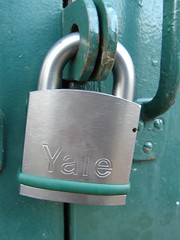
Yale (turquoise band)

There's a great little story here in the Guardian about how easy it is to cut keys from images on your Flickr photostream. This adds a new dimension to debates about internet safety. Local authorities and other administrative bodies may now have to change their policies. I'm taking a different view and hoping that someone can cut a key to unlock the padlocks that keep us out.

Tuesday, August 26, 2008

Post industrial post


I went to pay my last respects to Tinsley Towers last week and somehow managed to leave my camera at home! But not to worry, there are some excellent views of the demolition on YouTube and on Flickr, too. The two towers were right beside the M1, the major north-south arterial which was constructed when I was young. They were a sort of gateway to the North, or of course a return home; depending on your point of view. Anyway, I’ve been thinking quite a bit lately about growing up in the twilight of the industrial age. As a child I remember factory sirens, factory shut downs and crowds of workers leaving Raleigh Cycles, Players Cigarettes, and Erikson’s. Now only Erikson’s remains as we inhabit a post-industrial landscape where the sites and markings decay into history or are completely erased like the Towers. Erased except from memory and archive material on YouTube and Flickr.

Friday, July 04, 2008

Flickr and voyeurism


Roses

Yesterday I wrote that photosharing sites like Flickr have contributed to new ways of looking at the role of the visual image in our lives. It is as if our albums of photographs can now be released from the shelves and cupboards of our domestic life and thrown open for public viewing. But as a friend pointed out, this means that complete strangers can be leafing through shots of our family, our children and so on. Can this be an unsettling experience - peering like a voyeur into the lives of others...exposing one's own life to public scrutiny? I suppose it's all part of the blurring of private and public. But we'd be wrong to say that it is risk-free. We take intelligent decisions to remain safe and, I suppose, that is part of a Web 2.0 education, to ensure that our students make informed decisions about what is placed in public spaces, too.

Sunday, June 15, 2008

Flickr writing


Roses
In writing about Flickr, I have become more aware of its sophisticated design. Decisions about levels of participation are placed firmly in the hands of the user. At the most basic entry level, you can simply use Flickr as a private online archive of photographs. There is no pressure or obligation to do any more than this. However, images that are public on a photostream soon begin to attract some interest, particularly if they are seen as interesting by others and even more so if they are carefully titled and tagged. Others in the Flickr community may leave a comment or invite you to be a contact. But again you are free to accept or decline as you build up your list of contacts. There is no pushing or poking. You are in control of your level of particpation from the very onset. That's what distinguishes Flickr as a quality social networking site.

Thursday, June 05, 2008

Flickr reflections


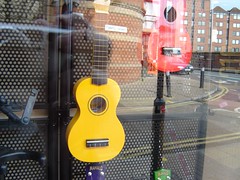
ukulele renaissance
Writing about photosharing is helping me to think more clearly about the Flickr experience. One thing that I realise is that I've built up a lot of knowledge about how Flickr works over a period of time. It has been an incremental approach in which I've learnt just what I need to know when I need to know it. Another thing I've realised is that the intelligent way in which it is structured leaves you in control of your own level of use. It's a very different experience to entering the somewhat anarchic world of YouTube. And finally, when you compare Flickr photosharing with blogging, you realise the difference in social interaction. Flickr allows for comments, notes, tagging and mail - so there are multiple options. By way of contrast, blogs will only display comments (and these are often hidden away). In Flickr they're right up there next to your picture. Blogging is much more about having your place on the net, personalising your page and performing your identity. Although you have your own portal in Flickr it looks more or less the same as someone else's. That seems to create the feel of a more continuous shared space.

Tuesday, February 19, 2008

Reclaiming history


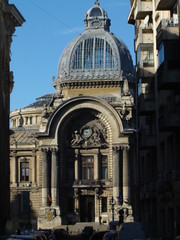
Historic quarter
It’s often said that anything goes in net culture - that it is essentially apolitical etc etc. So it was good to come across Flickr activity that shows that that’s not exactly the case. Some of my images of buildings in Bucharest have attracted attention, and as a result I’ve sent some pictures and then joined the Architectural Monuments of Romania group. The administrator mailed me today saying: Thank you for applying to the group and I’m looking forward to your contribution: as a word of caution - anything to do with Ceausescu's brutalist architecture (especially and in particular the so-called "Palace of the People" and former "Avenue for the Victory of Socialism" are all outside the remit of this group. Well OK, I feel a little guilty, I have some of those – but I’ll keep them hidden from the group!

Saturday, February 02, 2008

Learning through photosharing


Under the influence
Winter is probably not the best of times to be a tourist in Bucharest. Apart from the cold, there's a general lack of easily available information. Even with a Rough Guide, we found it quite difficult to navigate, ending up instead just wandering around looking at and sometimes photographing interesting looking buildings. This place looked quite attractive, I clicked and moved on. Later on, after uploading my photographs, I returned to my Flickr stream and noticed a comment. The photograph had received a new tag - stavrolpeos - and I'd been invited to send it to a group, which of course, I did without hesitation. The group is a 371 strong archive of images of the exterior and interior of the Stravropoleos Church, showing it over time and through the seasons. From my desktop I wandered around this visual record of the church, looking at the various contributions. There were tourist snaps, some showing those who visited the church, their girlfriends, boyfriends and so on; others were more studied, photoshoped or carefully composed. I learnt about this place, the atmosphere, the decor, the restoration, and also something about how people feel about Stavropoleos Church. Little of this was rendered in writing, apart from the short paragraph written by the administrator of the group who explains his or her interest and connection with the church. Google will offer you this - again simply visual. You have to go to Wikipedia to add to your factual knowledge. I was quite moved by the Flickr experience and felt the real benefit of being connected with others in this world of photosharing. I suppose I was learning from the widom of crowds.

Sunday, January 27, 2008

Degrees of participation


Let there be light
Going through my allconsuming archive made me realize something I’ve known for a while but not payed sufficient attention to. Engagement in a social networking site is a variable thing: you can be quite peripheral or right there in the thick of things…. or, of course, you can be at any point along the way. I’m right on the edge with allconsuming – you can see my profile and what I’ve been up to, but there are no comments and I’ve never done any tagging there, let alone any kind of interaction. Flickr’s different. I have a small and changing social network there - I describe, comment, tag, interact, meet new people etc etc. You make your own choices and it’s about degrees of participation, and reasons for participation … I suppose choosing your favourite social networking site is similar to deciding where you like to hang out in meatspace.

Friday, August 10, 2007

Break


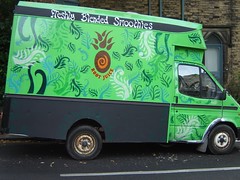
juice van
Pictures of vans attract lots of attention on Flickr (how strange). Previously a van pic was snapped up by the 'European Vans' group, and now this one, within minutes of publication, was requested by another van group (Ford transit) I think. Call it nerdy, call it niche interest, but it's clear that collecting is a way of adding value to the everyday. And now, I shall take a short break, leaving this blog for a week or so!

Thursday, June 28, 2007

Stranded


Originally uploaded by outallnight.
Today I was locked bumper-to-bumper in traffic trying to move North out of Sheffield. After an hour in the car I only managed to reach the outskirts – so I turned back! This is all the result of the now famous floods! I was on my way to Barnsley to work with the virtual world teachers. One of the latest quirky developments is using green screen digital storytelling to place actual children in role in the virtual world. Mind-boggling! There’s more on digital story-telling on these pages. And, finally, thanks to outallnight for the photograph of extreme weather in Sheffield - there's lots more on his photostream.

Monday, March 12, 2007

Lip gloss


No, I do not take medicines for this.
Originally uploaded by ♥ Eve ♥.

Last October I posted here about a joke birthday present from Ruth – the Peppermint Schnapps flavoured Mullet lip balm. I’ve had a few comments on the picture on my Flickr stream, and lately one from Eve who is a lipgloss collector. She has nearly 300 different ones. The picture above (shown with permission) shows part of her extensive collection. It’s tags are ‘lipgloss’, ‘lip’, ‘lipsmackers’, ‘smackers’, lipsmacker’, ‘collection’ and ‘lipbalm’. She also belongs to the LIPGLOSSADDICTION public group. So, just like the padlock example I wrote about here, we again see social networking in Flickr as a way of creating an affinity space for niche interests. Don’t worry about me – I’m not about to start a collection, but I’m intrigued by this aspect of photo-sharing!!

Tuesday, February 13, 2007

Attention!


weighty sign
People clearly have different motives for signing up to a photosharing site. My original motivation was to create a bank of pictures online that I could use on this blog. Since then things have changed a little - friends, family and a few online acquaintances will, from time to time, visit and comment on my photostream. I enjoy playing a small part in this community. This is quite a typical story of social networking. I’m aware that for others popularity/ attention is a strong drive. If you’re one of those, then Thomas Hawk has 10 tips for getting attention that you might like to look at. But of course it’s not a simple divide between attention-seekers and the rest. I quite regularly check on the popularity of my pics (mostly because it’s an accessible feature and partly because it’s nice to get some approval). The fastest climbing picture in my ‘views’ count is shown above. It’s a quite unremarkable picture of an icon on my daughter’s door. Posted on January 8th it’s now at Number 11 out of the 200 listed why? I guess it’s the tags. I’ve noticed ‘home’ and ‘house’ always attract attention (interesting)… ‘sign’ isn’t exactly a crowd-puller. So I guess it must be ‘weights’ and ‘lifting’. Now I’m running an experiment. I’m going to give the same tags and title to a random image and see how it goes on the ratings. There’s nothing better than a bit of attention, after all.

Friday, January 26, 2007

On the same lines


blue sky
It’s always good to think of improvements so I enjoyed reading Liz Lawley’s thoughts on Flickr friends. She says: ‘I’d love to be able to see who we have in common.’ That’s interesting because it’s rather more useful than visualizing social networks (anyway this sort of thing needs loads of contacts). Quite a lot of us signal networks across different sites. Here’s an example of this. But I’d rather like a smarter Flickr homepage – one in which you could tag and search interests, and one that you could personalize a bit. After all your profile is just a form you fill in, and up it pops on the corporate page template, hardly changed at all.

Tuesday, January 09, 2007

Press


'A year of bad press and security concerns means the educational potential of social networking sites remains largely untapped' writes Jerome Monahan in today’s Education Guardian. The full text is here with a small quote from me on padlocks! I also looked around a few education-related blogs today. School blogs seem to be quite disappointing – mostly providing ‘corporate’ information. Some do allow pupil voice, but this is often unfocused and short-lived. However, I enjoyed this school visit blog – the author turns out to be the Head of Education for East Lothian Council. I also stumbled on a student-teacher blog with much similarity to this one. Both are trainees on PGCE courses. One blog stops on Sunday 19 November and the other on the previous Sunday (12th November). Doesn’t that just tell the whole story!