
Showing posts with label graffiti. Show all posts
Showing posts with label graffiti. Show all posts
Sunday, July 21, 2019
Mark making


Friday, August 24, 2012
On hold

The phonebox, or public payphone, is quickly becoming a historic trace, an archeological remnant of earlier patterns of communication - of a time before the mobile phone. Gleick's book 'The Information' draws our attention even further back, to a time of telegraph stations and semaphore masts. In a similar way, they left their mark on the landscape. But because 'the phonebox that works' still exists in living memory, we can watch its slow slide into redundancy. The modern phonebox is like a scar on the urban landscape. A scar that has not yet healed. And yet we can still remember the strange social space that was defined by the phonebox: a place to queue, a place to wait, a place for teenagers to congregate, a place to shelter from the rain. The unique aroma; the opportunity for vandalism; the forgotten purse; the cryptic message scrawled on the damp directory and so much more. And of course, in the real world as well as the world of the imagination, the phonebox became the way to connect with distant places. The phonebox became the tardis, Dr Who's gateway to other worlds. Attempts to revive the phonebox have failed, because it has had its day. This one, discovered on a recent derive, is a hopeless case. All the windows are smashed. The door was removed a long time ago. Even the graffiti is sun-bleached. It promises 'text', 'email' and so on in a lost hope to move with the times. Perhaps an earlier version was a hub for the local community, but now there are better places to hang out, easier ways to communicate.
Sunday, July 10, 2011
Shop fronts and shutters

The shops used to be closed a lot. Sundays completely, often Saturday after lunch, and mid-week. I think Thursday was 'early closing day' when I was young. So if you were incarcerated in an educational establishment (and most of the time I was), looking at what you could buy was time-limited. From quite an early age I compensated for this by window-shopping, pressing my nose up against the fronts of closed shops, peering in against the glare to see what you could get. I started with children's toys, but as my ambitions grew I began to focus on musical instruments and LP covers (big boys' toys), spanners and wrenches (serious boys' toys) and eventually clothes and electrical goods. I carried that on well into adult life and as a matter of fact I still enjoying looking at things I could buy, might buy, or might one day buy. It's everyday life in the consumer market-place. Sometime in the 1980s shop-owners - particularly those in urban areas - began to worry about civil disturbance, disturbed, no doubt, by images of rioters putting bricks through shop-windows and helping themselves to stuff they ought to pay for. They began to install shutters to protect their interest and city streets, at least on Sundays, became greyer places. When I first got into Flickr, partly as a homage to my days as a window-shopper, I started photographing shutters, putting them in a set. I was interested in the way that shutters were becoming a surface for art-work and graffiti. The security barrier of the shutter effectively kept most people out, but while the goods were protected another form of expression was errupting. Now many shops commission artists to decorate their shutters. So you'll see The Rude Shipyard, itself a wonderful boho artsy venue has followed the trend. Must upload to Flickr!
Sunday, April 05, 2009
G20 literacies
Perhaps London’s G20 protest was a little unfocused and, of course, carefully policed but I was struck by the ways in which digital literacy practices were never far away. Some news sites had video footage up soon after the events themselves, mobile technology was much in evidence and there were Twitter feeds to follow the protest. In the TV news of police kettling that I saw, protesters’ cameras were very much in evidence. Why some groups favoured chalk instead of spraypaint to make their point seems curiously anachronistic. The Bishopsgate flash camp stole the headlines: it was well-coordinated and mostly good-natured. Don’t we all feel a little more at home with climate protest?
Saturday, November 22, 2008
Animated graffiti?
MUTO a wall-painted animation by BLU from blu on Vimeo.
If the concept of animated graffiti sparks your imagination, then this video shows it in operation. Is wall art a time-based text? I wonder. Here it certainly is (or at least the video is). I know Dr Joolz chronicles how some graffiti artists in NY capture the ways in which their work changes over time, but blu’s work authors changes in a way that animates the walls themselves. The website is attractive and describes the work as 'ambiguous animation painted on public walls'. You can see the blu blog (here). Many thanks to John for pointing to this - respect!
Wednesday, August 27, 2008
Ambigramming
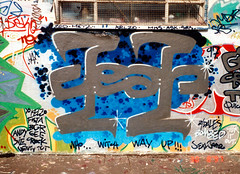
Clear
Originally uploaded by De Seven Free.
There’s a whole lot of work to do on creating a taxonomy of graffiti tags. Recently I’ve been tuning into the diversity of all the calligraphic styles. It’s interesting that they can’t all be read by the tagging community, but there’s clearly an awareness of styles. So De Seven Free's picture Clear introduces ambigramming, a reference that had me racing to the dictionary and then here, where you get Hofstadter's definition: a calligraphic design that manages to squeeze two different readings into the selfsame set of curves. Many thanks to DSF, keep on ambigramming, its remixing the script!
Thursday, July 24, 2008
No graffiti
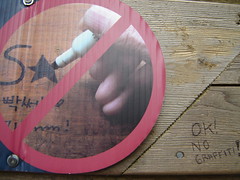
no graffiti
Views from the Capilano Suspension Bridge are truly amazing, and the experience of walking across reminds you of the fairground cakewalk. The cliff-top walkway gives equally good views of the gorge, but I must confess that I was completely distracted by the handrail! This is a foot wide smooth surface of wood that runs at chest height around the perimeter of the walkway. It is absolutely covered with writing in English, Vietnamese, Spanish, Hindi and so on. Visitors have left their mark on the handrail, using the materials at hand. Gouging out their names, writing them in biro, in marker pen, telling other visitors who they are, where they are from, and when they were there. It is the most basic form of mark making and identity performance. I was fascinated not only by the sheer diversity of visitors but the varied forms their messages took. Some were mourning missing relatives, others were statements of love or religious sentiment; others were more light-hearted (Bob smokes too much ganja) but none were obscene or malicious. Occasionally there was the polite notice from the owners, the no-graffiti sticker shown in the picture. But somehow this just became more graffiti. It is accompanied by a polite message reading "We don't come to your house and scribble on your walls, so please don't scribble on ours." Nonsensical really, because Capilano is not a house and a handrail is not a wall.
Saturday, November 03, 2007
Symbolic work?
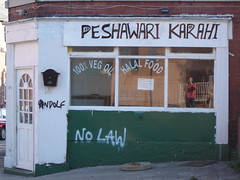
favourite shop
This is a favourite amongst my most recent photographs. There is something about the juxtaposition of the pro-anarchy spaycan graffiti and the folksy North-West Frontier ethic of the take-away shop-sign that is very glocal. Also, on closer inspection, there’s some textualising of the self - as I am caught in reflection in the window – captured, commented upon and circulated.
Tuesday, October 30, 2007
Mongolian?
Here’s a clip of Mongolian c-walking. C-walking (short for clown-walking or crip-walking) is a worldwide phenomenon, drawing on combinations of dance moves, like moonwalking, with plenty of inventive transitions. I’m not sure how Mongolian this c-walking really is, but I am struck by the multimodal nature of the performance. The music is a central feature, but also note the dress style and the graffiti backdrop – and the occasional floating in of written text. Hip-hop and a bit more edge than Michael Flatley, I think.
Thursday, October 18, 2007
That's OK
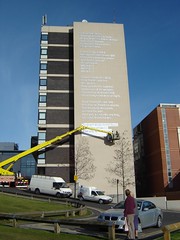
more graffiti
I’ve watched this writing on the wall growing over the last few days. I’m not sure whether you can say that the crane is a writing tool, but it looks like it. Each letter is about 3 feet high and mistakes need to be avoided at all costs. The poem (by Andrew Motion) is part of the Sheffield’s ‘Off the Shelf’ festival. Despite being a kind of writing on the wall that could offend some, it couldn’t be described as graffiti because it’s officially sanctioned – a privileged writer works with full permission (no danger of a court case here).
Thursday, September 20, 2007
Graffiti wars
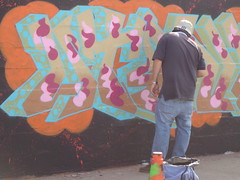
working
Graffiti provides a fascinating example of the intersection of the politics of space and the policing of literacy. It’s often a subject for posts on this blog, on Dr Joolz, and recently on Vic Carrington’s. I’ve had some great comments on my pictures of the Sheffield graffiti jam from the artists themselves, and an appreciative email today which reminded me that showing the faces of graffiti artists is a sensitive issue. Although Banksy has done a lot to attract our attention to graffiti, the law, as usual, is out of step with public opinion as this article argues.
Saturday, September 08, 2007
Jam!

wow
Ledgecrew, who commented on my photostream invited me down to the graffiti jam in Sharrow today - there are more pictures here. The event attracted artists from across the North of England to work on the only legal strip of wall in Sheffield. The air was full of paint mixed with the smell of extra strong lager and roll-ups, but there was plenty of talent. Buzzing with the sound of R'n'B, young men, young women and kids all worked together to produce some stunning wall art. It's great watching it all take shape, even when it's put on top of earlier work - after all it's an ephemeral form. I noticed how some artists have sketch pads, others work from manga and comic books, and some others just work directly to the wall.
Friday, August 31, 2007
Word is out
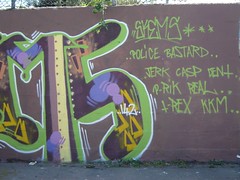
signed
Last Sunday I wrote a comment on some graffiti art – “Sometimes the writing is so stylized that it is hard to decipher; other times the meaning is hard to pin down” – but I didn’t post this text. Since then the explanation has appeared as a comment on my photostream: “The reason skemz wrote police bastard is because everytime we've been painting down at the courts we keep getting hastled by the police, there driving us to do illegals like tracksides, warehousers ETC because atleast we never get hastled....”. Well, that’s clear enough! This is meaning-making in the borderlands. In contrast, re-working books as sculpture is becoming quite respectable. Many thanks to Sigrid for pointing to Su Blackwell’s book sculptures. And there’s more here at wordandimage.
Sunday, August 26, 2007
Can do
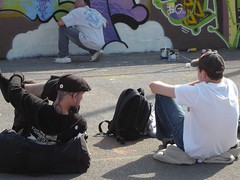
watching paint dry #2
I watched spray-can art yesterday. Here two of the the artists take a rest. There's an interesting sort of parallel play that goes on, in which they talk to each other, share materials and tools, but always appear to work on their own bit of wall. The man on the left is also big on body art (tatoos and piercings) - and the back of his jacket, which is just out of view, is covered in writing about anarchy. He's got to be a genuine metro-textual! I noticed that nearly all of the work combines image and writing. Sometimes the writing is so stylized that it is hard to decipher; other times the meaning is hard to pin down; but at all times it's a very vibrant form of mark-making.
Saturday, July 28, 2007
New graffiti
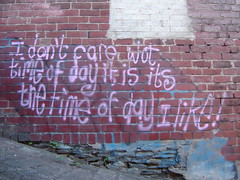
I don't care
Abandoning an autonomous model of literacy in favour of a practice account, in which literacy is both plural and context dependent, involves accepting that meaning-making varies. It varies not only with changing social practices but also with different physical, material and technological conditions. As a result, I'm increasingly finding that the binary distinction between ‘old’ and ‘new’ is conceptually problematic. I discovered this new writing on a wall near me, and it made me stop and think.
Tuesday, July 24, 2007
Environmental
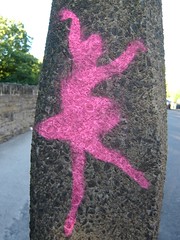
Pink dancer
For a number of years the idea of the print environment has been influential in the discourse of early childhood literacy. Drawing young children’s attention to the presence of print in their world – and its meanings and functions – has been an important feature of the pedagogy of emergent literacy. As often happens this sort of idea is contagious, and those professionals who work in the field of early literacy can become over-sensitized to the print environment. At least that is my own experience, and my interest in graffiti, urban mark-making and stencil-work springs from this. I’m particularly interested in the unregulated meanings made on surfaces like walls, shutters, bridges and street furniture. It strikes me that they are examples of a fundamental desire to express - to express opposition, anger, ambition, desire, social comment, love and hate, and so much more. They are essentially individual expressions, a kind of identity work, and a way of temporarily marking one’s presence in the environment. Stencil-work is a specific ‘genre’, significant because it is predominantly visual, but also because it involves careful preparation, a design process, practising and a choice of materials. But the concept of the print environment becomes less useful when we move into the visual mode – and certainly in the example above, meaning becomes open or fluid. Why a pink ballerina dancing on a lamppost in Sharrow? What could that signify?
Wednesday, July 18, 2007
My revolution
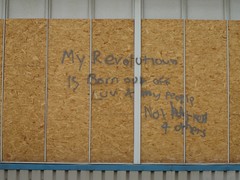
my revolution 2
For someone of my generation (the love generation) slogans about revolution can be shaded with nostalgia. Buying into the old ideas of large scale social change and the newer ideas of personal transformation, and sometimes a fusion of the two, a change that freed us from the greyness of the post-war era was really what we yearned for. Although seldom articulated with any clarity it was a myth of ‘the revolution’ we shared – an altruistic vision of the future – a better social world. This is precisely why I was struck by the personal tone of the ‘My revolution’ graffiti – so fitting, I thought, for a personalized world in which it is so much harder to imagine society or indeed any larger group than your immediate social network. And this at a time when commentators are predicting the end of party politics and a new era of issue politics in which our social and civic responsibility is redefined in terms of what matters most of all to us - in immediate terms. I realized how wrong I could be when I discovered that the slogan comes from the lyrics of Felipe Coronel (Immortal Technique) hip hop MC and political activist, with a very clear agenda for social change. Now I’m sure there’s a link or two to critical literacy in all this – and certainly a lesson to be learnt, too!
Monday, July 02, 2007
Literate bodies
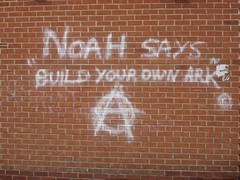
Noah#2
Last night I watched some extracts from Into Great Silence, one of which showed book-binding work in meticulous detail. I was struck by the physical labour of knotting and threading that was once part of publishing. The work of the hands has now been simplified to clicks and keystrokes by digital media. The changing work of the body in literacy fascinates me still, so I’m looking forward to this summer reading that looks at the physical dimension of reading. Today, after several disastrous attempts, I managed to photograph the Noah graffiti which appeared just after the floods on a wall near here. Along with the spontaneous humour and topicality of graffiti, there is the secret physicality of this work. Writing to scale, probably at night, with a spray can is a completely different engagement of the body.
Tuesday, January 23, 2007
Dangerous signs
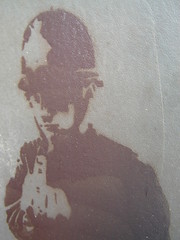
DSC02115
After the fun of graffiti bombing and the celebration of graffiti as art, it suddenly looks like dangerous business. One of our most subversive forms of literacy not only challenges laws and conventions, it can also be high risk. I doubt that this sad incident is going to change the picture – after all graffiti is as old as writing itself (1550 B.C Memphis, Egypt) – but I suppose we need to try to minimize the risks that graffiti-artists take (discussion here).
Subscribe to:
Posts (Atom)