Showing posts with label texting. Show all posts

Saturday, July 02, 2011

Texting change in language


Anthea Rowan had a good piece in yesterday's Telegraph. As to be expected it drew the usual range of comments. The full text from which she quotes (which I wrote for UKLA) runs like this: Language and literacy change over time. Social, economic and technological conditions influence these changes in significant ways. The development of mass media and, more recently, digital communication has accelerated the spread of language change and innovation. We now routinely communicate in different ways - such as emailing, instant-messaging, and making Skype calls. We use different technologies - laptop keyboards, mobile phones and webcams - to do this. These different channels of communication have led to the emergence of new communicative styles including text abbreviations, acronyms on bulletin boards, and microblogging conventions such as the use of @ and # in Tittwer. Writing, often a relatively stable or conservative mode of language, is currently enjoying a moment of creativity. This is a rich area for the study of literacy and one that has an unavoidable impact on children and young people. In fact young people are very often at the forefront of these innovations. It is too simple to suggest that 'new ways' are replacing 'old ways' or to suggest that the 'new litearcies' are somehow better than traditional practices. They co-exist and are likely to do so, at least for the foreseeable future. Most new literacy practices depend on the familiar -being able to read a familiar image and to encode and decode alphabetic writing. In fact they extend the possibilities for meaning-making and interconnection. Literacy is a much larger topic than it was twenty years ago, in an era when digital communication was still in its infancy. To fully participate in contemporary society, children, young people and adults alike need literacy more than ever before. They need to be able to write letters and send emails; they need to be able to fill in forms online and leave notes for friends and family members. There is no evidence that literacy is in decline. In fact there has been a massive increase in vernacular writing with the advent of the internet. At the same time, though, the ways in which we write and the ways in which we read are changing. In our capacity as an association for the promotion of literacy and with our interest in education, we are committed to supporting the reading and writing for all - reading and writing in whatever form is advantageous.

Tuesday, September 07, 2010

Nobody texts any more


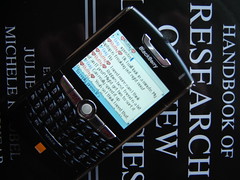
A few years ago the cool hunters of adolescent literacies were reporting that young people thought that email was dead. You might send an email to your parents or your tutors but that was about it. Young people in the UK began the massive communication migration to texting a while back. In fact many reports suggested that texting was bigger here than elsewhere (maybe the cost factor?). But what next? My daughters are no longer teenagers, but I was still interested to hear Ruth say 'Nobody texts anymore, there'll all on messenger!' It was new but not new, if you see what I mean. True though, to the extent that regular bulletins on the lead-in to the birth of my grandson, Dylan (pictured above) all came through Blackberry Messenger, as did the photograph itself. Born into a world of mobile messaging and phonecam images. New born babies are surrounded by our devices and their arrival in this world is recorded and distributed in new ways.

Thursday, March 05, 2009

OK - text


It’s always encouraging to see researchers from different disciplines engaging with similar issues. My own work (2001) suggested that the emerging conventions of text-messaging indicated a high level of facility with written language and a particular sensitivity to grapho-phonemic elements. Plester’s research in the British Journal of Developmental Psychology (here) suggests a strong relationship between texting and literacy development. It begs the question of whether texting improves literacy or whether texters just happen to be better at literacy. Elsewhere it is being suggested that phonologically-based abbreviations are processed quickly, but that the more creative textings, such as gr8 slow you down. Is that a bit like reading car number plates?

Tuesday, January 27, 2009

Flash mob futures


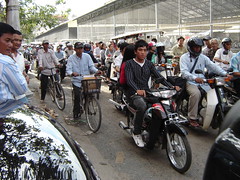
Rush hour Phnom Penh 1
Back in November I wrote a critique of Rheingold’s flash mobs and the whole idea of direct action mediated by new technology. I argued that it is hard to see how impromptu i-pod parties at Paddington Station or smart mob swarms in sofa shops fit into this vision. I suggested that they might constitute performance art or collective play, and certainly heralded a new kind of social participation, but weren’t so likely to transform society in any radical way. The French activist movement L’Appel et Le Pioche has just proved me wrong. You can read about spontaneous picnic parties in supermarkets here (their French blog) and the English press commentary here. Sounds great, but are things about change?

Friday, August 15, 2008

Out of it on new literacies


Fog your brain
Thank goodness it's just texting and emailing....blogs are perfectly OK! Phew. Here's the wonderful Becky Bowley (remember the dissolving knitting?). Her recent performance piece Transmerge was based on her train journey from Sheffield to Manchester. In Sheffield she dug a hole: then she took the earth to the next stop, Dore, where she then dug another hole and filled that hole with the earth from Sheffield. The process was repeated right along the Transpennine train route to Manchester. The Manchester earth was then taken back to fill the original hole in Sheffield. The full story's on the blog, complete with photographs of the costume and props. How cool is that?

Saturday, April 05, 2008

Back to Bauman


Black
Thinking about nested spaces and the networked individual made me go back to Bauman's observations about mobiles (in Liquid Love): cell phones signal materially and symbolically, the ultimate liberation from place....the advent of virtual proximity renders human connections simultaneously more frequent and more shallow....telling someone what station they had just left and what station would be next. ..Bauman uses the ideas of being always connected and virtual proximity to argue for the loss of intimacy. I reckon he misses the point. The networked individual has a more fluid sense of location and maybe this is why the communicative space requires updates on geolocation. So participants can imagine where they are. We often see the same behaviour in conversations across time zones. Having already calculated when the best time to call is we'll invariably catch ourselves saying: What time is it there?

Wednesday, April 02, 2008

Inhabiting the interstitial


bathroom wall
Are we learning to live in the interstices, between here and nearly hear, between now and soon? Thinking in this post about how email appears to insist on a quick response made me recall Stephen Heppell’s piece about inbetweenies. He talks here about time that is nearly now, soon but not later, using the example of txting. I think that email is also in this category. But the inbetween is also about space. As Bauman has observed, with our use of mobile technology we take others with us and we share their space whilst inhabiting a different one. In a way, then, we are here and not here. Virtual world gameplay is a bit like this too. We are here, at our keyboard, embodied; but also, at the same time, we are someone else, somewhere else. Heppell stretches the inbetween concept into other areas looking first at the ownership of the social space, the online spaces that exist inbetween social interaction, and then at the inbetween space between consumption and production. Both of the latter are useful observations, but they have been articulated elsewhere. I found the inbetween time idea more stimulating and that lead to thinking about spaces within spaces (nested spaces).

Monday, December 10, 2007

Where were you?


Revolution House
Most social networking sites allow users to create a profile and to publicly display their social connections and allegiances. Mobile social networking provides opportunities for participants to fine-tune their networks whilst they are on the move by saying where they are. Here’s Dodgeball which ties in location-based functionality together with these networks. I’m not sure whether geo-location or meeting-up becomes the social object here, but it’s certainly an interesting development. You could see Dodgeball in a number of ways - as a sophisticated tool for negotiating relationships, a consumer incursion into social living, or a risky development which ends up cocooning participants in their own small worlds. Alternatively, you could read this for some useful orientation.

Wednesday, October 31, 2007

Always with camera


Hannah and Amy
Here’s Hannah and her flatmate Amy who came up to visit last weekend. They’re very polite and wait until us old-timers start falling asleep before they turn on the laptops to start instant messaging and updating their MySpace. At other times they’re more discreet, maintaining their networks with text messaging (it’s less intrusive). I was interested to read in this report on how text messaging is taking off in China – the report suggests that it appeals because it is ‘short, fast and conversational’. We need to know more!

Thursday, October 11, 2007

To text (v)


bright kids
There’s now quite compelling evidence to suggest that British mobile phone owners just love to text. Even though mobile phone ownership isn’t particularly high (as compared for instance to Spain) this is the place for SMS. So why are we so into our mobile phones – why is it such a British thing to text? A new survey makes some interesting observations about presence and connectivity, but still doesn’t come up with clear answers. Meanwhile this article from the US argues that ‘the proliferation of writing, in all its harried, hasty forms, has actually created a generation more adept with the written word’ and goes on to suggest that texting may help to boost standards in literacy. At last, the voice of reason – texting is writing and writing is literacy! But back to the safety of statistics - many Koreans own 4 (or more) phones and owning up to 14 isn’t unknown. Knowing which one to ring or pick up could be quite a problem.

Monday, September 17, 2007

Masts


Heart_Open_Back
You've only got to mention phone masts in front of some people and they go all NIMBY. There's been a fascinating debate in our neighbourhood newsletter between those who think that masts put the cows off milking and fry children's brains (etc) and those who were caught up in the drama of the Sheffield Flood. When the phone lines went down, emergency services, medical supplies and family contact were co-ordinated through mobile phones. 'If we want the benefits of new technology' writes one resident., 'we must also entertain its physical presence.' I'm waiting for the replies....

Monday, May 28, 2007

Lolcats


Canada 2007 011
Today I was asked by The Globe and Mail for a comment on lolcats. Lolcats and the new ‘cweeole’ language are an interesting internet phenomenon. Building on the image macro idea of juxtaposing a caption on an animal image, it re-cycles the anthropomorphic idea of talking animals which runs from traditional tales, through comic books, Disney cartoons and greetings cards. In other words it’s a popular culture form with some pedigree – remember the song ‘We are Siamese, if you please’? From a cultural point of view it’s interesting to chart the rise of the ‘cute’,now well-established in Japan as Kawaii (for example ‘Hello Kitty’), as it begins to claw deeper into Anglo-American popular culture. I’m interested in the way that lolcat chat is staking out some linguistic territory. To me it represents an interesting trend in the diversification of written language associated with the rise of digital literacy. Researchers, myself included, have noted how writing is beginning to take over some of the functions of speech. Cute-speak, like it or not, is part of our cultural heritage, often hidden from view. Rendering it in the written form is what’s new, and, what’s more, given the rapid circulation of ideas in net-culture, it’s not surprising that this miaow-meme seems to be taking on a life of its own. So cute cat chat may be creolising after all!

Tuesday, April 10, 2007

Patterns of use


Barking Market at Dagenham Market
I’ve been down in London visiting family. I noticed that Emma and Sammy use mobile conversations to co-ordinate social arrangements and the net to get information. Ruth and Hannah, who are younger, use SMS much more and overlay this with MSN chat. Ruth’s probably the most connected, using MySpace to check for updates, MSN to maintain presence, SMS and mobile conversations for more precise co-ordination and YouTube for entertainment.

Monday, April 02, 2007

Panic


baggage
In this article I wrote about some of the popular manifestations of moral panic that surround online interaction. I suggested that the internet is often depicted as a hostile and volatile frontier, an insecure environment in which anything online can be stolen or corrupted by infectious viruses - a place where identity theft is rife and deception always around the corner, where you are constantly under surveillance or at risk from sexual predators. At that point I left narcissism and addiction out of the equation, but these must now take their place alongside cyber-bullying. Cyber-bullying is described by Noret and Rivers as ‘indirect’, a bit like gossip. Now ‘teachers and parents need to realise that a child’s mobile phone or computer isn’t just a communication tool – it’s also a way for a bully to reach children in their own homes.’ That’s quite a dramatic press-release. OK, 15% of the 11,227 children had received a nasty and aggressive text message or email, but come on, name me one communication tool that can’t be used for such purposes. Of course bullying of whatever sort should be discouraged, but on the other hand do we imagine that all communication whatever the medium is going to be ‘nice’ and harmonious and carefully policed by caring adults – and that we’d even know, most of the time. On a completely different note, here’s Ruth – in the studio again!

Thursday, January 04, 2007

Social


The house of rock
Here’s Danah Boyd predicting the future of social networking sites. It’s clear that there are some local differences here, but the media-fuelled moral panic in the UK is always only a few steps behind. My impression is that MySpace and Facebook have been slower to take off over here and it strikes me that they’re being used by older kids (late teens and above). Meanwhile our texting culture continues to grow as this suggests. Main providers report increased volume on New Years Day (but Christmas is a favourite for picture messaging). Better late than never, here’s some seasonal entertainment just in case you missed yesterday’s comments!