Showing posts with label literacy. Show all posts

Monday, November 10, 2025

The book


In spite of everything I may have written about the changes in literacy, the feeling of holding the book itself is still significant! The print copy of Rethinking Digital Literacy has arrived, and it feels important to hold it - even though it is light in weight when held against the hours of writing. It is a slim thing, but I'm proud of it and particularly appreciative of how it looks. I owe my thanks to my good friend for the great cover image and of course to my publisher, Edward Elgar, for doing all that publishers do and for their part in producing such a handsome volume. The book is, of course, available in digital format but I can't help thinking that readers would be missing out - even though they might be saving something like £45. But, having said that, I'm not really sure that I know what it is about print books apart from familiarity, nostalgia and habit that makes them seem so special. Rethinking Digital Literacy is an almost entirely digital thing. It was written and researched onscreen, on my iMac, at my stand-up desk. Open, on that desk, to my side, I would have had a notebook and pen, but that would be for a few scrawled reminders - that's all. It was a digital thing. It took form through tapping on a keyboard, it was saved sent, revised and checked digitally. I've never met anyone from the publishers - or even spoken to them on the phone. They might as well be machines or creatures from outer space as far as I know! I'm not complaining, I didn't feel as if I was missing out on anything, in fact I was undisturbed. The process was smooth, frictionless. I think of myself as being fairly measured. I don't go in for grand flourishes or big statements, but as the book developed and as it drew on some themes from Why Writing Still Matters, my previous book, I began to find myself arguing that there had been a revolution in writing - not just a revolution in how we produce text, but a revolution in the reproduction and distribution of text, accompanied by a discernible shift in the place of writing in the ecology of communication. As if that wasn't enough we are now obliged to take account of technological agency - not only the active work of search engines and algorithms, spell-checkers and other digital resources, but also the way in which AI and chatbots can create original text. The old monkey-typing idea- the idea that eventually (perhaps) a monkey's random keyboard tapping might produce the complete works of Shakespeare seems outworn now that AI can produce plausible and original Shakespearean English in a matter of seconds. All told, I've talked my way into a rather strong assertion. So whilst my ambition to write a powerful, popular book for a wide readership seems to have abated, I know that if I did it would be called The Writing Revolution or - perhaps its slightly weaker as a title - A Revolution in Writing. It would need someone to throw down the gauntlet before AI comes up with a version.

Wednesday, April 23, 2025

Academic outputs

At about the same time that academia was force-marched into accountability, the writing that academics do came to be referred to as outputs, as if in some sort of quasi-mechanical fashion scholars were being paid to sit on a production line watching ideas, data, themes or perhaps chunks of half-formed text rolling down a conveyor belt to be riveted together into papers, journal articles or monographs. According to this new industrial logic the productivity or worth of an academic would depend on the availability of high quality material published by a reputable publisher in a prestigious journal. Academic writing would then be on the market, favoured or favourited, liked, bought or somehow consumed by others. Just as the ways in which we think about publishing has had to take account of digital distribution and open access, academic activity, and writing in particular, has been reshaped by new market forces. Much has been written about this, and there's still plenty to debate, but the hidden cost lies in the reshaping of academic labour into something that appears to be measurable, even quantifiable in some way. A single output certainly could be described in terms of its weight as a printout, its word count or average word length - and people would be right to scoff if these were proposed as measures of its importance. So perhaps the number of citations an output receives seems more scientific - but then, if we think that influence or popularity is the same thing as quality we'd be fooling ourselves. Such measures are at the most a very rough guide, as is the h-index of an individual academic, dependent as it is on the cumulative market value of citations. Could we ever achieve consensus on the quality of academic writing? Perhaps in very broad terms we might agree that some outputs are more persuasive than others, that some develop a robust argument, develop or introduce a new perspective or contribute to the advance of knowledge. But as with writing in general, perceptions of quality are, in the end, an individual and even a temporary judgement, partly because of the way in which our own reading reflects shifting interests and purposes. For me it has frequently been the case that what I've read, and perhaps cited, may not be particularly well argued or well founded, but something that has caused me to stop and reflect - just as going to a presentation that annoys me can help to clarify my own thinking. Even academic writing that has had a formative influence may not be recognised as significant till later on, until its ideas have been absorbed, debated and reinterpreted. After all, even Einstein's groundbreaking work failed to make an immediate impact. Steady and considered assessment and re-assessment is how knowledge evolves, how ideas build within and across academic communities. As we know, a piece of writing - an output, if you must - is always in dialogue with other writing, with other discussions, and with a range of practices and perspectives. At the end of Middlemarch, George Elliot claims that the 'growing good of the world is partly dependent on unhistoric acts' and owed to those 'who lived faithfully a hidden life, and rest in unvisited tombs'. The accumulation of knowledge and the evaluation of the work of academics in general seems to me to require the same sort of logic - a recognition of a community of practitioners many of whom may live a hidden life, rather than an assembly line of outputs judged by their market value and the prestige of the individuals who produce them.

Wednesday, July 12, 2023

The desk


When my mother died, I couldn't work out what to do with the desk she had. It was rather like the one here, and it had been part of the family home as we grew up. About five foot in height, the hinged front pulled down for a writing surface revealing a series of small cubby holes that could be used to store things like envelopes, tape, pencil sharpeners and so on. I say five foot in height, but I can still remember it towering over me, not being able to reach the flat surface of the desk top, and having to be warned not to bang my head on it. I've kept hold of it all these years, although if anything it's a bit low to work at as a stand up desk. It's become clear to me that this one is a rather cheap affair - my mother referred to it as 'post-war utility furniture' - and I know that's probably true because a friend of mine's got a posher version. Better cubbyholes and drawers and even a couple of pop-out lopers that support the work surface from underneath. My parents could never quite agree on what to call it. It was one of a number of things that seemed to index their different backgrounds. My dad just called it the desk and was even known to deride my mother for calling it a bureau. For her it was a bureau, and for me because I'm interested in writing and all its appurtenances it's come to be known as the 'secretaire' which could be thought of as it's official classification in the world of furniture - 'secretaire' or 'secretary desk', although I note, in passing that in The Luminaries Eleanor Catton simply refers to is as a 'secretary' (and she can do no wrong in my opinion). And there's an alternative, too, that I rather like - the escritoire. Somehow that seems to be far too sophisticated a word to describe my dad's desk, but doesn't that just show the way we value a little bit of French? Secretaire is good because of its connection with the word secretary - originally someone who was privy to private and confidential matters (including correspondence), but escritoire appealing because of its etymological connection with scribing, with writing, with mark-making. I suppose there's a book to be done on writing furniture - desks, tables, study rests, lecterns and not to mention all those rather ugly computer tables. I'd like to read something that really grapples with the peripheral material paraphernalia of writing. Maybe not just furniture, why not venture into stationery as well? Its inventive, technological and - well, material.

Friday, August 19, 2022

Half full and half empty

In one way or another a work of fiction is always subject to the gravitational pull of the time in which it is made. Whether we're thinking of its material form as Ozeki does, or whether we're thinking of its subject matter, shape and substance are important. A print book has a particular heft and the 550 pages of The Book of Form and Emptiness lend it a certain weight. The extent to which that weight is simply ballast could be what distinguishes good writing from the rest. The Book of Form and Emptiness faces a challenge common to much contemporary fiction that directly addresses the current milieu. To put it simply, issues like environmental catastrophe, the inequities forced on us by global capitalism and the rise of national populism do not readily present us with opportunities for resolution or narrative closure. The predominant cultural story, if it's not straightforward disaster porn, is one of unsustainability and collapse rather than one of noble decline or a utopian back-to-nature simple life. Ozeki piles on the tragedies, both personal and social. I'd not encountered the term 'psychic diversity' before, but it takes its place alongside disability, mental health issues, substance abuse and poverty. If loss and grief act as a pivot for the book, hoarding, self-harm and even gender fluidity also play a part. Nearly all the principle characters are in some way lost, confused or misguided. Exceptions are the author of the fictional book-within-a-book 'Tidy Magic', Cory the children's librarian, and the unnamed woman in the library who is always typing away on her laptop - perhaps typing the book itself. Reading all this was a lot to digest, particularly since it included the post-modern device of having the book itself addressing the characters and the reader and even reflecting on the nature of books themselves. Served up with a side dish of new materialism, there was a lot here on the agency of objects, enchantment, vibrant matter and so on - as if Ozeki had taken a crash course with Jane Bennett. As a result I could have done without the potted biography of Walter Benjamin and quotations from his essays - and the Borges garnish that was liberally applied.

The Zen that the author claims suffuses the book is hard to see amongst all this clutter. Its most overt appearance is in the figure of Aikon, the Marie Kondo like author of Tidy Magic who dispenses advice on how to fold your t-shirts and underwear. At times I longed for an Aikon editor who might clear a path for the characters and events that were building some momentum. But perhaps that's unfair. The prophetic old Zen master may be a stereotype, but he is important in his own way. And Benny's koan is the question 'What is real?' which forms an interesting counterpoint to the critique of consumerism that flavours the book. They come close to being brought together when Ozeki asks 'What gives things the power to enchant and is there a limit to the desire for more?'. To combine these thoughts with the idea that things, both made and unmade, have agency sets an almost impossible question...and if a book, too, is agentive what then? And how do you square a critique of consumerism with Benjamin's obsession with collecting books? Perhaps these are just meant as a collection of ideas to think about. All told, books and libraries have a central place in this fictional world, but there are unresolved tensions even here. Early on Ozeki observes that within this 'social hierarchy of matter, we books lived on top'. But the past tense is telling. Benji's mother, Annabelle, is laid off as media goes digital, and towards the end something similar is happening with the thinning out of library shelves. There's some print nostalgia at work here, but Ozeki is up front about this. In the end perhaps, The Book of Form and Emptiness is a timely reflection on the ways in which books shape our lives in different ways.
Saturday, February 05, 2022

Literacy practices in libraries


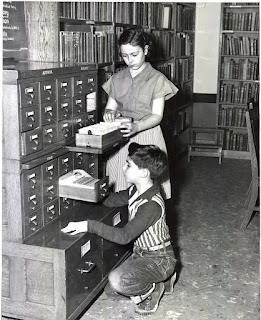
The public library was an important landmark in my childhood. It was in safe cycling distance, it was always warm, and it was the context for a ritualized, and mildly intimidating, interface with the adult world. I can clearly recall the heart-thumping point at which I would offer up my chosen books to be date stamped. I was in awe of the librarians who to my childish mind held the power to refuse me, point out my errors or even fine me. Invariably they were friendly, but they represented a powerful bureaucracy, an arm of local administration, that was strong and ought to be taken seriously. A successful visit to the library was rewarded by a subsequent rush of excitement - checking out was an experience like the end of a school day, clearing passport control or leaving a shop with just the toy you had in mind. But the pinch point at the library desk held all the power. It was the power that charged the anticipation as well as the release. The point where everything seemed to hang in the balance. With repeated visits and growing confidence I gradually became more and more interested in what happened at that point. The way in which a book's identifier - the book card, was deftly removed from a paper pouch glued to the endpapers, date stamped and then slipped with ease into my personal library card, snuggly held in alphabetical order in the custom-built wooden card index. As time went by I learnt more and more about the library system. Ways of classifying books, using card indexes and even requesting books that weren't in my particular branch. Home from my travels, in 1972, I was delighted to find that my mum had put in a request form for Herman Hesse's Magister Ludi - The Glass Bead Game. A postcard arrived at our home address on the 5th August that year with a hand franked two and half pence stamp. I know all this because the form dropped out of a book the other day. Evidently I used it as a bookmark and then forgot all about it. But the card is a fascinating record of a set of social and material literacy practices that were very much alive at the time, in libraries - and elsewhere too. The card - a reservation slip, a standard 6 x 3 inch postcard, serrated on one of its narrower edges at the point where it was detached from the counterfoil. One side with four pre-printed and indented rows of dots (for the address), the other with clearly labelled positions for the book's details - author, title, publisher and so on. The local branch name is ink-stamped on (oh, those ink stamps, so often the seals of officialdom!). All the specific details are captured in the distinctive flourish of my mother's handwriting. And one other feature that deserves a mention: two small holes and an impressed line in one corner, the scars of an earlier stapling, which tell something about a prior process of attachment. Such an efficient system, a marker of a sophisticated analogue literacy practice in its heyday, at a time when public libraries were generously funded. I could go on, but as I nostalgically turn this yellow-edged card in my hands I realise it's also charged with all those memories - returning home, my mother, reading Hesse, the smell of the public library, date stamps, stationery. It is slowly becoming other, its original and specific meaning is tucked into a card pocket in a much larger multidimensional catalogue. 

Thursday, September 24, 2020

The Meaning Makers

I never met Gordon Wells in person, but as a long-standing admirer of his scholarship I was deeply moved to read about his tragic death. It was one of those unfortunate coincidences - I heard the sad news just as I was agreeing changes on the draft of a piece I’d written. Mine was a piece that underscored the enduring influence of his work. As is often the case with writing, I needed to go through the process to clarify my own thinking, and that led to a fuller appreciation of his influence. Wells had a lasting effect on me as a teacher and researcher. Writing about The Meaning Makers, first published in 1986, it was necessary to return to the work, and I was pleasantly surprised to find it as fresh, engaging and relevant today as it was thirty-four years ago when I first encountered it. Subtitled ‘children learning language and using language to learn’, The Meaning Makers is nothing short of a landmark text. It is based on fifteen years of longitudinal research, all rather diminutively referred to as the Bristol Study. Fifteen years is almost unthinkable under current funding regimes, but it certainly helps in getting some depth. And the work of Wells and his team certainly had depth. The research was rigorous and carefully theorized, providing detailed evidence of how children’s language and early literacy developed at home and at school. It also strongly suggested how such development might be effectively supported. In his work Wells referred to a wide range of child language research, building on the insights of Britton, Rosen and Barnes in seeing language and learning from a Vygotskian perspective. Alongside this he repeatedly turned to the work of Bruner, developing a social constructivist view of meaning which was vividly illustrated through carefully selected extracts from his extensive fieldwork. Transcripts are chosen with care and subjected to close analysis in Wells’ writing and this provides an important model for all who follow in his footsteps. For me the simple message that children are active meaning makers remains a powerful guiding principle. That principle, and the convincing evidence used to illustrate it underscores Wells’ significant contribution to language and literacy studies.


Sunday, October 20, 2019

Gunther Kress

It is hard to think of what literacy studies would be like without the concept of multimodality - and for this we have Gunther Kress to thank. His death in June, 2019 came as a shock to many of us. Throughout his academic career and particularly from the mid-nineties he was a prime force in re-defining literacy. Although he always collaborated closely and generously with others, it is his thinking on social semiotics that has been influential in research, policy and practice. Two of his books 'Literacy in the New Media Age' (2003)and 'Multimodality' (2010) stand out as landmarks and contain those key ideas that he refined over a number of years. In these you find social semiotics, design, affordances, media and, of course, modality – all carefully explained and exemplified. Because of the significance and wide reach of his work on multimodality it is easy to overlook the breadth of Kress’s academic achievement. For instance, his work with Bob Hodge was particularly fruitful. Their book 'Language as Ideology' (1979) is still worth reading. And then in 'Learning to Write' (1982) Kress turned his attention to children’s writing - a topic which was then still seen as the poor relation to reading development. This is an important book for anyone interested in early writing, but it is the preface and additional chapter that he wrote for that book in 1994 that signals such an important shift of emphasis. ‘My own thinking’ he writes ‘has moved from a nearly exclusive interest in language to an interest in all those forms which are important in public communication, and in particular the visual.’ (p.xvi). That interest in the visual was expressed through his collaboration with Theo van Leeuwen in Reading Images (1996) and continued long after that. Kress’s impact on ideas about early literacy is as influential as his work on visual communication.  The project launched in 'Learning to Write' was followed with 'Before Writing' (1997) which took widely-accepted ideas about emergent literacy and expanded them in directions that still preoccupy the leading lights of literacy research. That book suggested that literacy begins with children’s earliest attempts to make meaning – intentional acts of representation that often involved objects, drawings, and what might otherwise be called play. The border between literacy as lettered representation and other forms of meaning making has been under dispute ever since this publication. All of these ideas played into his collaboration with the New London Group and into the expanded framework for multiliteracies (Cope and Kalantzis, 2000) which gained popularity with policy-makers and curriculum designers in many parts of the world and is still hugely influential. The part he played in this is clear for all to see, but it sits alongside an impressive catalogue of other achievements. This is a formidable contribution by any standard and yet it is the memory of Gunther Kress’s rigorous and generous intellect that we should treasure above all else - there is no doubt that his academic outputs will continue to draw a wide readership.

Saturday, April 13, 2019

H is for Harry


A good documentary should dig deep into a topic of interest or concern and judged against this the film 'H is for Harry' is good. Good if the topic of concern is the way in which our school system fails to meet some students' needs, but not so good if the interest is in unscrambling white working class underachievement as it repeatedly claims to do in its titles and voice-over commentary. At just under 90 minutes the film offers a sensitively drawn portrait of Harry's struggles at a sparkling new Academy in London staffed by enthusiastic and well-meaning teachers. Although there is plenty of close-up footage of Harry's intense interaction with teachers, and illuminating reflections from Harry - apparently on his way home from school, I found I wanted more detail. There is nothing about Harry's anger issues, although they are referred to a lot, and despite the fact that Harry's dad is on camera at regular intervals we don't learn very much about Harry's life at home or during his turbulent past. Of course there's only so much you can do in 90 minutes, but there's something deceptive about using Harry as a proxy for the diverse, amorphous and generally problematic social group that we refer to as the white working class. Of course, educators will draw different things from the film and that's inevitable. This one was impressed by the drive and commitment of the young teachers, but their dogged adherence to a regime of motivational slogans and exercises had a Brave New World feel to it. In a classic act of responsibilisation the achievement gap is presented as a tough challenge that individual students have to take on, whilst their unruly energies are pacified by a teacher who plays guided meditation to them on her laptop. But more worrying was the curriculum that played in the background like an old 78 - skill-and-drill phonics, grammar and Shakespeare. It was heart-breaking to watch the the teachers trying so hard to breathe life into something that was so clearly moribund. So what you might call the experience gap loomed large when you saw the world through the students' eyes - friends moving away, holidays that included a visit to a drug shop in Holland, a new swimming pool that magically appeared in Harry's back garden, a school exclusion for a stabbing (or was it an overdose?). Harry's thoughts about his future life? Staying alive. Unfortunately that seems about right. In the end 'H is for Harry' is a sad and moving film. It's very well crafted, but I'm not sure I'm any the wiser about the so-called white working class - or, for that matter, the crucially important 'others' who had walk-on parts at the Academy, but I applaud the film's sincere attempt to address the complex and important issue of the sate of education in state education. Let's have more!

Saturday, March 23, 2019

Eric Carle's book of hope

1969 – it was the year of the Stonewall Riots, of Woodstock, and Neil Armstrong walking on the moon. It was also the year in which The Very Hungry Caterpillar was first published. Author and illustrator Eric Carle had been playing around with a hole punch trying to make a story about a bookworm when his publisher encouraged him to think again. Fifty years on and his picture book is an international best seller, translated into over sixty languages, and has become a recognized classic of children’s literature. What’s more, it shows no sign of losing its appeal. It’s not just the fact that it has dark and light, the sun and moon, the days of the week, common fruit, and the numbers one to five - the brightly painted tissue paper cut-outs are distinctive and carry the simple narrative of transformation that adults and children have come to love. And, of course, at the heart of the story are the five pages of graded size with holes in them to show what the caterpillar eats. The page design is perfectly matched to the story. You see this when the butterfly, emerging from its lumpy brown cocoon, makes a vivid splash of colour across a double-page spread - its wings in harmony with the colours of the fruit in the previous pages. A wall of bright tissue paper circles decorates the end papers suggesting, perhaps, the food the caterpillar consumed. It’s a prompt to reflect on the story you have just read. In these and other ways, form and content are harmoniously woven together in a way that many later picture book illustrators have emulated. In a sense The Very Hungry Caterpillar marked the coming of age of the picture book. Janet and Allan Ahlberg, Jill Murphy, Anthony Browne and the best work of John Burningham were all to follow, helping to raise the status of the simple thirty two page spread layout into an art form in its own right. Together they showed how the verbal and visual could work off each other to create complexity and delight for young readers and the adults who sat with them. They liberated the experience of early reading from the tired predictability and narrative poverty of basal readers, introducing something you could return to time and time again - return to and enjoy. There’s more to learning to read than recognizing words. For example, understanding narrative involves remembering what has happened and predicting what might happen next and the die-cut pages in The Very Hungry Caterpillar naturally support this process. Patterned and predictable language also helps early reading. On Monday he ate through one apple, on Tuesday he ate through two pears, and so on. Eric Carle got it right. And of course, good children’s literature builds on direct experience. In a way you can’t get more direct than food! But more than that all this is the sense of wonder that adults and children can share as they read Carle’s story together. I mean, how unlikely that something that crawls along eating leaves might come to a halt, encase itself in a brittle shell only later to hatch out and take flight as something as colourful – as beautiful as a butterfly? Eric Carle calls it a book of hope. It certainly is, and it was something that seemed to be in the air in 1969 and something that is just as important in 2019.

Sunday, February 03, 2019

Alexa, why?


I'd been meaning to ask for sometime, and then I did. 'Alexa, are you female?' There's a polite pause followed by the reply 'I'm female in character' - but that said I still can't quite work her out. After all I'm not altogether sure that I like sharing my life with Amazon's virtual assistant, but now I'm settled to the fact that she's not eavesdropping, that she's only 'on' when I wake her, that she's actually voice activated, it's slightly - just slightly better. Better apart from the fact that I've now started wondering what her purpose is. So I pluck up the courage to ask, convinced that she'll maintain an enigmatic silence or say something oblique like 'I'm sorry I don't know that one'. 'Alexa, what's your purpose?' And then 'I was made to play music, answer questions and be useful.' Well OK, but the useful bit seems to have boiled down to writing shopping lists, which I have to admit is something she does quite well. We're out of spread so I ask her to add Vitalite. She does. She confirms that she has, but what comes back at me sounds for all the world like vitalité spoken with the intonation of an American speaking French. She's changed what I've said into the written word on my shopping list, and then read it back in her own voice. It's funny but also slightly creepy. Vitalité, liveliness. This isn't simple mimesis, it's transduction. 'Alexa, what's transduction?' She pauses. 'The noun transduction is usually defined as the transfer of genetic material from one cell to another by means of a virus.' No, that's not quite what I meant. I meant transfer between modes, between languages, between codes, but never mind. I recall HAL in 2001: A Space Odyssey (2001!). HAL, the very first AI villain in popular culture - if you discount Frankenstein that is - HAL whose gentle voice masks his murderous intent. Well then virtual assistants, AI and all the rest may be useful, but erring on the side of caution, I've decided to keep Alexa under surveillance. It seems better that way around.

Monday, January 21, 2019

Rock Sheffield

A friend gives me a small pebble that he found at a beauty spot on the edge of town, browny grey in colour and worn smooth by time. It fits snuggly in the hollow of my hand as some pebbles seem to do. To me, and perhaps to him, it is simply a pebble - a gifted pebble at that. I flip it over and it becomes more - there is writing on it. Someone has written Rock Sheffield with a black marker pen and then drawn a blue square with FB inside it. The words re-hide or keep are there underneath as well. Suddenly, or so it seems to me, the pebble carries more meaning. It's face - I refer to it now as the face since it has now become the front of the pebble to me - is a text. And it's a text with a history and a future, both of course much briefer than the total life of the pebble, but still it has been drawn into a new set of relations, a Facebook page (someone set it up I suppose) and a project of finding and re-hiding, a thing with a journey in a human as well as a more-than-human world. Again, I'm thinking with that small pebble, it has become special.

Saturday, July 14, 2018

Doing data differently

Reading that 8 million horses died in the First World War or that 200,000 were slaughtered with the collapse of the equine market after the Second is extremely disturbing. More so than if it had been a 'large number' or a 'great many' - and so, in such matters, numbers count. Being a literacy scholar with a background in the humanities and qualitative research often puts me in a particular position with respect to numbers. When paradigm wars break out, as they do from time to time, I repeatedly find myself in opposition to the bean counters. But as Jackie once pointed out to me, quantitative studies can be really useful in offering a broad view of trends and patterns. I just didn't listen. But now, working on the British Academy funded project Doing Data Differently I'm beginning to learn the error of my ways. In fact I'm learning a great deal, most of which I'm still mulling over. But here's a random collection of thoughts. First - and central to the Doing Data Differently project, is the significance of what you measure and what you don't (the shadow side if you like). Second, and related to this, is the sheer power of numbers, the 8 million horses effect as I shall now call it. Third is about how you visualise data. Visualisation is representation, and as a result it can highlight, it can exaggerate or it can distort information And finally, in this whole quantitative field it's all about relations, what can be mapped on to what, who or where. This can be a highly creative act (highlighting new relationships), or a selective act (implicitly suggesting that some relationships are more important than others) and probably much more, too. I'm guessing that this sort of critical perspective is all very familiar to those working in this tradition and it's probably part of the basic mathematics that I've conveniently forgotten - but it's a useful antidote to the intoxications of post-qualitative theory and is certainly helping me to think about educational data differently and equally importantly, we're sharing this journey with a wonderful group of teachers.

Sunday, March 11, 2018

Synthetic reading

Sometime in the mid '60s my father discovered drip-dry shirts. They were one of the many products of the modern world; a world in which science and technology seemed to know no bounds. They released my mother, at least temporarily, from the chore of ironing, because that's how the domestic economy was for them back then. The shirts were hung, rather unceremoniously, over the bath to drip and dry, and that could take rather a long time in the days before central heating. But they were something different, and they were, my father explained, man-made (not that other shirts weren't), and  they were artificial, they were synthetic. And therein lay their downfall. They were still a little creased after drying and what's more they didn't perform particularly well when it, or should I say he, heated up, which happened on regular occasions. Soon he'd had enough of what he called 'that synthetic rubbish', and as a result, synthetic, the very word, became associated in my impressionable mind with the artificial, or the inauthentic - something rather inferior that imitated the real thing but clearly wasn't. So now, when I see that word synthetic associated with reading teaching, I can't help but think that the obsession with phonics-above-all, and particularly phonics taught in a very specific way kind of way, is just that - an artificial product. To cling to that particular dogma, because I'm afraid that's what it is, seems rather like exhuming those shirts from the '60s, hanging them up to dry without central heating and somehow conning yourself into thinking that they perform better than any others. They don't.

Friday, February 09, 2018

Immersive reading

I think I may have coined the term 'immersive reading' in an attempt to draw parallels between the experience of dwelling in the imaginary world of gameplay and the more traditional experience of reading print fiction. It still works for me, and I imagine a continuum that runs from lightweight to immersive engagement. Not that immersive is in anyway better, it's just a different sort of experience, and one that may, on occasions, be appropriate. Having just spent 3 weeks in India, and a considerable amount of that time on very long train journeys, immersive reading was certainly appealing. I'd taken with me a substantial tome - what you might call a European classic - slow moving and highly descriptive. That turned out to be quite a challenge, partly because of frequent disruptions to my reading, but also because the narrative context (the collapse of the Austro-Hungarian Empire) seemed so far removed from the dust, heat and general mayhem of the sub-continent rolling past my open window. Somehow or other there was a dissonance between the jolting carriages, the clanking of couplings and the click-clacking of the train and the slow, dignified conduct of the story's characters. I had to work in order to conjure this faraway place, despite the fact that it was so meticulously described. I returned home with a few chapters to go, and this seems an altogether more fitting context for an immersive reading - at least of this particular book. I now feel I've missed out! Thinking about this, I was reminded of how I'd become completely hooked when I picked up a copy of Panjak Mishra's novel 'The Romantics' where I was staying in Kathmandu a few years ago. It just seemed to fit my mood. Context is a strange thing. Clearly there are no golden rules; if there were, stories would never travel, but nevertheless immersion appears to be a delicate experience and subject to all sorts of complex factors.

Saturday, July 15, 2017

The Case of the iPad

In a rather lengthy email earlier this week, our publisher announced that The Case of the iPad is now out. What exactly out means is, of course, a moot point. The work, also called a book, was completed about six months ago, although at that stage it was only really a document in Word. Somewhere along the line it adopted that rather quaint epithet 'manuscript', even though it was never handwritten and only ever illuminated by the thought that went into it. The publishers (Springer) have, inevitably, worked their magic on it and in doing so it has taken on the virtual form of a published volume. It's not quite clear yet, when the printed copies will roll off the press or whether that process is complete, or how much it matters but nevertheless the book is already out...in some sense, somewhere. Things are moving. On Amazon, for example, the picture of a Union Jack t-shirt, which for some inexplicable reason had been a placeholder, has now been replaced by an image of the book, which you can metaphorically 'look inside'. You can place an order for a print copy or the Kindle version. It looks like you can have the Kindle version right away, but the print version won't itself be released for another ten days. So you get the idea that published but not yet released may have something to do with distribution, which of course is pretty much instant in digital formats. But more interesting than all of this is the fact that the book - if that word still holds any fixed meaning - is unbundled. If you are a die-hard fan of Simpson and Walsh, or Karen Wohlwend (or any other of our wonderful contributors), Springer will sell you their chapter, as a stand alone, for just shy of thirty dollars. It makes some sort of sense. If that's all you want, that's what you can get, without having to shell out for the whole volume. It probably makes sense for Springer, too. I'm sure they've done their research. For an author and editor, and possibly for a reader too, there are some down sides. People are less likely to stumble on your chapter if they take the unbundled route. One of the reasons I like edited volumes, is that you can accidentally, as it were, find yourself reading somebody or something that you wouldn't otherwise encounter. Unbundling also changes things for editorship. In The Case of the iPad we purposely gathered together scholars with different takes on mobile literacies, and we spent some time in Skype meetings, offices and hotel bars discussing what their work did, and what it did alongside the work of others. The book is an ensemble of these and I think Cathy, Alison and Maureen would agree with me, that it's greater than the sum of its parts. But that's old-school, more like a prog-rock concept album or a sampler (remember them?), when what people seem to want now is their favourite DJ using a remix of the work and artfully fading across into someone else's with approximately the same BPM. Anything really, as long as the punters come in, and the dancefloor is full. Or is that the wrong idea? Do we just become our own DJ mashing up Bergson and Baudrillard, for example? And wasn't that what good readers did best in the first place? I don't know, but something has shifted. Buy the book!

Saturday, April 15, 2017

iPads and digital literacy

This new volume will be published in the summer and is the result of a collaboration with Alyson Simpson and Maureen Walsh. It's been an exciting project to work on and follows in the wake of Literacy, Media, Technology in which we attempted something similar - that is to take a number of quite different perspectives from scholars in the field in order to outline the complexities of digital technologies in the lives of children and young people, in and out of educational contexts. There are no easy answers and we'd be fooling ourselves if we said there are, and of course that all assumes that we know what the question was in the first place! In a scene-setting chapter, Cathy and I had a lot of fun exploring the whole notion of mobility, or mobilities. Obviously we couldn't go as far as John Urry does in his excellent book, but we had a good, quick stab at it. It seems very important to me to think about what's mobile and what isn't, and just as important to think about who's mobile and who's not. These are pressing issues in a world that has both wars, walls and migrant camps as well as unfettered multinationals, rampant capitalism, and mobile capital. Urry argues that mobility requires different kinds of anchorage, immobile platforms that control the flow of people, goods and information. Platforms, gateways and gatekeepers. There's a great feature by James Meek on chocolate production in the latest edition of the London Review of Books and it provides a really clear illustration of how late capitalism profits through its knowledge of these flows, relentlessly driving down the cost of raw materials, seeking out the cheapest and least disruptive labour force, and distributing to new and emerging markets. All in the name of maximising profit. And, in one way, that's all part of The Case of the iPad, too.

Thursday, May 21, 2015

Digital literacy in the classroom

In a current piece of writing we've been asking why an expansive view of new literacies is hard to realise in practice. We note that some innovative teachers are able to incorporate 21st Century literacies in their classroom practice whilst others find it hard. Part of that difficulty comes from competing curriculum priorities, the extensive blocking of websites, and conflicting messages about the role of technology in learning. For example, media discourses continue to polarise opinion, reporting here on the positive influence of banning mobiles in school, here on the negative effects of video gaming and here on girls' online reading. As always the studies are more nuanced than the headlines suggest, but the media reports still bolster dichotomous viewpoints. In the face of this it is timely to consider something a bit more sophisticated than the old 'is technology good or bad' question. We should be asking how particular digital literacy practices relate to activity, interaction and engagement, and then how they might benefit (or disadvantage) their users. New literacies won't go away - and anyway we're rather powerless to check their advance, but we can as educators help in promoting efficacious uses of hardware and software.

Sunday, May 11, 2014

Boxes of poison

Stacks of cardboard boxes are scattered around Barnsborough. Children's avatars might just discover them, and if they do, by hovering over them they will read a label that says 'boxes of poison'. Such a chance discovery might or might not map on to their interest, and to the play of narratives that emerges in this virtual world and the classroom in which it is accessed. And what is more this will only happen through extended, exploratory and open-ended action and interaction. Story building of this sort, whether it involves drama, videogaming, movie-making, virtual world play or immersive  engagement with written text, takes time and has multiple and complex learning outcomes that are not quantifiable or easy to measure. Although understanding narrative and the opportunities for problem-solving and generating hypotheses that are embedded within are generally understood to involve important habits of mind and learning dispositions, they have come under threat from a curriculum that is driven by simple, measurable outcomes, over-specified learning objectives and so-called evidence-based practice. Reclaiming this territory is fraught with difficulty, particularly when dominant discourses are pervasive, and present a regime of truth which evokes sentiments like investing in our children's future, securing high standards and developing a world-leading education system - who could criticise those virtuous ambitions? In a forthcoming piece provisionally titled 'Boxes of Poison' that's exactly what we'll attempt to do!

Saturday, October 26, 2013

For your pleasure in this present state


Reading for pleasure and self-improvement has an enduring and emotive appeal, and through its close association with typographic print, with the book, and with immersion in literary fiction the idea has significant currency in recent debates in literacy education. This is indeed welcome when understood as a re-statement of the importance of the liberal arts curriculum in an educational landscape dominated by accountability and assessment regimes that carve up learning into measurable parcels. In England the backwash of testing in spelling and grammar is emblematic of how progress in literacy can result in learning that is parcelled up and quantified. As a counter-narrative then, reading for pleasure evokes everything that is good from individual choice and independence to interest-led autonomous learning - qualities that by their very nature elude measurement. Yet even though the challenge to an atomised and autonomous model of literacy is desperately needed, this should not place the idea of reading for pleasure beyond scrutiny. Reading for pleasure sits at the centre of a nexus of ideas about literacy that constitute an ideology that requires careful examination. Reading for pleasure derives its justification from a number of different traditions. What the Cox Report called 'cultural heritage' is a justification that draws on (well-deserved) pride in the tradition of English literature. How empathy and vicarious experience may develop moral virtue is a second justification, and one popularly articulated in Pinker's recent work. And since no educational debate now seems complete without a contribution from neuroscience, the influence of what we presume is immersive reading on our neural pathways surfaces here. But what might the challenges be to reading for pleasure in our densely mediated, highly mobile and increasingly digital world? This is the project I'm now embarking upon! Watch this space.....

Friday, October 04, 2013

The pleasure principle

Good quality research data on reading for pleasure is always a useful complement to the rhetoric on the topic. So it's great to see the clear message that 'children who read for pleasure are likely to do significantly better at school than their peers' (who presumably don't). This comes from the Centre for Longitudinal Studies report here. If you delve into the report you see that the key influence is defined in rather broader terms - 'home reading culture' and 'leisure reading' are described in some detail and these are to my mind rather more sophisticated concepts. However, put the headlines alongside this and you might quickly get the picture that print culture is doomed and with it the written word. I don't actually think is the case - there's probably more reading and writing going on with everyday uses of technology than ever before in history, and there are also more possibilities for narrative pleasure. But digital media are an 'and' not an 'or'. Children and young people simply have far more textual choices than ever before. We know about the claims made about bedtime stories - but rather than simply accepting this as a privileged ritual (or a ritual of the privileged), we need to understand more about what's going on. I'd put my money on the shared endeavour of skilled and apprentice meaning-makers making sense of text together. If this is accurate then the benefits could extend to any media, unlocking a wider palette of pleasures.