Monday, November 26, 2007

Gone!


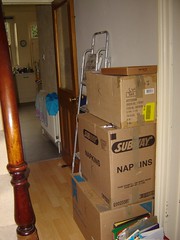
my house 4
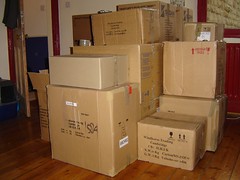
This is was what it looked like in the final stages...and this is just to say that I haven't completely gone from the blogosphere and will be posting again soon! Apart from being very tired from what is one of the major upheavals you can make meatspace, I've found it really difficult to get a broadband connection. There's a message to Ofcom on the way, but how ridiculous that one provider can block your connectivity with another. They must be short-staffed at the telephone exchange! In the meantime I've been making a start on the book 'Web 2.0 for schools' which is a collaboration with Julia Davies. More about this one soon.

Tuesday, November 13, 2007

I threw it all away


my house 1
Reading Benwell and Stokoe (see sidebar) is confirming my view that identity is constituted and performed through discursive practice. But I also want to extend this to the ways in which we express identity through consumption in order to acknowledge how we build social ties around the ways in which we consume, resist, parody and critique our consumption (another kind of discursive practice, perhaps). It’s not quite as simple as ‘we are what we consume’ it’s way more subtle than that; but neither are we the unthinking dupes of consumerism. More it’s how we consume, what we don’t consume, and what we throw away! This was brought home to me through frequent trips to recycling points and dumps as I sort through things in the run up to moving house!

Sunday, November 11, 2007

Working ground


sad princess
We’ve been experimenting again with blogs and wikis on our Masters course. Yesterday we had 14 students with little previous experience construct a wiki of about 30 interlinked pages with out-facing links and rich media in just under 60 mins! I noticed 2 things much more clearly this time. Firstly that, because the writing/thinking and contribution is much more open, the potential for collaboration is often in conflict with self-confidence and impression management (this is probably more the case for blogs than it is for wikis). Secondly and not unrelatedly, the digital writing involved tends to make identity work overt as students tell their own stories and colour these with details from their non-professional lives, hybridizing self-disclosure with critical reflection in new and interesting ways. Blogs and wikis as tools for online collaboration and learning are explored in this article in Language Learning and Technology. And here it is argued that: ‘There is a lot of emerging literature regarding the potential of blogs and wikis as learning spaces. The majority conclude that these social software tools can be a transformational technology for teaching and learning. Blogs and wikis are tools supporting a social constructivist theory of learning. Social constructivism, a variety of cognitive constructivism, contends that knowledge is actively created by social relationships and interactions, emphasising a collaborative model for learning.’ OK, we know that the real challenge is introducing them and working them into what we do in intelligent ways.

Friday, November 09, 2007

Blogs bloom


lilly flower
Blogging seems to be as buoyant as ever in the UK. This article reports that 'of Britain's web population of 26 million,15% kept a blog.' That’s a lot of blogs, a lot of writing on line, and a lot of posting! Much of the blogging boom is attributed to Facebook and MySpace, and of course commentators are caught up with defining the boundaries between blogs and other online formats. And so you get: 'The line between a blog and a website has finally blurred enough it's often hard to tell if you're a blogger or not,' said Jon Silk, of the PR firm Lewis. 'Users of sites such as Facebook and MySpace are all bloggers.' But I suppose the main message is worth re-stating digital literacy is becoming a central part of many people’s lives, and education is only just starting to catch up.

Wednesday, November 07, 2007

Surveillance (again)


verichip
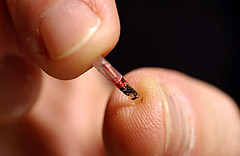
This report, from 2005, on the rfid-tagging of school students in California (as if they were criminals) caused a minor storm, but showed us the shape of things to come. More recently, a school in Doncaster started piloting a scheme in which students have rfid-chips sewn into their school badge. The manufacturers say that tagging helps "accurate and speedy pupil registration, child security." Also it aids " school behaviourial and reporting systems covering rowdy pupils" – I wonder how we got so bad at registration, and why we opt for custodial measures rather than trying to understand disaffection. Not surprisingly, civil liberties groups are not amused. Let’s face it students will soon realise that the technology locates the badge not the individual. Swap uniforms, lock your badge in a secret location, interfere with the rfid signal – the possibilities are endless!

Tuesday, November 06, 2007

La fracture numerique


caged in
La fracture numerique (digital divide) is exposed in a survey of young adults in the US. The survey looked at patterns of use with respect to the social networking sites Facebook, MySpace, Xanga, and Friendster. The main headlines are that “gender, race and ethnicity, and parental educational background are all associated with use, but in most cases only when the aggregate concept of social network sites is disaggregated by service…” So, as we suspected we have a picture of unequal participation related to user background. The author concludes, here, that differences in the adoption of social networking services will contribute to digital inequality. A similar theme was identified here by Jackie who refers to the social graph (here).

Saturday, November 03, 2007

Symbolic work?


favourite shop
This is a favourite amongst my most recent photographs. There is something about the juxtaposition of the pro-anarchy spaycan graffiti and the folksy North-West Frontier ethic of the take-away shop-sign that is very glocal. Also, on closer inspection, there’s some textualising of the self - as I am caught in reflection in the window – captured, commented upon and circulated.

Friday, November 02, 2007

Invention


hospital bed

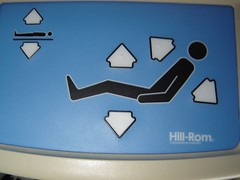
I came across a reference to electronic paper and tried to work out what this might actually be. For once the wikipedia entry was unhelpful; this not much more so; and this lost me after the first few sentences. I must say, I can’t quite see its use - apart from securing a place in the quirky inventions gallery alongside author Margaret Atwood’s gadget for remote book-signing (the LongPen) and this from BoingBoing Gadgets – the Bible-writing robot!

Wednesday, October 31, 2007

Always with camera


Hannah and Amy
Here’s Hannah and her flatmate Amy who came up to visit last weekend. They’re very polite and wait until us old-timers start falling asleep before they turn on the laptops to start instant messaging and updating their MySpace. At other times they’re more discreet, maintaining their networks with text messaging (it’s less intrusive). I was interested to read in this report on how text messaging is taking off in China – the report suggests that it appeals because it is ‘short, fast and conversational’. We need to know more!

Tuesday, October 30, 2007

Mongolian?


Here’s a clip of Mongolian c-walking. C-walking (short for clown-walking or crip-walking) is a worldwide phenomenon, drawing on combinations of dance moves, like moonwalking, with plenty of inventive transitions. I’m not sure how Mongolian this c-walking really is, but I am struck by the multimodal nature of the performance. The music is a central feature, but also note the dress style and the graffiti backdrop – and the occasional floating in of written text. Hip-hop and a bit more edge than Michael Flatley, I think.

Sunday, October 28, 2007

Seen from above


I remember a few years ago taking a good friend to see a unicursal turf maze I’d recently found out about. It was on a beautiful hilltop overlooking the southern sweep of the Humber estuary. We talked about reading the landscape as a palimpsest – the shadows of history marking its surface – just the same term that was used in the years between the wars by the early aerial photographers who contributed so much to our knowledge of archaeology. I’ve just been reading Kitty Hauser’s fascinating account of the life eccentric aerial mapper O.S.G. Crawford, whose interest was nurtured on reconnaissance flights over the Somme. I was struck by the way we see things differently from different perspectives – obviously flying over the landscape was still fairly novel in Crawford’s time – but also, in times of war, you are looking for different information in the landscape. Later, Crawford's colleagues exploited the opportunities offered by new technologies in quite daring ways. Major George Allen, for example, would fly solo with a specially designed aluminium camera. When the time came for aerial photography he would fly hands-off leaning out of the window to take his snaps! When I saw this last week about militants in Gaza using Google Earth to access secure information, I was reminded again of the co-incidence of technology and warfare. “It is not the first time that Google has been accused of unwittingly abetting the activities of militant groups or terrorist organizations” Guardian reporter Clancy Chassay points out. Information is only information – it’s only in times of conflict that it becomes dangerous.

Thursday, October 25, 2007

Perspectives


liquid lunch
You always get interesting stuff on the Digital Ethnography blog, and a recent post profiles ‘the student of today’. I didn’t read much here about gameplay, but you do see plenty about the diversification of literacy practices. For more specific work on gaming there’s the online journal Loading and the upcoming conference announced by Colin and Michele here - whereas in today’s Guardian, Alex Krotoski considers whether the dialogue between gamers and academics is actually taking us anywhere.

Tuesday, October 23, 2007

Flaneur!


SFstreet1
Will Self is a middle-aged flaneur. He sometimes calls his art psychogeography, but whatever the label, he’s a self-confessed twilight rambler. I listened to his confessions here last night, but you can read an account of his ramblings in this article too. He name-checks a number of luminaries including Guy Debord, but not, interestingly enough, Flaubert. At least he’s big enough to own up to the fact that Iain Sinclair is the contemporary expert in the field – and his psychogeography gets almost mystical!

Monday, October 22, 2007

Games people play


This video made me laugh because it came up as being about women gamers and the first two segments are so male-orientated that I thought it was a joke. Anyway there’s an interesting bit at the end. And over here there’s a blogger giving a warm reception to the Byron Review, particularly praising the inclusiveness of the consultation. Further on there are more comments on the ‘media violence’, but nothing really unexpected.

Saturday, October 20, 2007

Where I'm coming from


Autumn walk
Social networking sites provide rich examples of what Giddens describes as the ‘trajectory of the self’. My daughter, Emma describes how Friends Re-United never did anything for her, and MySpace was ‘too young’ whilst Facebook, not only thickens her existing social ties but also networks her with old acquaitances – friends who have moved abroad, people she knew at school and so on. This, she explains, 're-defines who you are' and ‘how far you’ve come’. As Giddens says: ‘The trajectory of the self has a coherence that derives from an awareness of the various phases of the lifespan. (1991:75). Interestingly, Mark Zuckerberg, the founder of Facebook (interviewed here) says: ‘We're talking about the set of connections that everyone has in real life. All we're trying to do is take those connections and map it out. Once we have an accurate model, we can help people to share their information more effectively. But it's going to take 30 years – or at least tens of years – before this becomes a really mature platform.’ You can view this project as an attempt to establish personalization through commodified experience resolving one of Giddens’ dilemmas of the self. An ambitious project (...and I’m not on Facebook, yet).

Thursday, October 18, 2007

That's OK


more graffiti
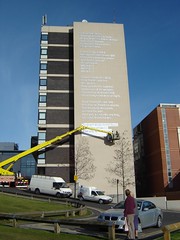
I’ve watched this writing on the wall growing over the last few days. I’m not sure whether you can say that the crane is a writing tool, but it looks like it. Each letter is about 3 feet high and mistakes need to be avoided at all costs. The poem (by Andrew Motion) is part of the Sheffield’s ‘Off the Shelf’ festival. Despite being a kind of writing on the wall that could offend some, it couldn’t be described as graffiti because it’s officially sanctioned – a privileged writer works with full permission (no danger of a court case here).

Tuesday, October 16, 2007

Risk


Hot metal
Looking at the Byron review, one of the key questions is “What are the benefits and opportunities that new technologies offer for children, young people, their families, society and the economy?” well that’s OK for starters and there’s plenty to say on that topic. But really it’s all about risk, and that’s tricky…. You can’t argue that there’s no risk involved for children and young people surfing the net any more than you can argue that there’s no risk in going to the local park. More important though is gauging the scale of the risk, and educating children and parents to be aware of risks. One of the problems that a number of us have reported on is the way in which schools (and school authorities) become so pre-occupied with internet safety that their students rarely get beyond the walled gardens that are so heavily protected by filters and firewalls. Well the worry is understandable, but if school environments are so heavily policed don’t we end up severely limiting children’s explorations of the internet? Then we filter out most of the best stuff along with the worst stuff and deprive them of the opportunity to choose sensibly. I also think we need to think more clearly about what we mean by risk – exposure to violence is one so-called risk factor which always gets cited. But don’t we all really know that the history of narrative shows our on-going fascination for fictionalized violence? On that note, here’s Henry Jenkins getting to grips with the concept of ‘media violence’ - pretty convincing.

Monday, October 15, 2007

Don't panic


we electric
The government is clearly worried about vulnerable technosubjects. The DCFS has commissioned the Byron Review to look into “the risks to children from exposure to potentially harmful or inappropriate material on the internet and in video games.” I 'll be featuring comments on this over the next few weeks and linking to the views of other bloggers – one would hope that this isn’t just about moral panic. Meanwhile, the Primary Review suggests that young children are stressed out – mostly about government tests, but to be fair about other things, too. Sue Palmer manages to get toxic in this report (it’s all down to screen-based entertainment, of course) although Robin Alexander, the director of the review presents a more balanced picture.

Sunday, October 14, 2007

On blogs


old sticker
There’s a lot of change in my life at the moment, moving offices, moving house (and more, too). So I find myself very pressed for time and leaving a few more spaces between posts than normal. When Dr Joolz writes about blog guilt - we’ve been here before, I recall – that doesn’t quite accord with my feelings. Perhaps I feel more that I either just don’t have the time, in the way that Flaneuse describes, or that I’m not quite sure what I want to blog about (see Simply Clare). Now that last one’s interesting because I could just blog about having a busy day, or being completely cheesed off with timewasters, or unnecessary meetings, or...but I don’t. And this is because my posts have become more focused, my blog has morphed into a technology-education-literacy sort of thing – or to put it another way, I’ve gradually started using my blog to perform a particular identity. Dr Joolz and I dubbed this the ‘hide and reveal’ phenomenon – in other words on days when I don’t really have something on technology-education-literacy, haven’t thought something, read something or visited somebody else’s blog, it’s harder to post (I hide rather then reveal).

Thursday, October 11, 2007

To text (v)


bright kids
There’s now quite compelling evidence to suggest that British mobile phone owners just love to text. Even though mobile phone ownership isn’t particularly high (as compared for instance to Spain) this is the place for SMS. So why are we so into our mobile phones – why is it such a British thing to text? A new survey makes some interesting observations about presence and connectivity, but still doesn’t come up with clear answers. Meanwhile this article from the US argues that ‘the proliferation of writing, in all its harried, hasty forms, has actually created a generation more adept with the written word’ and goes on to suggest that texting may help to boost standards in literacy. At last, the voice of reason – texting is writing and writing is literacy! But back to the safety of statistics - many Koreans own 4 (or more) phones and owning up to 14 isn’t unknown. Knowing which one to ring or pick up could be quite a problem.