Tuesday, May 06, 2008

Learning from YouTube


Janet ponders
Today, DrJ and I were thinking through some of the issues around YouTube and formal education. We concluded that there’s plenty of potential for textual study and critical reading (the media studies bit), but there are difficulties when it comes to using it as a learning tool. One of the difficult issues is the rather chaotic nature of YouTube -for instance, there seems to be absolutely no logic governing the related videos section. It might as well be random. You’re as likely to stumble on dodgy humour, soft porn or parody - it encourages garden-path connections. Here’s a report on a YouTube course. I liked the six binaries (bottom of the page) but was uncertain about how these are construed as limitations. This is another report on the same course and here’s Henry Jenkins interviewing Alex Juhasz (who taught the course). Part One and then Part Two.

Monday, May 05, 2008

The text


The posse
May Bank Holiday. I've been taking a bit of a break. There have been some rather dismall local election results and a worrying rise in BNP voting. I can't see much hope for a London with Boris, but we'll see. Meanwhile I'm just on the look out for some good academic work on video-sharing...and, as promised here's a direct link to Jackie's inaugural (to go with the picture). Oh so multimodal...which reminds me , Sigrid has this link to the king of multimodality, click here, it's a corker!

Wednesday, April 30, 2008

School 2.0


Down under
Jackie’s inaugral lecture was a real celebration of her achievements. I look forward to picking up the paper: Emergent Literacy 2.0, and will link to it from here. I was left wondering when digital or new literacy gets rehabilitated with mainstream literacy. If we accept that there is diachronic and synchronic variation in literacy/ies then we should be able to accommodate the full range of mark making procedures from scratches, to pen strokes, spraycan graffiti and onscreen writing. We might also be able to account for the affordances of these different writing media, their power and status, their legitimacy as well as their intertexts. And then we could describe them all as literacy practices etc etc. So far, so good. But, like the original emergent literacy concept, the emergent literacy 2.0 concept must be partly defined in opposition to ideas of 1.0. So, until dominant perceptions of literacy, and particularly schooled literacy, including of course early literacy, begin to broaden out new literacies, digital literacy and Emergent Literacy 2.0 are necessary ideas to hold. Maybe it’s also possible, as some have begun to suggest, that there is a bigger picture, that could be sketched out under the heading of School 2.0 .

Sunday, April 27, 2008

On the same page


Church door
Teaching a group who are all on wireless laptops is a strange affair. Yesterday I was trying to explain some ideas on a powerpoint which my group all had access too. Of course they could control the rate of their own progress through the slideshow, and I had a somewhat slippery control over the process of my commentary. I confess that I really wanted everyone on the same page (yes I know I’m a control freak) and that brought the didactic urge to the fore, even though it was embedded in a sequence of teaching that included exploratory group discussion, reflection, paired work as well as online activity. Coming home I was reflecting on the power of that idea of being on the same page, a phrase from the age and perhaps the pedagogy of print. I imagined that it derived from an era of scriptural authority or what deCerteau refers to as the scriptual economy of written language, and indeed this source refers to a hymnal. What would be a more contemporary reference point for the digital age? Starting from the same link, working in the same affinity space - or, do we in fact need to spend more time on the same page?

Thursday, April 24, 2008

Doing different things


Strange house...
I examined a thesis the other week in which the candidate (who was looking at innovations in e-learning) made the distinction between doing things differently and doing different things. I find this a very helpful way of looking at new technology. In a sense it’s value free. As I see it, that means that sometimes we do the same (old) thing, but we end up using new kit, new software or whatever. Like phoning my mum on my mobile rather than on the landline. It doesn’t change much, she still can’t hear what I’m saying, and I for my part need to be extremely patient! But then blogging really means doing different things - and as I’m still learning, using blogs educationally is another thing altogether.

Tuesday, April 22, 2008

Pandorama


Boal
I was talking to Richard about the Kris Gutierrez paper in RRQ that describes teatro do oprimido (Boal’s theatre of the oppressed). He made a connection with Tressell’s fictional account of the pandorama in The Ragged Trousered Philanthropists. Of course, the workers' cinema that Bert White’s Pandorama envisaged is a fictional account, but I suppose new media could provide a platform for popular mobilisation. Here’s a description from the book: The `Pandorama' consisted of a stage-front made of painted cardboardand fixed on the front of a wooden box about three feet long by two feet six inches high, and about one foot deep from back to front. The`Show' was a lot of pictures cut out of illustrated weekly papers and pasted together, end to end, so as to form a long strip or ribbon. The show itself, illustrated exploitation, unemployment and police violence. More reflections on this topic can be found over on Blogtrax.

Monday, April 21, 2008

Glogging


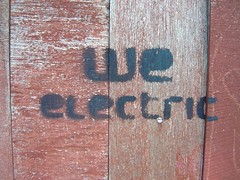
we electric
At last week’s NAAE conference I introduced the Glogster’s glogs as an example of a new Web 2.0 development. Now the term glog is rather misleading, because it can actually be used to refer either to a games blog or a geo blog (a sort of mobile video blog). But that aside, I asked whether a Glogster glog was most like a poster, an online shrine, a scrapbook or a new textual form? But also because we were exposed to the three Cs (cultural, critical and creative), not to be out done, I thought I’d have me some Ps, five of them: personalisation, publication, presentation, peer-to-peer and popular - these being characteristics of Web 2.0 apps. I must say I rather like these, and may develop the idea. After all, there’s nothing like a list to get you started!

Sunday, April 20, 2008

Books


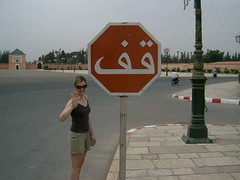
Moroccana104
I read an interesting review by Doug Black on Coolhunting of a book called "Letter by Letter", by designer/calligrapher/artist Laurent Pflughaupt. The book looks at alphabetic letters as standalone objects, and sounded from the review like a more interesting read than David Sacks’ book “The Alphabet”. After an inspiring radio interview with Raymond Tallis, I think I’m going to order a copy of “The Kingdom of Infinite Space: A Fantastical Journey Around Your Head” which deals with topics like kissing and spitting and why thoughts can’t really be said to be in your head…. And on the related topic of kingdoms (segue) I’m putting in an order for Lisa Jardine’s “Going Dutch” which looks at that erased link of the forgotten invasion, or Glorious Revolution, and why we’re more Dutch than we think we are!

Thursday, April 17, 2008

Technologic


drinks tray graffito
The Daft Punk song Technologic captures the spirit of what Colin and Michele call the new ethos stuff in digital production: plug it, play it, burn it, rip it (full lyrics here) and the rest, seems to describe these new practices. Today I was in Manchester doing a keynote at the NAAE conference and it occurred to me to restate that, whilst I stick to my definition of digital literacy as primarily being about writing, I see that it only plays a part in larger texts; texts in which meaning is dependent upon the orchestration of multimedia semiotics. Anyway, in the end, I forgot to say that, so this acts rather like a postscript.

Wednesday, April 16, 2008

Space and time (again)


space city
A short while back I promised Sarah I'd do a favourite three list of sources on time, space and new technology. So here’s how it goes. First I have to have Giddens, because he writes so lucidly about the changing nature of place, space and time in late modernity. For me he sets out the broad context in which specific technoliteracy practices are played out. Secondly, I really enjoy Jay Lemke on this topic - probably Across the Scales of Time: Artifacts, Activities, and Meanings in Ecosocial Systems is what I’d go for (there’s a version here). Third is Kevin Leander – I don’t enjoy the theoretical stuff as much as the case study commentary (so, I’d nominate ‘You won’t be needing your laptops today’ which is in Knobel and Lankshear’s New Literacy Sampler). I’d have Lefebvre in, but although I like some of it I can’t make it all work for me. And then, out of the one’s that didn’t make it, there is Barry Wellman. His idea of the movement from the glocal to the networked individual is really based upon changing spaces and time, but I don’t think the theme is really foregounded in his work. Well anyway that’s how I’m thinking about things at this moment in time!

Tuesday, April 15, 2008

Vertical space


stairwell
I scaled these stairs yesterday afternoon to put the finishing touches to a book chapter on blogging. Somehow, whilst doing this, I realised how much more there is to explore in this particular territory. It’s that familiar tension between taking in the broad sweep of things (the Web 2.0 book will do that) and focusing in on specific new literacy practices. From now on my attention will be on working up the virtual world material for publication…and on that note I’m looking forward to this day conference on virtual worlds in May which looks very interesting. Meanwhile, back at home, renovation work carries on apace with work on all the sash windows and dust everywhere!

Saturday, April 12, 2008

Your place from space


bright
I’ve been getting pretty addicted to using Google Maps on my handheld just to see where I am in satellite view (kind of sad, but kind of true). When I’m at home I can zoom in and see a couple of cars parked up outside, but they’re always the same two cars and neither of them is mine. I reckon the satellite data must be a couple of years old at least. Google Street View gives a more detailed view and there are concerns about the level of intrusion (surveillance) that results as this article reports. Meanwhile Jackie draws our attention to the concept of geo-schooling. Here’s Adam Greenfield’s piece on location-based and context-aware education that she refers to.

Thursday, April 10, 2008

Nested spaces


new lits (side view)

I borrowed the idea of nested social/communicative spaces from David Barton who talks about nested and chained literacy events. It seemed to me that the idea captured the sense of being simultaneously here and elsewhere, occupying two different interactive spaces at the same time. It strikes me that this is rather different from liminal activity in that the latter is often seen as a disorientating, indeterminate sort of space. Nested spaces are pretty much mainstream, and I suggest that although they are a good way of describing technological-mediated communication they also provide a reasonable account for more traditional forms of partial immersion (book-reading; movie-viewing and so on) where one isn’t exactly in the zone but accessing an alternative reality. Sarah points to Ito and Okabe’s study of Japanese Youth and mobile messaging (here) and the new technosocial spaces that are documented. Some of these seem to me to be examples of nested events. I’m not sure that they are necessarily new - just more pervasive and more persistent.

Tuesday, April 08, 2008

Virtual bimbo


disk
Well there are virtual spaces and there are virtual spaces. Some are exciting, others rather trivial and then there’s the noxious Miss Bimbo. So, first you Find your own cool place to live; then you Find a fun job to pay for your needs and all the clothes a Bimbo could possibly want. It gets worse...... as you Shop for the latest fashions and become the trendsetting bimbo in town. You can then become a socialite and skyrocket to the top of fame and popularity, and date that famous hottie you've had your eye on and show the Bimbo world the social starlet you are. But wait....... you can (and I quote) Even resort to meds or plastic surgery. Stop at nothing to become the reigning bimbo. Needless to say, this has created a bit of furore. Here’s a report on the watchdog investigation.

Saturday, April 05, 2008

Back to Bauman


Black
Thinking about nested spaces and the networked individual made me go back to Bauman's observations about mobiles (in Liquid Love): cell phones signal materially and symbolically, the ultimate liberation from place....the advent of virtual proximity renders human connections simultaneously more frequent and more shallow....telling someone what station they had just left and what station would be next. ..Bauman uses the ideas of being always connected and virtual proximity to argue for the loss of intimacy. I reckon he misses the point. The networked individual has a more fluid sense of location and maybe this is why the communicative space requires updates on geolocation. So participants can imagine where they are. We often see the same behaviour in conversations across time zones. Having already calculated when the best time to call is we'll invariably catch ourselves saying: What time is it there?

Wednesday, April 02, 2008

Inhabiting the interstitial


bathroom wall
Are we learning to live in the interstices, between here and nearly hear, between now and soon? Thinking in this post about how email appears to insist on a quick response made me recall Stephen Heppell’s piece about inbetweenies. He talks here about time that is nearly now, soon but not later, using the example of txting. I think that email is also in this category. But the inbetween is also about space. As Bauman has observed, with our use of mobile technology we take others with us and we share their space whilst inhabiting a different one. In a way, then, we are here and not here. Virtual world gameplay is a bit like this too. We are here, at our keyboard, embodied; but also, at the same time, we are someone else, somewhere else. Heppell stretches the inbetween concept into other areas looking first at the ownership of the social space, the online spaces that exist inbetween social interaction, and then at the inbetween space between consumption and production. Both of the latter are useful observations, but they have been articulated elsewhere. I found the inbetween time idea more stimulating and that lead to thinking about spaces within spaces (nested spaces).

Tuesday, April 01, 2008

Byron Review!


floater

The Byron Review’s Final Report has just been released (27th March) and the full text can be downloaded here. The report recognizes the experience and curiosity of children and young people around new media and yet still avoids demonizing the technology. But at the same time it acknowledges the widespread concerns about appropriate material and draws attention to the role of education. In the Executive Summary, the public swimming pool metaphor is used to good effect. It goes like this: Children and young people need to be empowered to keep themselves safe – this isn’t just about a top-down approach. Children will be children – pushing boundaries and taking risks. At a public swimming pool we have gates, put up signs, have lifeguards and shallow ends, but we also teach children how to swim.

Friday, March 21, 2008

More tube


Deep cut
We know that Web 2.0 sites are partly defined by their dependence on user content. In this respect YouTube is no different. But as I observed here, it doesn’t really promote participation through linking, indexing and commenting. In fact the connections that YouTube make are more outward facing, ending up in other sites, personal blogs and word of mouth recommendations. If you’re looking for the Flickr of moving image then Vimeo is the answer. You can upload video to share with people and friends via a contacts list…in short it’s more of a networking site, but will it challenge YouTube domination?

Thursday, March 20, 2008

Email stress


tow path
Usually I take a positive stance on new communications technology. I think of new channels of communication as being inherently neutral in character, offering different opportunities and choices to users. Reflecting on email, particularly in the way that it is so intensively used in academic and institutional settings, I’ve come to wonder why it contributes to so much work-related stress. Now, of course, it’s not email itself – it’s the way we use email, and the working practices that it supports. I’ve talked to a number of colleagues about this, and watched how they sigh when referring to their inbox, and I’ve watched how people will flick across to their email when working on something else, just to delete irrelevant messages in a desperate bid to keep on top of things. And then there are those of us who obsessively check our mail – before going to bed, on waking up and so on. Here’s a wonderful piece on email apnea that reflects the phenomenon of email stress and even meanders into medical territory. The theme is not new. This article in the Guardian summarized some recent research. I’ve been unable to track down any more from Karen Renaud, but this is a useful introduction. As we approach a bank holiday and the possibility of a few days leave, how many of us will worry about the state of our mailbox on our return? Well, I’m not going to worry about it until I do! In the mean time here are my mail management strategies: try to keep the inbox as empty as possible; delete the obvious junk and reply-to-alls; read it, respond or delete; if it calls for a detailed response, send a holding message; limit the number of times you check your mail each day….And if you’re reading this and wondering what happened to your reply – well, they’re just strategies. Sometimes I forget to use them!

Tuesday, March 18, 2008

Comic Poetry


I listened to a celebration of comic poet, Hovis Presley over lunch and my first thought was to reach for a YouTube clip which is exactly what I’ve served up today. I’m getting gradually more interested in the YouTube phenomenon as it enters more and more into public discourse and everyday conversation. This blog contrasts the anarchic nature of its archive with the popularity of the entertainment that it provides. Although it doesn’t quite deliver on developing community it certainly gets around – it’s so easy to embed the clips, so quotable and so unlike traditional media.

Thursday, March 13, 2008

Focusing on text


sorry
I was here yesterday for the first seminar Theorising the benefits of new technology for youth: Controversies of learning and develop. There was some interesting debate, but I realized that I begin from a different starting point. My interest is in textual production and consumption and I draw theory from that, and apply new perspectives to it…perhaps that is characteristic of a digital literacy approach. I focus on resources, practices and processes of meaning making….So, when Rebekah, as discussant, used text to illustrate some points about framing and performing identity I began to see more clearly what I thought was missing from an otherwise engaging conversation.

Tuesday, March 11, 2008

Visuals


This was sent by a friend who said I liked the unusual...well, it's an old Sesame Street thing but it's a very visual representation, with animals unaware of the human meanings they're making. Well, the same thing's going on here (don't you just love that lounge music!) trivial, but visually quite interesting.

Sunday, March 09, 2008

Voices


RuTube
I was interviewed by Kate Spicer for the Sunday Times on Friday about the feminization of the internet through social networking. OK, so I didn’t get a mention (I’m all right about that), but I still think that the article does a good job of capturing current trends. The main message for me is that although girls and young women seem to be the most prolific producers and consumers this doesn’t translate into financial gain or industry success. This is an interesting aspect of Web 2.0 – it provides a platform for publishing, but the hidden publishers are the one’s who really profit. The rest of us just produce and consume the content.

Saturday, March 08, 2008

Views


thirst
It was interesting introducing blogs and wikis to a new group of masters students today. I think Richard and I are getting better at it as it becomes a part of our pedagogy. In the morning people were blogging their reflections in a very natural way. There are clearly a range of views about the value of thinking-through-writing, but I'm really keen on it! At one point the room went very quiet as people started making comments on each other's blogs. I found myself replying to one with a link to this Marshall McLuhan site. The afternoon had a different flavour, with an introduction to wiki building. I was interested in the way the peer-to-peer technical support was mixed in with the content stuff. So often we teach skills and then expect learners to apply them. This seems a much better model, in which one kind of learning is folded in with another.

Wednesday, March 05, 2008

Vernacular


no entry #2
I gave a seminar here today called Logged on: doing literacy in a virtual world, in which I talked about the Barnsborough project. I’ve noticed that when I do this it’s the unconventional nature of synchronous chat that usually captures most attention. Spelling and punctuation are sensitive issues with educators. I suppose we’re all caught in a double bind here, recognising that language and literacy change but also that policing the language, holding notions of correctness, and maintaining standards go with the job. Digital literacy brings this to the fore. I have one extract where children are playing hide and seek and one writes - gis sum clus wire yu ar – quite unselfconciously written as it would be spoken in South Yorkshire. There’s not only the issue of non-standard spelling here, but also all the issues around accent and dialect. I’m reminded of this (from 2006), which suggested that text-language might actually be helpful, but also all the argument for allowing vernacular language in school where it is appropriate. Where would it be more appropriate than in informal chat?

Monday, March 03, 2008

Changing mediascape


awareness
Today’s report on the 2008 Digital Entertainment Survey makes interesting reading. To say that: Homework is threatened by social networking, as the Guardian does, is bound to attract a bit of interest and a bit of complaint. But hidden beneath the headlines is some interesting information on media trends. For instance, over 60% of the under 25s regularly use social networking sites; most youngsters tend to fast forward through adverts; and the interest in on-demand programming is potentially huge. Social networking sites for content delivery are attractive with over 1 in 4 seeing the benefit of being able to chat with others or interact with the content as it is being streamed. Not so surprising is the age factor in online behaviour - 55% of males aged 15 to 19 regularly browse social-networking sites, only 13% of 45-to-54-year-old – are you surprised? The full report should be here, but I can’t find it.

Sunday, March 02, 2008

Autism in Second Life

This video presents some of the key issues for autism activists, showing the tensions between the medical model and the social model in everyday terms. But it also highlights how new technology – specifically the internet can be a powerful tool for such groups. Amanda Baggs has taken the Autism Liberation Front into Second Life, representing her everyday behaviours in virtual space….this is fascinating: why choose to be other than you are?

Friday, February 29, 2008

What's hot?


frost trees
New literacies aren’t a particularly hot topic according to surveys in the UK and USA. Both the IRA survey and the National Literacy Trust's survey depend on asking experts to read the runes. So experts in both countries think that new literacies and new media should be hot topics but aren’t. Of course both surveys are rather dependent on who’s asked (and, I suppose, who does the asking). Here in the UK we’re still obsessed with phonics….and assessment - no surprises there. Comparing the lists you can’t help but be struck by how they mirror the political agendas in both countries.

Wednesday, February 27, 2008

Names and places


Tracks
I was here today – I know it doesn’t look great, but the staff are fabulous and the students really interesting. The place has recently re-branded itself, which I think is a good move - after all central England could be anywhere, whereas Birmingham, well that’s an entirely different matter. The university’s front page explains that: the move follows extensive consultation with students, staff and key university stakeholders, who were asked to vote on three alternative names for the university. Of the 4,700 people who responded to a survey earlier this year, the greatest number (42.8%) voted in favour of Birmingham City University. That's the power of democracy!

Tuesday, February 26, 2008

Restricted access


lock out
The news on Sunday informed us that the Pakistan government had blocked access to YouTube because of anti-Islamic movies posted on the site. Today we learnt that the service has been restored again. Apparently attempts by the Pakistan Telecommunications Authority to block the site caused a near global blackout of the site on Sunday. This report suggests that Pakistan Telecom hijacked the web server address of the video site…details were then passed on to the country's internet service providers so that anyone in Pakistan attempting to go to YouTube was instead re-directed to a different address. This shows how the internet is not beyond political interference, but is it beyond political control? China made similar attempts last year and is now implementing a general policy on restricting access.

Saturday, February 23, 2008

Nada


frog
Is Nada Kakabadse fanning the flames of moral panic in her investigation of the addictive effects of ICT? BBC news reports that techno addiction can be so bad: that people wake up several times a night to check their e-mails and text messages (the full report is here).Well I can go one better than that. On Thursday night I got a text message whilst I was asleep….but I knew what it said before I read it the following morning. Could this support the theory that I now receive text-messages straight to the brain, thus bypassing any technological devices? Have I gone beyond addiction and entered the realm of psychic messaging? Probably not – it’s more likely that my life is thoroughly predictable…. Anyway, the whole crackberry phenomenon already attracted some good headlines in the Daily Mail last August: it’s similar to drugs – they said (you know you can get arrested for carrying them, you get high and then it's back to normal etc etc). But Kakabadse’s tells us that we would: be surprised how many people had their PDA or Blackberry next to their bed heads. Well maybe they’re using them as alarm clocks, or pillow books....who knows? Well, let’s turn this whole thing around and ask why frogs aren’t getting addicted to technology, that's what I'd like to know?

Thursday, February 21, 2008

Getting together


Ducks on ice
I like the idea that networking sites cluster around nodes or social objects - MySpace around music, Flickr round pictures and YouTube round video. Of course they also seem to add another dimension to pre-existing networks. Facebook, by contrast, is a bit different because the network itself seems to be the social object. Is that why I’m suspicious of Facebook? There’s a whole host of reasons for non-participation here; other bloggers just don’t get it; and then, of course, there’s the questionable data protection issues. But maybe there’s also got to be a limit. Blogging, Allconsuming and Flickr take some time –and then of course there’s the teaching blogs, the wikis…not to mention music sites like Clare Large’s intelligent audio.

Tuesday, February 19, 2008

Reclaiming history


Historic quarter
It’s often said that anything goes in net culture - that it is essentially apolitical etc etc. So it was good to come across Flickr activity that shows that that’s not exactly the case. Some of my images of buildings in Bucharest have attracted attention, and as a result I’ve sent some pictures and then joined the Architectural Monuments of Romania group. The administrator mailed me today saying: Thank you for applying to the group and I’m looking forward to your contribution: as a word of caution - anything to do with Ceausescu's brutalist architecture (especially and in particular the so-called "Palace of the People" and former "Avenue for the Victory of Socialism" are all outside the remit of this group. Well OK, I feel a little guilty, I have some of those – but I’ll keep them hidden from the group!

Saturday, February 16, 2008

A question of time


times past
It used to said, quite glibly, that education was about the transmission of culture. Nowadays it seems to be more an acting out of popular neuroses: responding to moral panics. Whether we worry about obese pupils or internet safety – education is supposed to fix it. Well maybe that’s cultural transmission – a sort of hyper-concern around risk. Not surprisingly then, my initial reaction to five hours of culture in the curriculum was to laugh out loud. Now let’s be clear that that is a guarantee of five hours of quote high quality culture every week (whatever that is). Needless to say the government plan has met with a mixed response. Kids could end up doing some really exciting things; alternatively could be doing really naff stuff. But what really gets to me is a) the time thing, and b) the implication that there’s not enough culture around in the first place. Having got ourselves in a complete mess about time allocation in a standards-driven, outcomes-based education system, innovators are now continually faced with the question of how to fit new ideas into an over-full curriculum. It’s as if pupils, as empty containers, were already brimming over. Actually they’re bored with more and more of the same. So let’s have some arts, some media, some videogaming; but let’s create curriculum space and take some of the pressures off teachers.

Wednesday, February 13, 2008

Pace


old media
Clay Shirky’s new book Here Comes Everybody argues that new social tools are important for society in many different ways. He says here that: one of the great frustrations of writing a book as opposed to blogging is seeing a new story that would have been a perfect illustration (hence the new blog: Here Comes Everybody). I suppose this just illustrates how slow traditional forms of writing and publishing are in comparison with the fluid world of online activity. We always end up writing about what was happening last year. But then again, blogging’s not always at the cutting edge. I’m always apologizing for posting about things I’ve missed (ie things that are old news for some), and that’s curious – the headlong pace of late modernity - it’s a bit like the time-compression phenomenon on email. Just because someone can reply in the next minute we expect them to. And so we often behave as if email isn’t an asynchronous medium when the reponse time is slow. So I’m not going to apologize for pointing to the special issue of JMC on social networking – after all it was only out last October!

Tuesday, February 12, 2008

One in five


garden centre #1
This e-government bulletin draws attention to the suggestion that only one in five primary and secondary schools in the UK make full use of new technology. We know technology is under-used, and that access and connectivity are limited, but it makes one wonder how full use could be defined. Nevertheless, the headline provides an opportunity for Becta to launch a new initiative – next generation learning. The front page of this is interesting in the way that it foregrounds improving teaching (learning platforms), driving up standards (interactive whiteboards), and saving time (recording and analyzing student achievement) – clearly playing along with the old standards agenda which has held sway over this generation’s learning - nothing about harnessing the power of social networking, transforming learning, or critical media literacy. ...

Thursday, February 07, 2008

Learning (again)


Green man

To date, discussion of the opportunities, and indeed the risks (see Dr Joolz, here) presented by Web 2.0 development has been largely confined to the exploration of social and recreational worlds. I'm keen to open up discussion about the relevance of Web 2.0 to educational practice. How might the kinds of communicating and collaboration promoted by Web 2.0 applications combine with new insights into learning in ways that transform how we conceive of education? Do we need new models and new pedagogies?

Tuesday, February 05, 2008

Friending and orality


Snow in Old Whittington #2
This is a really interesting piece by Alex Wright who links the conversational and ‘friending’ aspect of social networking to Walter Ong’s work on orality. I liked the Michael Wesch quote: In tribal cultures, your identity is completely wrapped up in the question of how people know you … when you look at Facebook, you can see the same pattern at work: people projecting their identities by demonstrating their relationships to each other. You define yourself in terms of who your friends are (see more of Michael Wesch’s work here). I think the analysis is interesting, but there are some very significant ways in which online interaction is different to tribal behaviour - but that aside, the parallels between written conversations and orality are useful. I also liked Lance Strate’s comment that social networking sites: fulfill our need to be recognized as human beings, and as members of a community.

Saturday, February 02, 2008

Learning through photosharing


Under the influence
Winter is probably not the best of times to be a tourist in Bucharest. Apart from the cold, there's a general lack of easily available information. Even with a Rough Guide, we found it quite difficult to navigate, ending up instead just wandering around looking at and sometimes photographing interesting looking buildings. This place looked quite attractive, I clicked and moved on. Later on, after uploading my photographs, I returned to my Flickr stream and noticed a comment. The photograph had received a new tag - stavrolpeos - and I'd been invited to send it to a group, which of course, I did without hesitation. The group is a 371 strong archive of images of the exterior and interior of the Stravropoleos Church, showing it over time and through the seasons. From my desktop I wandered around this visual record of the church, looking at the various contributions. There were tourist snaps, some showing those who visited the church, their girlfriends, boyfriends and so on; others were more studied, photoshoped or carefully composed. I learnt about this place, the atmosphere, the decor, the restoration, and also something about how people feel about Stavropoleos Church. Little of this was rendered in writing, apart from the short paragraph written by the administrator of the group who explains his or her interest and connection with the church. Google will offer you this - again simply visual. You have to go to Wikipedia to add to your factual knowledge. I was quite moved by the Flickr experience and felt the real benefit of being connected with others in this world of photosharing. I suppose I was learning from the widom of crowds.

Wednesday, January 30, 2008

Down in the dongles


Romania 08 066
Mobile phones aside, digitally mediated person to person communication has so far, in the UK, tended to be location-specific. Given the relatively low level of free wifi provision, that means you’re either at home or at work (unless you’ve got a Blackberry). Any communication on the move (apart from by phone) is fraught with difficulty. So, largely speaking, Barry Wellman’s idea of networked individualism exists more in vision than reality. But times are changing: the mobile phone company 3’s affordable dongle gives you connectivity and freedom of movement. If competition drives the price down, multiple forms of person to person communication may become far more available when you’re on the move. Perhaps at that point we’ll be networked individuals, if indeed we choose to be. The choice would be nice, and there's some obvious benefits, but do we always want to be in contact? I suppose you can always unplug your dongle!

Tuesday, January 29, 2008

Reprise


Eternal knot
Last week I wrote about a study of the information behaviour of the future and the resulting scare headlines about the google generation. John Naughton’s article in the Observer last Sunday gave a more thorough consideration of the findings which made me realise how my own reading was rather hasty. In this book, Colin Lankshear and Michele Knobel talk about the emergence of new kinds of reading and this is a good example of what that looks like. Here’s John Naughton: The findings describe 'a new form of information-seeking behaviour' characterised as being 'horizontal, bouncing, checking and viewing in nature. Users are promiscuous, diverse and volatile.' 'Horizontal' information-seeking means 'a form of skimming activity, where people view just one or two pages from an academic site then "bounce" out, perhaps never to return.' The average times users spend on e-book and e-journal sites are very short: typically four and eight minutes respectively. Well that’s so interesting, because that’s exactly what I just did….but then I also returned to the topic from an alternative source, wrote about it and passed it on, links and all! All in all that must count as a case study in new literacy - read, think, write, link, read, think, write, link...

Sunday, January 27, 2008

Degrees of participation


Let there be light
Going through my allconsuming archive made me realize something I’ve known for a while but not payed sufficient attention to. Engagement in a social networking site is a variable thing: you can be quite peripheral or right there in the thick of things…. or, of course, you can be at any point along the way. I’m right on the edge with allconsuming – you can see my profile and what I’ve been up to, but there are no comments and I’ve never done any tagging there, let alone any kind of interaction. Flickr’s different. I have a small and changing social network there - I describe, comment, tag, interact, meet new people etc etc. You make your own choices and it’s about degrees of participation, and reasons for participation … I suppose choosing your favourite social networking site is similar to deciding where you like to hang out in meatspace.

Friday, January 25, 2008

Flying in


Bucharest
So tonight I returned to Bucharest from Transylvania without any suspicious marks on my neck! It was an eye watering minus 1C when we landed, with grey mounds of snow still stacked up on the roadside. Getting an internet connection in Cluj was difficult, so I was forced to maintain radio silence. This afternoon I learnt how to build a Joomla website with very simple tools. I also took a look at librarything, which looks good, but I’m afraid I still have brand loyalty to allconsuming. Again there was mention of classroom 2.0 and I made a mental note to spend some time investigating this space. I’ve also been beginning to wonder how social bookmarking and RSS feeds can feature in the Web 2.0 book.

Saturday, January 19, 2008

Placeholder


IMG_0635
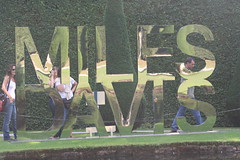
It’s fascinating how we imagine space. I loved this Miles Davis photograph when I first saw it and was convinced it must be in a sculpture park in New York despite the unmistakable English background. Of course, it was only unmistakable when later I found out that it was at Chatsworth House in Derbyshire! (The new Duke's quite trendy.) Still good, but somehow different. Now we’re set to fly out to Cluj in Romania for an IDEC leadership conference. What’s Cluj like? Well, I have some vague stereotypical images in mind. ... the official site, Cluj cyber city is here, but actually this is more informative. Apparently it has a world famous equestrian statue! Anyway, I hope to be able to blog from there, but have no idea about what connectivity is like. But I promise there will be some pictures sooner or later!

Friday, January 18, 2008

Panic?


VIP
Just when we’d started to adjust to the digital assets of a new generation of university students, concerns are being raised about the google generation. The headlines from JISC are that we should be concerned about: impatience in search and navigation [that’s me], and zero tolerance for any delay in satisfying their information need. Young people are dangerously lacking information skills, and that’s in this report. I’m not so sure that there is any evidence of a decline in criticality, but perhaps we need to adjust what we expect, what we provide and what we assess to take into account environmental changes.

Tuesday, January 15, 2008

Networked professionals


old technology
Applying the principle of social networking to professional learning could well be the shape of future CPD. Imagine being able to keep in touch with friends you’ve taught or trained with, and other like minded people, sharing ideas, resources and teaching plans. That’s the idea behind Englishspace, the place where Facebook meets the staffroom. David Hargreaves has spelt out the idea of teachers as hackers involved in ad hoc innovation networks here – Englishspace could help move this forward. Of course like any social networking site, the success of Englishspace will depend on the commitment of its users…and maybe Facebook’s a poor comparison. I say that after reading Tom Hodgkinson searing criticism of Facebook..

Saturday, January 12, 2008

Testing the breaks


Deep cut
I’m learning more about breakbeats, sometimes listening to iBreaks.co.uk, but also through talking to people. It comes out of a digitally-infused subculture, in which the source music is often downloaded and remixed with samples and softsynths. Apples are the preferred platform for doing this. Most of the stuff I’m borrowing comes from live sets, often freebie CDs given away as part of the DJ promotion. I’m not up to partying just yet, but I’m hooking in to Plump DJs, Krafty Kuts, and Def Inc. Am I getting all neurotic about my age, I hear you ask? Probably:What’s your neurosis allowing you to do that you couldn’t do otherwise? asks Richard Ford…

Thursday, January 10, 2008

Loomings


Moby
I’ve got Loomings as a title for a talk. It’s a bit wacky, but I like it! You may already know that it’s the title of Chapter 1 in Moby Dick. I like the idea of social networking looming on the horizon of the curriculum. To loom in the OED is to come into sight dimly, esp as a vague and often magnified or threatening shape. A loom can also be a vague often exaggerated first appearance of land at sea etc. And then if you’re already sailing along with this metaphor, Melville says: So there is no earthly way of finding out precisely what the whale really looks like. And the only mode in which you can derive even a tolerable idea of this living creature, is by going whaling yourself. Meanwhile UKLA and NATE are experimenting with a professional development/ teacher social networking site. It’s still under development but you can get the idea here. So, if you're an English teacher, come whaling!

Wednesday, January 09, 2008

Everyday new literacies


quotidian
Looking at university students’ work is always a bit of a mixed experience. Nonetheless, I’m always open to new ways of formulating old ideas about new literacy. This morning I read how we assume a social identity when writing for a specific purpose (eg on a social networking site). I liked this and mapped it on to the idea of performing identity through text in which the purpose of getting your message across to the intended audience is implicitly a kind of identity work. Quoting from here : sites like MySpace and YouTube represent social and semiotic domains for youngsters where their communicative competence and identity are played out and created (p.185). I also note in the Erstad article that digital literacy is core competence in the Norwegian curriculum but that: there is so far a lack of discussion about what digital literacy really is. Ah well, that just seems to be the everyday muddle around new literacies!

Monday, January 07, 2008

Everybody online


winter tree
One laptop per child began as a charity idea to empower children in developing countries by providing them with powerful tools for transformation. One Laptop is a non-profit organisation led by Nicholas Negroponte, designed to create extremely low-cost laptop computers that can be powered without electricity and run free, open-source software. Here’s more on that subject. Last week I commented on the domestic plan to give every child internet access. This piece reports on schools minister Jim Knight being in talks with Microsoft, BT, Sky, Virgin and RM to sponsor his vision, the computers for pupils initiative (you can see the launch speech, here). There have been some misleading news reports:this isn’t a laptop for every child (domestic or otherwise). In fact, and I quote, eligibility has been based on a formula to determine some of the most disadvantaged Key Stage 3 and 4 children throughout the country. The project has now been taken over by Becta and could well help to bridge the digital divide. But I guess the devil’s in the detail. Just throwing resources at a problem doesn’t make it disappear. Imagine, though, the impact on literacy if every child in every class had wireless access: that would transform our schools, and our ideas of learning and teaching in a single stroke.

Sunday, January 06, 2008

Muffin prophecy

After reading Dr Joolz on memes, I wanted to trace one of my own - one that has a history as long as the art of divination, reading tea-leaves and seeing faces in clouds. It surfaced recently in the case of the image of the Virgin Mary on toast (auctioned for $28,000 on eBay) and is also present in paranormal communication through miraculous fruit. The human pre-occupation with signs sometimes tempts us to read meaning into the strangest of places. My mother still sees the face of David Mellor in the grain of the wood in her kitchen! In the wonderful Next Muffin routine, the comedian Russ Noble riffs off this meme of mysterious signs to produce his own comic routine about random meaning-making and prophecy.

Friday, January 04, 2008

Great walls of fire!


close
Journalists and commentators seem to think that moves by China to restrict online video sharing are outrageous (that’s interesting); its probably escaped their notice that local education authorities in the UK have been doing that for some time. There's censorship and then there's surveillance. Technology is, of course, OK if it’s about monitoring pupil progress and reporting to parents. The government's aim (here) is to give parents continuous online updates on their child's lessons, performance and behaviour. Oh thanks, you hear them chorus, just what we always wanted! Anyway let’s hear it for Bebo: a recent Which? Report comparing features, ease of use and so on puts Bebo top of the social networking sites. And lastly here’s Lilia Efimova with the most sensible commentary on blogging that I’ve read in a long while. She says: Blogging is about microcontent: publishing small pieces of thought and commentary, anchored with permalinks and carried away by feeds. However, the real value is not at the post level: ecosystems between blog posts are more interesting and more important. Think of the fuzzy feeling of knowing someone from reading a weblog over time, implicit understanding of a new issue that emerges while following a conversation between bloggers or sense of belonging to a network of others, in all cases posts and links are only a tip of the iceberg. Counting and measuring those visible traces is tempting, but knowledge, reputation, relations are likely to escape rankings. So don't take this post too seriously!

Wednesday, January 02, 2008

Good luck/bad luck


new light on old logs
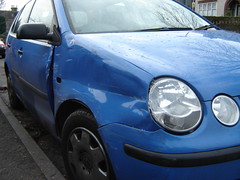
I had a head-on collision in the car this afternoon, taking a blind corner on the single-track road to Hundall. No injuries, but plenty of broken glass and twisted metal. I was travelling about 20 mph - the other guy about twice that. He mounted the steep bank at the roadside nearly turning his vehicle. I guess we were both extremely lucky to escape without a scratch and nothing but mild shock to our respective passengers. I've just been sitting here thinking was that good luck, bad luck or a bit of both?

Tuesday, January 01, 2008

A new start


country literacy
After seeing the new year in it feels like I need to re-boot my brain. Starting with some exploratory writing, I’ve come to the conclusion that teachers involved in innovative new literacies work are confronted with a set of key questions:
1. How easy is it to leave the comfort zone of conventional, classroom-based pupil-teacher relationships and experiment with new and fluid online interactions?
2. What are the implications of working in an environment in which some pupils are more experienced or confident than the teacher?
3. How can this sort of work be justified and defended in an educational environment which regularly lurches back to a pre-occupation with ‘the basics’ and traditional print literacy skills?
4. How can the level of immersion and flexible online access required be operationalised within the constraints of current resource and timetable structures?
5. What additional planning and co-ordination work is necessary to make the most of online work, to facilitate exchange between year groups and interactions between schools?
6. What real or perceived risks may be faced by engaging in virtual world gameplay (eg: child protection; parental censure)?
I’m sure you could add to this list. Have I missed anything? I’ll be working on this over the next few days, suggestions are welcome!