Wednesday, August 24, 2011

Virtual reading


Michael Heim's 'The Metaphysics of Virtual Reality' makes for a curious read in that it was published in what seems like another era - 1993! He mixes a sort of cautiousness about technology with occasional bursts of enthusiasm. For all this I liked the description of what he calls cyberspace, which seems to me more like virtuality: 'We inhabit cberspace when we feel ourselves moving through the interface into a relatively independent world with its own dimensions and rules. The more we habituate ourselves to the interface, the more we live in cyberspace.' (1993:79). But what if that interface is print text? Heim has a view on this, too. '...the magic of the story comes from our ability to cross over from the words of the narration to an inner vision of the sequence of virtual events (which occurs to us when we walk through the wall of words on the page). (1993:133). So somehow our belief, or immersion, in a represented world defines this kind of virtuality. Carroll's looking glass, C.S. Lewis's wardrobe and Philip Pullman's subtle knife all act as metaphors for this in the sense that they are gateways to an imaginal world - a sort of parallell universe of the prosumer's fantasy sketched out for us by the author/designer. In this sense all that changes with technology is our ability to mediate or represent that parallell universe.

Friday, August 12, 2011

Government may try to disrupt social media


The idea that the government or the police should have the power to disrupt social media in the event of further civil unrest seems to me to be more like the action of a totalitarian state than a liberal democracy. I'd be particularly worried that a power such as this might be evoked to control legitimate protest or even the everyday communication of innocent citizens in times of unrest. Ironically, the advice to us at the university ran like this: 'For up to date information about the situation in Sheffield please monitor the South Yorkshire Police social media channels, which are regularly updated. Follow them on Twitter @syptweet or on Facebook For national Government guidance about the situation please visit http://www.direct.gov.uk/en/Nl1/Newsroom/DG_198958'.

Wednesday, August 10, 2011

What did you get in London?


Whatever our opinion about the motivation of rioters, it needs to be acknowledged that mass unrest is a kind of spectacle and a political statement - even though it might not be a product of an articulated political doctrine. But as spectacle a riot is now densely mediated. It makes compulsive TV viewing, particularly when you are familiar with the location. Watching one sequence I was aware of watching 'from' the Sky News helicopter as 3 citizen 'journalists' photographed 1 rioter in a hand-to-hand scuffle with a policeman in Lewisham. Hidden from my view more images were probably collected from the nearby police helicopter and from behind their lines. After the event, if it is anything like the student unrest earlier this year, it will become a battle of images. But technology was to the fore in at least two other ways. Firstly, as has been widely reported, social networking sites and Blackberry Messenger (BBM) were used both to distract police attention and to co-ordinate activity and looting. Rheingold may have been ahead of his time with Smart Mobs, but this is mobile mahem writ large on the streets of London - so much so, that the police, roundly outflanked by youth are reportedly looking at (hacking?) BBM chatlogs. Secondly, the main targets appeared to be mobile phone shops and Curry's Digital. Gadgets have become objects of desire, significant cultural capital and a potent symbol for all. We do not need to speculate prematurely about whether this is a restless underclass seizing what has been denied to them, or a lawless mob stealing what can easily be sold (maybe both are true at the same time) in order to see the significance of the main retail targets.

Sunday, August 07, 2011

Wanderings


Way back when I was doing my Masters, Bill Harpin upbraided me for taking the scenic route in my studies. He wanted me to read his book on writing; I was reading Derrida. I'm not sure it made any difference, but old habits die hard. Now somehow, a week or so ago, I ended up getting Brian Massumi's 'Parables for the Virtual'. Maybe I liked the title, or perhaps it was the cover. Anyway I got 2 copies. I thoroughly enjoyed the first copy and read it cover to cover. Just as this reading was coming to an end I realised that I'd hardly understood a word of it, and so I decided to go to the second copy and it is, indeed, exactly the same. Word for word, the same. But I'm going to it as a second reader, to try to find the point at which I got lost, and maybe to watch myself getting lost all over again. This much because I like Massumi's starting point. It goes a bit like this. He critiques cultural/social theory for its inadequate account of the 'body in movement'. He says: 'Earlier phenomenological investigations into the sensing body were largely left behind because they were difficult to reconcile with the new understandings of the structuring capacities of culture and their inseparability both from the exercise of power and the glimmers of counterpower incumbent in mediate living. It was all about the subject without subjectivisim: a subject "constructed" by external mechanisms. "The Subject".' (2) That creates a sort of stalemate because for example: 'Aren't the possibilities for the entire gamut of cultural emplacements, including the subversive ones, precoded into the ideological master structure?' (3). Instead Massumi focuses on the sensing body, seeing structuration as a back-formation - 'positionality is an emergent quality of movement' (8). As you can see, I'm doing OK so far, but that's just the introduction. When will I see myself getting lost? That's the mystery. No. The real mystery though is why Amazon sent me two copies. Maybe they knew I'd struggle with the first reading, who knows. They made me read it twice.

Saturday, July 30, 2011

Baroque literacies?


The picture is supposed to evoke the idea of ponds within ponds (Leibniz) and the following are some of the ideas I'm working on, beginning with the idea that the human subject is embodied and all activity is situated (there is little choice in this, after all, at least from a phenomenological poit of view). And then, as a result there may be little gain in ‘looking up’ to more abstract theory, but a compelling richness in ‘looking down’ into the complexities and interconnections of embodiment and situated activity itself. Rather than moving in the direction of coherence and convergence this suggests a view of literacies informed by the notion of ‘baroque complexity’ (Kwa, 2002) - one that may provide a more nuanced account of how digital texts enter the communication economy of contemporary literacy practices. Drawing generously on the work of Deleuze (1993), Kwa outlines three characteristics of the baroque: 'First the historic baroque insists on a strong phenomenological realness, a 'sensuous materiality'. Second, this materiality is not confined to, or locked within a simple individual but flows out in many directions, blurring the distinction between individual and environment. And third, there is also the baroque inventiveness, the ability to produce lots of novel combinations out of a rather limited set of elements, for instance as in baroque music.’ (Kwa, 2002:26). So Kwa’s version of the baroque encourages us to ‘look down’ at the detail rather than to ‘look up’ for some broader picture (Law, 2002). In practice that may well mean seeing the ways in which the broader patterning of practices such as the global flows of information, shifting power relations and so on are inscribed or become manifest in specific situations. To be continued....

Monday, July 25, 2011

Learning to....


Gearing down for the summer offers more time for my exploration of music software. For the non-specialist, Logic Studio is a densely-wooded forest of terminology, toggles and plug-ins. You could easily get lost. It brings me face-to-face with digital learning. Step-by-step guides, help functions and tutorials are evidently a non-starter. First of all I want quick gains. You could call it impatience, but I need a certain feel for the possibilities before the questions and then the real learning start up. So my first step is to hitch up midi controllers and to begin to playfully explore what's available. And my way of doing this is to draw on repertoires I already have - just to get started, to gain interest and to experience some early success. And then I'm in! I want more, because I'm at that point that Jim Gee calls the 'pleasurably frustrating'. My curiosity kicks in: 'surely you must be able to...'; 'I wonder how...'; 'will it let me...'; 'what happens if...' And the perfect solution is the just-in-time advice that at-elbow support can give you. Ruth, whose already done a course, is great for this as she show me how to quantize, modify the velocity and fade out. But if I aspire to my own brand of contollerism (see the vid and here) I know I have a long way to go.

Thursday, July 21, 2011

Of maps and brains


Sometimes when you're on a journey you glance at the map to see exactly where you are, and at that point become suddenly aware of how far you've travelled. Sometimes, too, you can see the exact point at which a particular choice - a fork in the road, for example - took you in a particular direction and into a distinctive kind of landscape. I had the impulse to check the map at this year's UKLA conference in Chester, when I was listening to Usha Goswami. Her explanations of neuropsychology and what it tells us about early reading were lucidly presented, but they seem to be located in another territory. It is a territory in which 'the brain' is a central feature and in which stories of how the brain works and how it develops are told. Checking my metaphorical map, I find I'm accustomed to a completely different set of landmarks, in a very different country. It's a far more densely populated place - one in which meanings are negotiated and exchanged, in which stuff is used in all sorts of ways, and one in which irregular and complex shapes form and re-form as practices evolve. I can't find the fork in the path, though. But I suppose my interest in language variation, in the stories we write and tell and in the impact of the digital on these things all presuppose a sociocultural orientation. I am in different territory and I'm glad I am, but I'm also pleased to know that some people are interested in brains. The map would be inadequate without their work.

Tuesday, July 12, 2011

Kids, kit, classrooms


It looks as though we've got nearly all of our students enroled on the learning futures wiki (pilot version), so I'm now really looking forward to looking at the work of these digital leaders over next couple of weeks. In the meantime I've been sitting on a list of views that emerged during our last planning meeting. They tend to cluster - in the ways I have them on the wall - around ideas about students and ideas about schools. Students are generally percieved of as having technological expertise, whereas schools are seen as an inhibiting force. Technology and innovation are described as 'kit', and basically you're lucky if you've got it! All our views are of course far more subtle than that, but the broad contours are still there. At this point in time I'm intrigued to see if the digital leaders themselves have a different view of these issues.

Sunday, July 10, 2011

Shop fronts and shutters


The shops used to be closed a lot. Sundays completely, often Saturday after lunch, and mid-week. I think Thursday was 'early closing day' when I was young. So if you were incarcerated in an educational establishment (and most of the time I was), looking at what you could buy was time-limited. From quite an early age I compensated for this by window-shopping, pressing my nose up against the fronts of closed shops, peering in against the glare to see what you could get. I started with children's toys, but as my ambitions grew I began to focus on musical instruments and LP covers (big boys' toys), spanners and wrenches (serious boys' toys) and eventually clothes and electrical goods. I carried that on well into adult life and as a matter of fact I still enjoying looking at things I could buy, might buy, or might one day buy. It's everyday life in the consumer market-place. Sometime in the 1980s shop-owners - particularly those in urban areas - began to worry about civil disturbance, disturbed, no doubt, by images of rioters putting bricks through shop-windows and helping themselves to stuff they ought to pay for. They began to install shutters to protect their interest and city streets, at least on Sundays, became greyer places. When I first got into Flickr, partly as a homage to my days as a window-shopper, I started photographing shutters, putting them in a set. I was interested in the way that shutters were becoming a surface for art-work and graffiti. The security barrier of the shutter effectively kept most people out, but while the goods were protected another form of expression was errupting. Now many shops commission artists to decorate their shutters. So you'll see The Rude Shipyard, itself a wonderful boho artsy venue has followed the trend. Must upload to Flickr!

Tuesday, July 05, 2011

If it's not baroque....


I'm still on the romantic/baroque theme today and savouring Chunglin Kwa who makes the case for the baroque so eloquently: 'It may seem unnecessary to use an overloaded word like baroque, especially because it is not immediately apparent that there is a historical continuity with the grand style of the seventeenth century. In the case of romanticism it is much easier to argue for an uninterrupted lineage. Yet several important characteristics of the historical baroque make the term baroque attractive to use for later periods, including the present. First the historic baroque insists on a strong phenomenological realness, a 'sensuous materiality'. Second, this materiality is not confined to, or locked within a simple individual but flows out in many directions, blurring the distinction between individual and environment. And third, there is also the baroque inventiveness, the ability to produce lots of novel combinations out of a rather limited set of elements, for instance as in baroque music. Similarly, action in early baroque theater is not based on the logical development of a plot but rather on a sequence of monologues, debates, and allegories.' (Chunglin Kwa, 2002:26). And it satisfies the inner-geek to copy this out of my Evernote notebook entitled 'Folds'!

Sunday, July 03, 2011

The modern disease?


In 'The Wild Places' Robert Macfarlane dichotomises the human social world and the natural world, and I think that's the weakness, or at least the romanticism, of his project. At best, in his writing, he captures the baroque in ways that equal Deleuze, and details the specific in a style reminiscent of Bachelard. But I think that the thesis that man is alienated from the natural world in a sort of latter day fall is a romantic fallacy. So the author slips all too easily from observations of our current condition into a sort of moral panic as the following extract illustrates: 'In so many ways, there has been a prising away of life from place, an abstraction of experience into different forms of touchlessness. We experience, as no historical period has before, disembodiment and dematerialisation. The almost infinite connectivity of the technological world, for all the benefits it has brought, has exacted a toll in the coin of contact. We have in many ways forgotten what the world feels like. And so new maladies of the soul have emerged, unhappinesses which are complicated products of the distance we have set between ourselves and the world. We have come increasingly to forget that our minds are shaped by the bodily experience of being in the world - its spaces, textures, sounds smells and habits - as well as by genetic traits we inherit and ideologies we absorb. A constant and formidably defining exchange occurs between the physical forms of the world around us, and the cast of our innere world of imagination. The feel of hot dry wind on the face, the smell of distant rain carried as a scent stream in the air, the touch of a bird's sharp foot on one's outstretched palm: such encounters shape our being and our imaginations in ways which are beyond analysis, but also beyond doubt.' (Macfarlane, 2007:203). Bring back Rousseau! It's an argument that's not exactly wrong, but incomplete. But in the end, you have to admire Macfarlane's rugged frontier spirit - when things get really wild his unstoppbale reponse is to strip off and go for an icy-cold swim - naked probably, although that's the kind of detail we're spared!

Saturday, July 02, 2011

Texting change in language


Anthea Rowan had a good piece in yesterday's Telegraph. As to be expected it drew the usual range of comments. The full text from which she quotes (which I wrote for UKLA) runs like this: Language and literacy change over time. Social, economic and technological conditions influence these changes in significant ways. The development of mass media and, more recently, digital communication has accelerated the spread of language change and innovation. We now routinely communicate in different ways - such as emailing, instant-messaging, and making Skype calls. We use different technologies - laptop keyboards, mobile phones and webcams - to do this. These different channels of communication have led to the emergence of new communicative styles including text abbreviations, acronyms on bulletin boards, and microblogging conventions such as the use of @ and # in Tittwer. Writing, often a relatively stable or conservative mode of language, is currently enjoying a moment of creativity. This is a rich area for the study of literacy and one that has an unavoidable impact on children and young people. In fact young people are very often at the forefront of these innovations. It is too simple to suggest that 'new ways' are replacing 'old ways' or to suggest that the 'new litearcies' are somehow better than traditional practices. They co-exist and are likely to do so, at least for the foreseeable future. Most new literacy practices depend on the familiar -being able to read a familiar image and to encode and decode alphabetic writing. In fact they extend the possibilities for meaning-making and interconnection. Literacy is a much larger topic than it was twenty years ago, in an era when digital communication was still in its infancy. To fully participate in contemporary society, children, young people and adults alike need literacy more than ever before. They need to be able to write letters and send emails; they need to be able to fill in forms online and leave notes for friends and family members. There is no evidence that literacy is in decline. In fact there has been a massive increase in vernacular writing with the advent of the internet. At the same time, though, the ways in which we write and the ways in which we read are changing. In our capacity as an association for the promotion of literacy and with our interest in education, we are committed to supporting the reading and writing for all - reading and writing in whatever form is advantageous.

Thursday, June 23, 2011

Research pedagogy


Provoked by some discussions on the return journey from Belgium, I've been reflecting on the hidden pedagogy of research. In disciplines like education that are driven by professional activity, the application or impact of research is often a topic of conversation. But at the same time a lot of research (mine included) addresses itself to the ongoing construction of knowledge and theory, and pays less attention to direct application. In fact, in the research community, something as simple as an effective solution to an everyday problem can seem to be too trivial. Nonetheless it seems that even the more abstract or theoretically-orientated research has a hidden pedagogy in that it privileges particular ways of finding out, particular ways of seeing social actors and social institutions and in doing so holds up particular actions or activity as worthy of interest. This suggests that it may be fruitful to look for the implicit assumptions about what is worthwhile in the design of applied research.

Thursday, June 16, 2011

Participation

Wordle: participation

OK, well here I was just trying to uncover my own preoccupations by feeding one of my own academic papers into the Wordle machine - it's something I've criticized students for doing, but it was helpful for me, particularly in noticing how frequently I've been using the participation word. Working with a colleague on the theme of participation has made me realise how I need to spend more time unpacking this concept. What does it mean when we talk about 'participating in civic life'? What do we mean by 'learning through particpation'? Anne Edwards (2005) warns us that the meaning of the concept of participation may becaome opaque through over-use. Now there's a thought.

Tuesday, June 14, 2011

Reading campaigns


On the surface of things it would seem like a very good idea to mobilise public support and interest in helping young children's literacy development, and in fact the Volunteer Reading Help scheme has a good track record in doing just that. But somehow the Evening Standard's campaign GetLondonReading pushes all the wrong buttons. Politically it plays on the Big Society agenda and regularly features donators who are models, celebrities or former politicians - in other words public or media figures who want to do something worthy. But celebrity support is no substitute for public education and the high expectations placed on the volunteers themselves may not be the best way forward. You might predict that if the campaign makes a massive impact, there will be political capital to be made. If it doesn't it will sink from view. No surprises there, because that's just the same story that we associate with governmental interference in matters of curriculum. What worries me more is when the transport networks of London are flooded with travellers waving the banner headlines 'One in five parents cannot read aloud'. Although that's based on evidence produced by the National Literacy Trust (another reputable body) it's a scare story. Firstly, literacy is more than reading and certainly can't be reduced to 'reading aloud', but secondly, and more importantly it neatly ducks some key characteristics of the fluid multilingual demographic of our cosmopolitan capital. On the 9th June Free Standard the grinning picture of blonde (?) white model Laura Bailey - who donated £1000 - appears to be the solution to a hyped-up problem. And in the text, reading is clearly connected with empowerment, which is ironic when the most evident power lies elsewhere.

Monday, June 13, 2011

The future of the past


In our discussions on Monday for the It's the learning future project some of our teachers talked about children living in the technological present and then stepping into the past when they come to school. According to this view school becomes a sort of working museum in which children are in role as learners of the past - enacting how we used to live. At the same time we can only imagine the future on the basis of the present, or at least in our experience of recency (which is in effect the past). Although it may sound like word-play there is a very real sense in which these timescales reveal complexity and seem, in fact, to overlap. I thank Chris Thomson, someone who is also trying to imagine the future with pupos[ed], for introducing me to the design concept of the Skeuomorph which is another example of how the past is useful. So, not all history is bunk!

Friday, June 10, 2011

Mapping the mind


I'm in Belgium at the moment, but I'm reading Robert MacFarlane's evocative and excellently written book 'The Wild Places' which is a first-rate exploration of wild-ness and one which is tied to the British landscape. In a section on mapping, he tells us that over a million road atlases are sold in England and Ireland each year and that there are thought to be about 20 million in circulation at any one time. That's a lot of geographical literacy that's going on - and that's before you start thinking about AA maps, Google maps and various sat nav systems. Wow! But, as he observes, "The fells, the caves, the tors, the woods, the moors, the river valleys and the marshes have all but disappeared. If they are shown at all, it is as background shading or generic symbols. More usually, they have faded out altogether like old ink, become the suppressed memories of a more ancient archipelago....The priorities of the modern road atlas are clear. Drawn by computers from satellite photos, it is a map that speaks of transit and displacement. It encourages us to imagine the land itself as a context for motorised travel." In other words (my words) maps help to produce a kind of social identity - a mobile identity - in which we are constantly on the move between urban spaces, and the rest is something that is blank or something we go through.

Thursday, June 02, 2011

Post-modern literacies


I'm reading a pre-publication version of Colin and Michele's New Literacies (3E) at the moment. The opening sections provide a really useful map to 'where we are' and 'how we got there' in literacy studies. They've just about got it right with a definition of literacies as 'socially recognized ways in which people generate, communicate and negotiate meanings, as members of Discourses through the medium of encoded texts'. I know it doesn't exactly trip off the tongue and I suppose that nearly every phrase needs translating (which is, as you'd expect, what haoppens in the book). I still have a problem with the social spread of new literacies and wonder to what extent the exciting practices which appear to be the popular everyday practices of children and young people are actually niche interests. On a more abstract level I enjoyed reading about Andreas Reckwitz's work on practice theories and made a note to follow this up. The football analogy reminded me of Bourdieu which sent me scurrying back to The Logic of Practice. Bourdieu, at least in the translations that I read, can be hard going, but one of his clearest pieces (Chapter 4 ibid) actually uses the football metaphor to good effect. But here he is on 'practice', the principle of which is found 'in the relationship between external constraints which leave a very variable margin for choice, and dispositions which are the product of economic and social processes that are more or less completely reducible to these constraints, as defined at a particular moment.' (p.50). That makes me think twice about agency in cultural (re)production and is something to pit against remix and participatory culture.

Saturday, May 28, 2011

Radio silence


I've had one of those times when life takes over, and blogging falls by the wayside, spending most of my time looking after baby Dylan (in the picture) and my daughter, Hannah. It's interesting watching the play/work of a 9-month old and the ways in which new media is woven into the environment. Firm favourites are the V-tech products (particularly the dance tower), but Skype calls on the laptop, grasping for the mobile phone and nursery rhymes on the i-touch are all part and parcel of daily life. At the moment my attempts at keeping a record have been squeezed - maybe I need a firmer plan. Whilst immersed in all this life goes on with several projects under way and an opportunity to re-engage with the Barnsborough virtual world. More on that later on.

Friday, May 13, 2011

Are we still nodes?


The network metaphor is everywhere. Yesterday I travelled down to Oxford on the rail network; most of the time I could use my mobile (I'm on the Orange network). In the book I was reading Gilbert told me that in my brain 'millions upon millions of new connections are formed....in increasingly complex networks.' It seems that networks are both inside and outside me. That's a distinctively 20th century metaphor suggesting as it does desktop computers tethered together and interconnected. So a network is a connection between points or places, a channel of communication. But what happens when the metaphor is applied to the social? Actors are reduced to points - not even points of view, but nodes connected to other nodes. In the fluidity of everyday life we make and break ties, the signal breaks up, the network goes down - do we cease to exist? When we flicker in and out of communication, when we become more mobile are we still nodes? And how does the network metaphor consitute us as human subjects? Perhaps there's a better way of imagining communication and connectivity...


Wednesday, May 11, 2011

Guitar hero?


Well, maybe not. But this is me in full swing with my new midi controller. What you can't see is the way I'm hooked into Garageband, playing digital instruments and samples (my favourite percussion is taken from an audio-file of the porridge-spoon rocking in the bowl!). To the extent that I'm researching my own learning I'm finding that my own, rather limited, skill with the old technology of strings and frets has an interesting iterative relationship with my midi play. Because the midi has different affordances, I can do a whole range of new things - and I'm still discovering them. I also have to learn new skills of preparation (eg: clipping samples, importing them, stitching together a rhythm track) as well as new skills of performance. Yet at the same time all this brings a new understanding of what I can and can't do in a more traditional environment. It's almost as if the learning and reflection happens because of this back and forth movement. This all gets framed up in my favourite arena, which is live improvisation with my partner-in-crime!

Friday, May 06, 2011

Misspent youth


Collecting the football cards that came with Anglo Bubblegum stood me in good stead later in life. Redolent of that sugary fruity flavouring (a sort of guilty pleasure) each packet contained a card with basic details about a player, his club, his position and so on. I could never work out whether I prefered the information or the gum. They took it in turns. Maybe it was a rather dry strip of gum that ran out in less than a minute; maybe it was Danny Blanchflower or Jimmy Greaves; maybe it was just the taste you needed. But all that Anglo Bubblegum pedagogy served me well when the sixties came blowing in to the Midlands where I grew up. Not only did I bask in the popular music that seemed so new and fresh, I scoured the album covers for information. Who wrote those songs? Who recorded them? Who played bass and who did the cover art? I geeked out on all the information, always keen to identify the key players and to trace the influences that had helped shape what I liked. Nothing much has changed. What might seem like a misspent youth was actually a substantial investment. A shift in the field to the world of theory and research is actually quite a small shift. I'm still listening out for 'new tunes' and trying to understand how they came about (who they were listening to when they wrote them and all that). Surely that's the starting point of a good literature review - creating your own map of the territory. And to think it all began with bubblegum!

Saturday, April 30, 2011

Advantageous practice


In an article co-written with my colleague Cathy Burnett we've been problematising the notion of critical literacy - particularly in the context of social media. We've drawn on Greenhow and Robelia's notion of 'advantageous practice' which raises all sorts of interesting issues. One thing we're keen to avoid is the idea of teachers telling students what they think is best - a pitfall, as we see it, of some critical approaches. They end up by being uncritical to the extent that they try to force particular ways of reading texts, and particular ways of seeing the world. So advantageous practice is perhaps best seen as a dialectical process, based in an enquiry into how one is positioned in and positioned by social context, with a view to seeking ways in which these positions can be influenced in a positive and worthwhile way - one that is likely to benefit the communities and social networks of affiliation. Advantageous practices are then likely to be situated and often localised in character, although they may well relate to larger national and transnational concerns.

Friday, April 29, 2011

Books smell


I borrowed this wonderful advert for 'The Smell of Books' from Angela Thomas as an illustration for my keynote at the recent BAAL seminar on language and disadvantage. My point was to illustrate important changes in the communication economy (ie: the rise of self-sponsored writing; of new conventions, new relationships and ideas of appropriacy as well as the usual suspects: multimodal, multilingual and multiscriptual texts) that prompt us to reconceptualize disadvantage and to recontextualize public discourse about 'bad language', and to point out how all this takes place against a backcloth of persistant nostalgia for the book and other fixed forms of print literacy. For me it was a return to some key debates in sociolinguistics and with a title like 'The Trashmaster: popular culture, bad language and writing online', a return to form in grabbing attention. The nub of the question settles on old language prejudices - those that so readily associate with class, although as the seminar discussion uncovered, class is far more fragmented than it was when these debates last headlined in the late 1960s. Same same; different different.

Wednesday, April 27, 2011

Nostalgia for the future


Most visions of the future just flesh out the present - or even re-imagine the past. John Banville describes this effect extremely well when his narrator explores the 'outmoded atmosphere that pervaded ...[his]...dream of what was to come.' So here goes: ' So what I foresaw for the future was in fact, if fact comes into it, a picture of what could only be an imagined past. I was, one might say, not much anticipating the future as nostalgic for it, since what in my imaginings was to come was in reality already gone.' (The Sea: 71)

Monday, April 18, 2011

Looking back

window by on-the-run window, a photo by on-the-run on Flickr.

September 1994 should be regarded as a landmark in the recent history of literacy studies. Or maybe it should be spring 1996. Either will do, because the autumn of 1994 was when the New London Group first met, and 1996 the date when their jointly authored paper ‘A Pedagogy of Multiliteracies’ was first published in the Harvard Education Review. To explain: New London is the name of the place in the US where the group met, where Courtney Cazden, Bill Cope, Norman Fairclough, Jim Gee and Mary Kalantzis, joined forces with Gunther Kress, Allan Luke, Carmen Luke, Sarah Michaels, Martin Nakata and Joseph Lo Bianco to discuss how literacy pedagogy might adapt to suit the changing context of the late twentieth century. Despite the impressive range of expertise it was an ambitious undertaking, but one that was nothing if not generative and, with the benefit of hindsight, highly influential. By the time the book Multiliteracies was published, the project had gathered momentum, had attracted new voices and was beginning to influence debate amongst literacy educators in much of the English-speaking world, and elsewhere too. At this year's AERA conference the group re-formed -well not all of them - but it was an impressive line-up. There was a fair dose of nostalgia, some great photos of New London in which they all (surprise, surprise) looked much younger and plenty of evidence that they all have more to contribute. Maybe the multiliteracies banner is a little jaded, but it's influence is still felt.

Sunday, April 17, 2011

Migrations

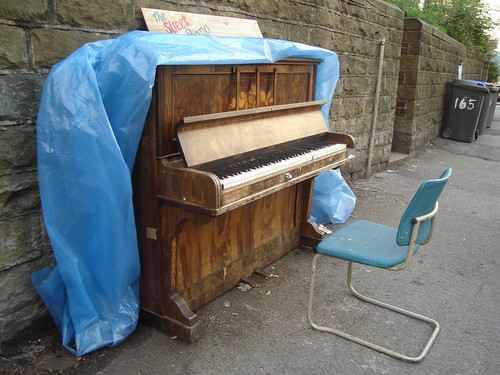
Street Piano 2 by on-the-run
Street Piano 2, a photo by on-the-run on Flickr.
Constance Steinkuehler talks about her work as migratory ethnography, and this description conjures two possible descriptions of research in digital worlds. One is practice- (or text-) focused and would turn the lens on how particular literacies and textual formations migrate across sites and between communities, whereas a second interpretation would look at how people migrate across sites over a period of time. They both have some relevance to what I've been thinking about Flickr lately - sparked by the fact that my subscription is up for renewal. Basically I started thinking about whether my subscription is justified by my usage and my level of participation in the Flickr community. Funnily enough just after my renewal reminder when I was wondering whether Flickr had had its day, I got Flickr mail from someone who was interested in the Street Piano photographs - wanted to initiate something similar at an arts festival and was asking for permission to use my pictures. This fascinated me - I'd already written about how the Street Piano became a 'slippery narrative' weaving its way between the real and the digital - and here it was again entering a new phase of migration! And this just at the point when I was considering leaving Flickr. I've now reconsidered; but it does make me think how Web 2.0 does produce rather transitory audiences/producers. Bloggers come and go, I deserted Last.FM in favour of Blip.FM and I find I've lost interest in Twitter. It would be interesting to trace people's migrations, to understand why they move and which practices they take with them into new environments. At least people continue to tickle the ivories!

Friday, April 15, 2011

Identity blues


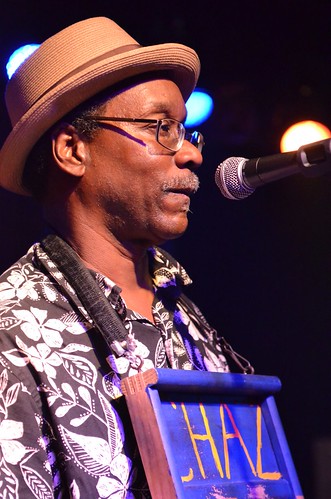
Dorothy Holland and William Lachicotte have a great chapter in the 2007 Cambridge Companion to Vygotsky. They identify two tracks in identity theory, one is organised around the idea of a coherent sense of self and can be traced back to Erikson - with obvious connections to notions of psychological well-being. The other runs back to Mead, the formations that take place through social interaction and symbolic communication and suggests the possibility of plural identities. This allows the crafting of identities that may be a sort of bricolage of different social roles, a more creative way of inhabiting the various postions and roles afforded us by society. I don't know how far that confers us with agency, but it makes me quite happy to be a 50-something academic who attends conferences and loves live music. The video of Little Freddie King was taken at the French Quarter Festival in New Orleans on my Blackberry as I went (?) from one meeting to the next.

Tuesday, April 12, 2011

New Orleans!


I haven't been posting for a few days - that is since I became a temporary resident at the Sheraton Hotel in New Orleans, the location for this year's AERA conference. It's been a great event, with some very good keynotes and papers. I really enjoyed being discussant at Sarah's symposium on digital literacies in higher education, and the event I shared with Rebecca Black, Julia Gillen and Jackie Marsh went really well. Constance Steinkhueller was an excellent discussant. I've met lots of good people - too many to list - and enjoyed everything I attended. This morning I was wowed by the digital dome and the possibilities it presents (here's one). Jeffrey Jacobson's paper was thought-provoking and I found myself much in agreement with his comments about 'augmented' and virtual reality. The conference reality was helpfully augmented by the French Quarter Festival which was a musical extravaganza, with excellent Zydeco music (Donna Angello for one) and the full-on exuberance that seems to be the soul of New Orleans. Would you believe it, but I forgot to pack my camera!

Saturday, April 02, 2011

Crowdsourced music


Imogen Heap's latest composition has a creative take on music in the digital age. Making extensive use of social media she has encouraged audience involvement in her latest work 'Lifeline' by incorporating the sounds and words sent to her. Now you could be picky and say that this is just a sophisticated marketing ploy, an easy way of gathering material and highly dependent on free contribution rather than open participation - but that would be unfair. The whole process springs from a different way of looking at the world, and one that reminds me of Colin and Michele's idea of mindset 2.0. In essence there's a distinctively new relationship between producer and consumer here, and a radically different take on where ideas come from and who owns them. Crowdsourcing is an interesting way of describing this because it leads us to ask for more precision in determining who the crowd is in the first place. The crowd here isn't 'the public' but it is 'a public'. It's not everyone, but it could be anyone. Similarly the crowd is not the audience but it may be part of the audience. No, the crowd is composed of a fluid coming and going of people who are part of a transient and distributed network - inhabitants of what Gee calls an 'affinity space'. There are clearly some resonances with other emerging social and political groupings, but I suppose the distinctiveness is around leadership and authorship (or ownership). Heap's achievement is, after all, still hers albeit with a little help from her friends, but it's framed by new ways of thinking about things, new practices and shifting networks of connection. Sell our sounds back to us, Imogen, or set them free: that's the question.

Friday, April 01, 2011

Getting mobile


In his careful exploration of the role of the mobile phone in contemporary life, Gergen (2003) uses the metaphor of the ‘floating world’. Historically-speaking the floating world refers to the urban lifestyle associated with the Japanese Edo period – an unregulated social world devoted to everyday pleasures and pastimes. The similarities between this informal social world and the floating world of mobile phone users is carefully sketched out, but the contrast lies in the conceptions of space and place that are involved. Geography is clearly less significant for networked communities and as Gergen poetically suggests these communities are ‘elevated from the physical terrain’ and each mobile ‘is a sign of a significant nucleus, stretching in all directions, amorphous and protean.’ It’s a vivid image of a pealing apart of place and space, and it also suggests that those who really count aren’t there. They are the ones that you left behind, because in the final analysis a mobile device presumes a mobile user. And in this way we are positioned as people on the move dependent on our phones for navigation, for orientation and most of all for connection. That seems strange when only ten years ago we thought that technology would allow us to travel anywhere without even leaving our terminal.

Thursday, March 31, 2011

Augmented reality


The way Layar can deliver additional location-based information is a real bonus if you're in the right place with the right kind of phone, but all the same some of the more extravagant claims made about augmented reality warrant careful examination. Surely an augmentation would involve a heightened sense of reality whereas most AR apps are just clever annotations. In a way reality is diminished if you stare at it through the window of your phone. That's not to claim its of no use; it's just a matter of definition. Of a different order, of course, is the headset or the reality goggles. The BMW video shows AR goggles in operation. Surely, the ultimate toy for boys! I watched this with interest knowing full well that if I was working on an engine bolts would fly off, tools would malfunction, things would go wrong that no amount of augmentation could fix.

Saturday, March 26, 2011

First Skype call


In affluent and highly-digitized societies childhood is infused with technology. Digital technology has to be factored in from the prenatal stage when the first images of a baby are scans on screens, circulated by mobile phone and posted on social networking sites. And for the newborn, not only are the toys digital but the everyday practices that they participate in with adults are similarly mediated. I'm slowly building up an archive of images - here's Dylan at six months doing his first international Skype call. And that's just the beginning!

Friday, March 25, 2011

The hammer and the keyboard


In the everyday use of tools, their operation becomes routine and normalized. Interfaces work in the same way. When we switch devices there is often a certain amount of disruption and we are thrown back on the stubborn materiality of our instruments of control, those tools that we normally experience as being straightforward - become almost invisible. 'Heidegger's hammer' is a way of explaining how the tool recedes from view in daily use. Its visibility is heightened when 'the tool turns out to be damaged or the material unsuitable.' (1962:102). That was my experience operating the above keyboard. Nothing went well. I had to look a bit closer to see that the familiar looking object was subtley different. The letter arrangement is not the usual QWERTY layout, but the Belgian equivalent. It disrupted my operations, I became hesitant and dependent on an expert to guide me.

Friday, March 18, 2011

Yardie shoes


For me Clarke's shoes are forever associated with the sensible and conventional footwear of the late '50s. Now they are the shoe of choice for the discerning Yardie - at least if we believe the video. There is that strange loop in which naff things suddenly become cool and cool things become naff. The same happened to Burberry (which I believe is back where it started) and high-waist wide-leg trousers which are making a come back. Who knows, maybe Vybz Kartel have got it wrong about the shoes - maybe Yardies prefer sandals - or maybe it's subtle viral advertising. But if I'm sitting on the Tube and catch sight of some Clarkes, I think I'll play safe and avoid eye contact. You never know.

Wednesday, March 16, 2011

Whose generation?


Young children lit up yesterday's dissemination conference of the 'Children's playground games and songs in the new media age' project at the British Library. The documentary film Ip-dipi-dation: My Generation was a triumph. I hope it gets a more public airing or at least gets posted somewhere where more people can get access to it and talk about it. Adult intervention has been minimised, the kids just talk and show what they do, and that's what makes it so powerful. Having said that it is, of course an adult view, with the images carefully framed, edited, and sequenced. We hardly notice the meta-text which is about adults talking to adults about children. And I was left with that overall feeling about this area which is such a tricky one to study. The project team have been meticulous in avoiding over-interpretation and unnecessary theorising, but as adults we certainly have a thirst for that. The British Library now have an impressive digitised archive which you can see here and the researchers have plenty to write and talk about. Part of that, I suspect, will be about the methodological problem of making sense of children's worlds in the first place. I was struck by how much we want to make some of this ephemeral stuff meaningful. For the children themselves, particularly the younger ones, I suspect that meaning is always in process. They do it because they do it, without being clear about why, and so the meanings are both opaque and fluid, and always multiple.

Sunday, March 13, 2011

Robots can dance


Will robots ever become part of everyday life in the way that computers have? Well, I suppose it depends on what counts as a robot. I'm looking for something robotic for our futures event in July and came across these little ISO-bots. They don't look great, but they can be controlled with a nunchuc which is pretty impressive. If your associations with basic robotics are anything like mine then they're about turtles and roamers and they become a sort of conceptual exercise in programming. Skip the alpha-numeric stuff and go straight to movement sensors and gestures and you have a whole new kind of robotic control; something akin to an out-of body experience! I looked for a good clip and found the one above. I'm not sure how these ISO-bots are controlled (I think its the standard controller), but the choreography is interesting. The guys' reactions are at least as good as the dancing robots! If you want more go here.

Friday, March 11, 2011

Obsessing about fonts


Studies of the textual landscape seem to be grabbing our attention at the moment, and some of the work seems to reach a bit further than the original geo-semiotic work. But today I was made aware of the strength of popular feeling about the presentational features of alphabetic representation in the environment. Before the advent of word-processing, choice of font (and the very word itself) was the preserve of the publishing industry. Now it's everyone's business. Name your font, search for it in YouTube and you'll quickly see the level of interest and the strength of feeling about different fonts. I enjoyed this particular offering, which happened to lead me to bancomicsans.com. But what lies behind all this isn't just a simple question of design, it is also very much about socially agreed matters of taste. And the videos themselves are part of the process, producing and performing our ideas about what writing looks like.

Saturday, March 05, 2011

What colour is the future?


The way in which colour associates with ideas and rituals is certainly a cultural construction. Note the way in which people in different societies use different colours at weddings and funerals. The same goes for an idea like the future. For a long time I was so impressed by the advertising campaign that I thought that the future was Orange. But recently I've succumbed to the idea that the future is in fact blue. Cars are employing blue technology (which is apparently green) and all sorts of new gadgets are blue-chipped or have bluetooth fitted, and videos, of course now have blu-ray equivalents. But the future is a moving target and my future colour scheme underwent yet another change on Friday. I was, in fact, reminded of Proust and I quote from the last book of his monumental work: 'As in a snowy landscape,the degree of whiteness attained by a person's hair seemed in general to be an indication of the depth of time through which he or she had lived, just as in a range of mountains the higher peaks, even though they appear to the eye to be on the same level as the rest, nevertheless reveal their great altitude by the intensity of their snowy whiteness.' I was at yet another retirement do; and that's where I formed the distinct impression that the future is now white. In fact, at least for me, white is the new black.

Thursday, March 03, 2011

Images


I love Michael Constanza’s video of Hope Sandoval on this YouTube clip. The dreamy quality goes so well with the track. It’s interesting how readily music and image combine in new media. I'd love to write a bit more about music; I had so much fun doing that chapter in the Web 2.0 book. And image has been very much on my mind of late. So for my latest project I’m looking for a reliable way of streaming live video. I’ve been experimenting with U-Stream which does the job quite well. I also learnt today about Screencast-o-matic which seems to do everything I used to do with Jing, but not what I want to do on the project, but I’m looking into that one, too.

Thursday, February 24, 2011

Firewall frustration


Talking with one of the teachers we hope to involve in the learning futures project, the old topic of firewalls came up. She described the imposition of a blanket firewall as an action worthy of a police state. Even quite reputable educational sites are blocked, along with YouTube etc. Googling, as you do, I wondered who else had recently been writing about school firewalls, but what appeared in my rather crude initial search was pages and pages of firewall hacks and dodges such as this one. In other words there seems to be more interest in subverting systems than challenging those who operate them! I suppose in the long run widespread adoption of such practices would undermine the justification for having firewalls in the first place. Perhaps this is an instance of a new digital politics in which sneaking round firewalls, dodging copyright restrictions, freeing-up information and networked action are coming to the fore.

Sunday, February 20, 2011

Coming soon!


I always think a good breakfast sets me up for a day of writing, and having just signed a couple of contracts I'll be needing all the help I can get. Last year's ESRC seminar series is coming to fruition with an edited book for Routledge called 'Virtual Literacies' and I'm involved in a couple of joint ventures producing handbook chapters one on digital texts in the classroom and the other on early digital literacy. Apart from that we have some exciting collaborations between the two Sheffield universities which may well result in some publication. Some colleagues have also been successful in setting up a BAAL seminar series on language and deficit; I'll be doing a keynote at that with the snazzy title 'The Trashmaster: Popular Culture, Bad Language and Writing Online.' So although the policy context is looking rather grim there seems to be plenty to be getting on with. I'll need a good breakfast, but maybe I'll skip the Krave.

Tuesday, February 15, 2011

Bolton boys blog


Well, good: blogging is catching on! But I was left rather bemused by this article that showed how introducing children to blogging had revolutionised writing practices in Bolton (taught them to write properly). In the current climate of increasingly myopic curricular vision when something like this becomes national news you just have to celebrate it. Maybe my eyes have been dimmed by too many digital innovations, but the whole idea that blogging solves the so-called gender and writing conundrum is a bit underwhelming. Oh I'm glad enough they're blogging (by the way, is that a 21st century skill?) but 5,000 word stories for their blogs? I ask you! I'm still working on that one myself. Scores are going up too. That must be good? Call me a cynic, you can do that, but I was genuinely pleased to read that 'they exchange blogs with places as far apart as Canada and Australia'. Yes they're really far apart, that's global. I know there are other countries, too, but it's good to hear that Bolton is connected. So that's little me in the picture above on the left, before I got glasses. OK so I might be squinting but at least I was legally blonde. And now I'm resolved to improve my writing with more blogging; I'll have to work hard!

Sunday, January 30, 2011

Stories from things


I've just finished reading de Waal's book (see interests) and I must admit that I'm still unconvinced that it deserves so much critical acclaim. But, the quote on the dustjacket does capture its originality: 'You take an object from your pocket and put it down in front of you and you start. You begin to tell a story.' And that's a theme that certainly resonates with me - the ways in which objects shape the stories we tell. Anyone familiar with the poetry of Seamus Heaney will know how so often it's the object that's the way in; but narrative research often uses objects in a similar way. The shoebox fad is one example, but I'm also thinking of the way in which Margaret Mackey's excellent auto-bibliography does a similar thing. Putting the object in a particular place, or a series of places as de Waal does, starts to unlock the stories. In a way our memories exist in the present, and with objects we can make the link between present sensibilities and past events, thereby opening a space for reflexivity.